Perimenopause Mood Swings: What to Notice and When to Get Support
Mood changes can show up during perimenopause, but their timing alone can’t prove hormones are the cause.
Perimenopause can coincide with low mood, irritability, or mood changes, and disturbed sleep may be part of the picture. But a hormonal transition doesn’t explain every person’s symptoms. Notice when mood shifts happen alongside menstrual changes, sleep problems, hot flashes, stress, or changes in daily life. If symptoms persist, disrupt your life, or include thoughts of suicide, seek care rather than dismissing them as “just hormones.” 1 2 3

Mood changes can have more than one explanation
Irritability, feeling low, or more noticeable mood changes can occur during the menopausal transition. That makes perimenopause relevant to discuss, but it doesn’t establish that changing estradiol is the cause of a particular person’s symptoms. Menopause guidance recognizes mood disturbance and disturbed sleep among symptoms associated with the transition, while also noting that perimenopause-specific recommendations remain limited. 3
Sleep is worth considering alongside mood. In a small randomized trial of women with both perimenopausal depression and insomnia, the researchers described the conditions as commonly occurring together and as having a two-way relationship. That doesn’t show that poor sleep causes every mood change, or that the same pattern applies to everyone. It does support treating sleep as part of the picture, not a side note. 2
Stressful events, past mental health difficulties, some medicines, and medical conditions can also matter. Depression can affect everyday activities, and medical conditions such as thyroid disorders or medicines can produce symptoms that resemble it. A mood change during perimenopause deserves attention without assuming a single cause. 1
Look for a pattern, not a perfect explanation
If you’re trying to make sense of what’s changing, jot down a few details in a calendar or notes app when symptoms occur:
- What the mood change feels like, such as irritability, sadness, or losing interest.
- Whether it seems to cluster around menstrual changes, hot flashes, or disrupted sleep.
- What was happening in your life around that time, including major stressors.
- Whether it is affecting work, relationships, sleep, or everyday tasks.
- Any past depression or anxiety, relevant health conditions, or recent medication changes.
This isn’t a diagnostic test, and you don’t need a complete record before asking for help. It’s a way to give a clinician a clearer picture than “I’ve been moody.” The trial that studied perimenopausal depression and insomnia assessed sleep, mood, life events, coping, and menopause symptoms together, reflecting how these factors can be considered in context. 2
When it may be more than a passing mood shift
Depression is more than feeling sad or irritable for a few days. MedlinePlus describes major depression symptoms as affecting daily activities and lasting at least two weeks; symptoms may include low mood or loss of interest. A clinician can ask about your symptoms and history and may consider whether a medicine or medical condition could be contributing. 1
You don’t have to wait two weeks if the changes are already seriously affecting your life or you’re worried. And thoughts of death or suicide call for immediate help, not a wait-and-see approach. 1
Bring the whole picture into the care conversation
A useful starting point could be: “My mood has changed, and I’m also noticing changes in my sleep and menopause symptoms. Could we look at what might be contributing?” You can add what you’ve observed about timing, daily impact, past mental health, stress, health conditions, and medicines.
Guidelines don’t treat all mood symptoms as interchangeable. A review of menopause guidance found that some higher-quality guidelines included menopause-associated mood disturbance among possible reasons to consider menopausal hormone therapy, but clinical depression was not a treatment indication. That distinction matters: a discussion about menopause symptoms shouldn’t replace assessment and care for depression. The review also found that perimenopause-specific recommendations were limited, so treatment decisions need to fit the symptoms and situation being discussed. 3
A clinician can help sort out whether the main concern is a menopause-associated symptom, depression, sleep difficulty, another health issue, or a combination. You can raise that question before you know which explanation fits.
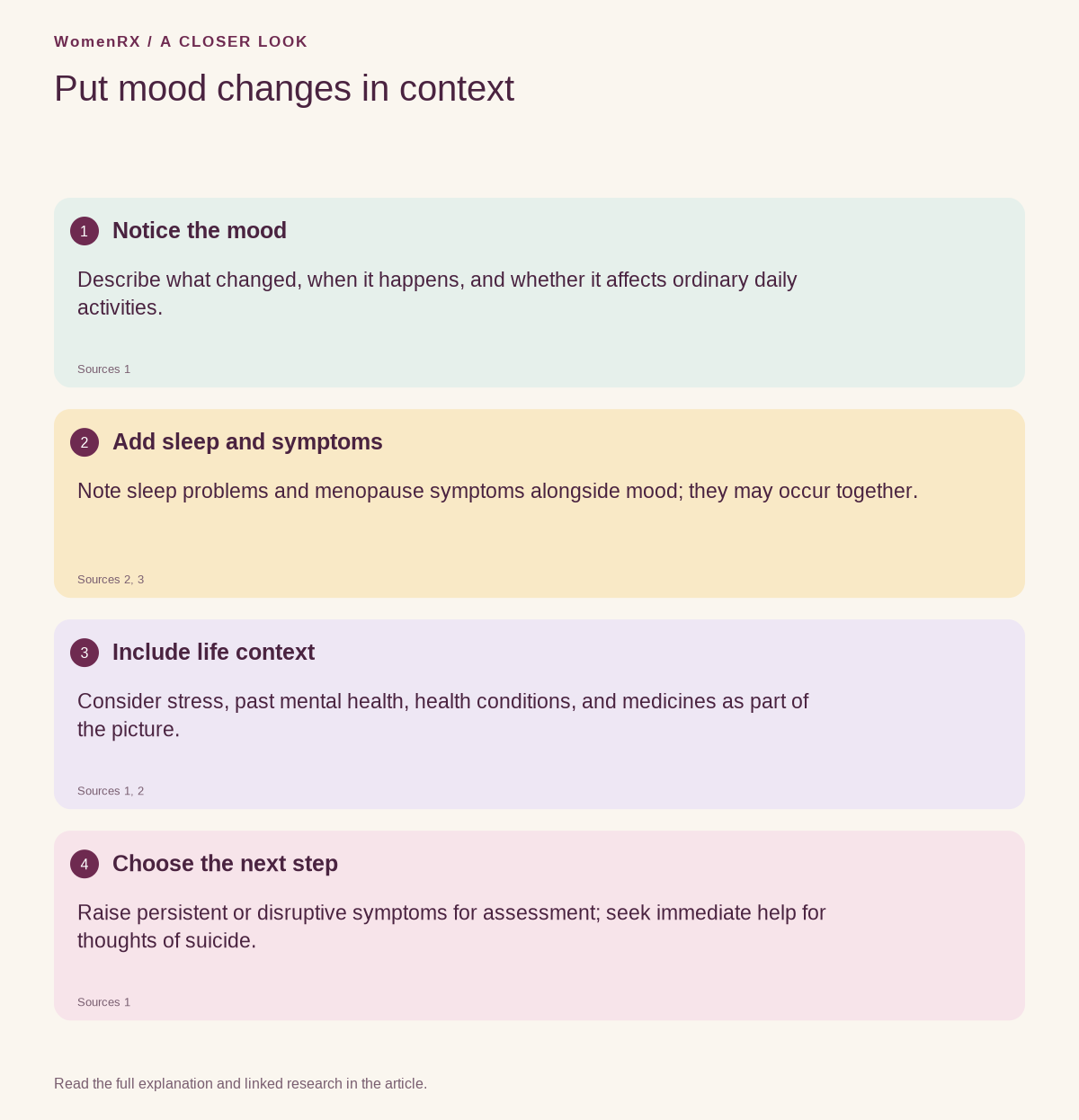
Put mood changes in context
Notice the mood: Describe what changed, when it happens, and whether it affects ordinary daily activities.1
Add sleep and symptoms: Note sleep problems and menopause symptoms alongside mood; they may occur together.23
Include life context: Consider stress, past mental health, health conditions, and medicines as part of the picture.12
Choose the next step: Raise persistent or disruptive symptoms for assessment; seek immediate help for thoughts of suicide.1
Read the figure as text
Consider what is happening around a mood change before settling on one explanation. These are useful discussion points, not a diagnostic test.- Notice the mood: Describe what changed, when it happens, and whether it affects ordinary daily activities.1
- Add sleep and symptoms: Note sleep problems and menopause symptoms alongside mood; they may occur together.23
- Include life context: Consider stress, past mental health, health conditions, and medicines as part of the picture.12
- Choose the next step: Raise persistent or disruptive symptoms for assessment; seek immediate help for thoughts of suicide.1
More questions, answered
Does feeling angry mean I have depression?
Not by itself. Irritability can occur with mood changes, but depression involves ongoing symptoms that affect daily life; a clinician can assess the broader pattern rather than drawing a conclusion from anger alone. 1
Does hormone therapy treat clinical depression?
Menopause guidance distinguishes menopause-associated mood disturbance from clinical depression. A review found that some guidelines included menopause-associated mood disturbance among possible reasons to consider hormone therapy, but not clinical depression as a treatment indication. 3
Sources you can check
- Depression: MedlinePlusAccessed 2026-09-25Return to first citation
- Acupuncture for comorbid depression and insomnia in perimenopause: A feasibility patient-assessor-blinded, randomized, and sham-controlled clinical trial.Zhao FY, Zheng Z, Fu QQ, Conduit R, Xu H, Wang HR, Huang YL, Jiang T, Zhang WJ, Kennedy GA. · Frontiers in public health · 2023Return to first citation
- A systematic review and critical appraisal of menopause guidelines.Hemachandra C, Taylor S, Islam RM, Fooladi E, Davis SR. · BMJ sexual & reproductive health · 2024Return to first citation