PCOS and Mental Health: When to Seek Support
PCOS can add emotional strain, but it doesn’t affect everyone the same way, and support is available.
PCOS is associated with depression and anxiety, but that doesn’t mean the condition causes them in every person or that your experience is predetermined. Symptoms, fertility concerns, body image, and the strain of managing a chronic condition may all matter. If low mood, worry, or distress is lasting or interfering with daily life, you can start by talking with a primary care provider or mental health professional. 1 3
PCOS can affect more than your periods
Living with PCOS may mean coping with symptoms that affect how you feel about your body, concerns about fertility, or the repeated work of managing a chronic condition. Those experiences can weigh on mental health. But PCOS doesn’t make depression or anxiety inevitable, and a person’s emotional response can vary.
Research finds an association between PCOS and mental-health concerns, but association is not proof that PCOS directly causes them. Studies also don’t all find the same pattern. For example, one cross-sectional study of infertile women in India found depression levels were comparable between women with and without PCOS, while anxiety and stress were higher in the group without PCOS. That study involved women experiencing infertility, so it can’t describe everyone with PCOS. 3 4
It may help to consider the parts of your life that feel most difficult right now. For one person, distress might center on unwanted hair or acne; for another, fertility treatment, sleep, or simply managing a long-term condition may be the bigger strain. These are examples, not a checklist you need to match.
Notice what is changing for you
A hard day doesn’t by itself mean you have a mental-health condition. Pay attention to patterns that persist or start getting in the way of work, relationships, sleep, or everyday responsibilities. Possible signs include ongoing sadness or hopelessness, worry that feels difficult to control, noticeable changes in sleep or energy, social withdrawal, or mood changes that disrupt daily life. 1 6
Sleep and mood can overlap. In a retrospective study of 1,068 people with PCOS, low energy and daytime dysfunction were closely connected in a network of reported depression, anxiety, and sleep symptoms. This kind of analysis can show which symptoms occur together, but it cannot establish that one causes another. If you’re tired or having trouble sleeping, that experience is worth mentioning along with your mood, rather than assuming it has only one explanation. 6
Support can address both PCOS and distress
A primary care provider can be a starting point if you’re unsure where to turn. You can describe what has changed emotionally and how it affects daily life, then ask about next steps or a referral to a mental-health professional, such as a psychologist, psychiatrist, or clinical social worker. Talk therapy and medication can treat mental-health conditions; the right approach depends on the person and the concern. 1 2
PCOS-specific research on mental-health treatments is growing, but it doesn’t yet establish one best option for everyone. A 2026 network meta-analysis included 25 randomized trials with 1,453 women with PCOS. It found promising results for approaches including emotion-focused therapy and mindfulness stress management; peer support also appeared promising for depression, but its anxiety results could not be analyzed in that review. These findings are encouraging, but they don’t mean each option will help every person or replace individualized care. 3
If you’re already getting PCOS care, you can raise mental health there too. The goal isn’t to assume that treating PCOS will automatically resolve anxiety or low mood. In a small, naturalistic study, 33 women received varied PCOS treatments over 12 weeks and reported improved depression and anxiety symptoms, but the study design cannot show that a particular treatment caused the changes. Mental-health support can be discussed as its own part of care. 5
When you need help right away
Thoughts about death or suicide are a reason to seek help right away, even if you’re not sure what to call what you’re feeling. If you or someone you know is struggling or having thoughts of suicide, call or text 988 in the United States. 1
You don’t need to wait until distress becomes overwhelming to bring it up. Saying, “My mood or anxiety has been affecting my day-to-day life, and I’d like help,” is enough to begin the conversation.
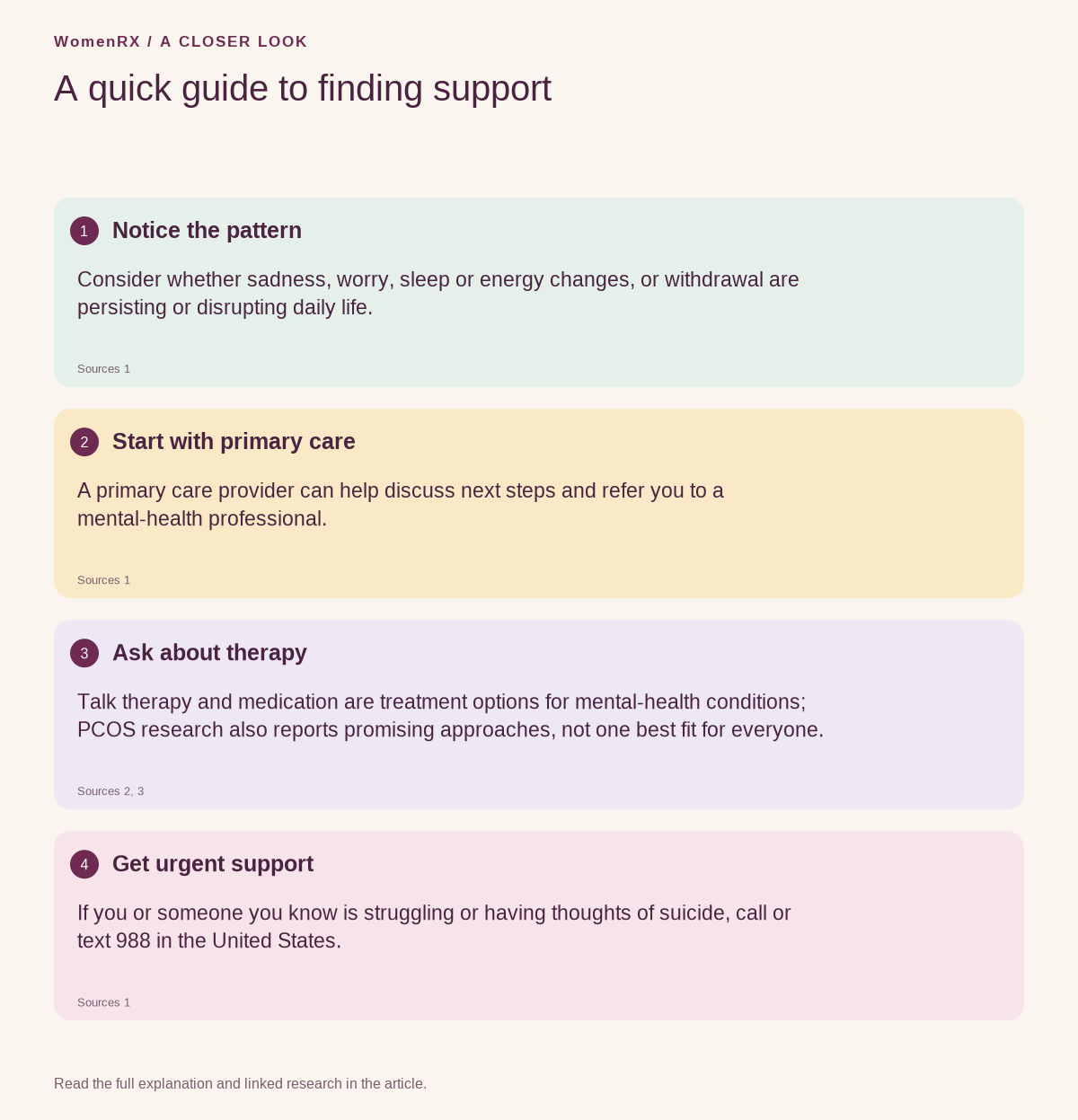
A quick guide to finding support
Notice the pattern: Consider whether sadness, worry, sleep or energy changes, or withdrawal are persisting or disrupting daily life.1
Start with primary care: A primary care provider can help discuss next steps and refer you to a mental-health professional.1
Ask about therapy: Talk therapy and medication are treatment options for mental-health conditions; PCOS research also reports promising approaches, not one best fit for everyone.23
Get urgent support: If you or someone you know is struggling or having thoughts of suicide, call or text 988 in the United States.1
Read the figure as text
Use these prompts to recognize what you’re dealing with and choose a next step. They aren’t a diagnostic checklist.- Notice the pattern: Consider whether sadness, worry, sleep or energy changes, or withdrawal are persisting or disrupting daily life.1
- Start with primary care: A primary care provider can help discuss next steps and refer you to a mental-health professional.1
- Ask about therapy: Talk therapy and medication are treatment options for mental-health conditions; PCOS research also reports promising approaches, not one best fit for everyone.23
- Get urgent support: If you or someone you know is struggling or having thoughts of suicide, call or text 988 in the United States.1
More questions, answered
Does treating PCOS also treat depression or anxiety?
Not necessarily. A small naturalistic study found mood and anxiety symptoms improved during varied PCOS treatment, but it cannot establish that treatment caused the improvement. Mental-health concerns can be addressed directly through appropriate mental-health support. 5 2
Where can I start if I’m not sure what kind of help I need?
A primary care provider is one place to begin; they can help discuss next steps and refer you to a mental-health professional. If you’re having thoughts of suicide, call or text 988. 1
Sources you can check
- NIMH: Women and mental healthAccessed 2026-09-25Return to first citation
- Mental Health: MedlinePlusAccessed 2026-09-25Return to first citation
- A network meta-analysis of interventions for anxiety and depression in PCOS.Tan Z, Li Y, Liu J, Hu X, Su X, Huang Y. · PeerJ · 2026Return to first citation
- Psychological Morbidity (Stress, Anxiety and Depression) and Fertility Quality of Life amongst Infertile Women with and without Polycystic Ovary Syndrome (PCOS): A Cross-sectional Study.Mahey R, Patkar D, Kalaivani M, Hemraj C, Deep R, Jayraj AK, Badal R, Shukla A. · Journal of human reproductive sciences · 2026Return to first citation
- Changes in facial emotion processing and depression and anxiety symptoms with polycystic ovary syndrome treatment: a longitudinal, naturalistic study.Douglas KM, Sukhapure M, Porter RJ, Fenton A, Eggleston K. · Archives of women's mental health · 2026Return to first citation
- Mapping the network structure of anxiety, depression, and sleep symptoms in patients with polycystic ovary syndrome.Li S, Zhang Y, Tang X, Deng M, Luo H, Chen Y. · Frontiers in psychiatry · 2026Return to first citation