Can Journaling Support Mental Health? Choose by Purpose
Writing can help you reflect, but expressive writing, gratitude prompts, and symptom notes serve different purposes and don’t have the same evidence.
Journaling may be a useful reflection practice, but it isn’t a proven substitute for mental health care. Expressive writing has some encouraging, population-specific findings, including research with postpartum women experiencing distress. Gratitude-writing evidence cited here comes from schoolchildren, while symptom notes are best treated as personal observations, not treatment. If writing leaves you more distressed, stop or choose a gentler format. 3 5

Pick the job you want the page to do
A journal can hold difficult thoughts, draw attention to things you value, or help you keep track of how you’ve been feeling. Those are different aims. It’s easier to judge whether writing is useful when you choose a format for a specific purpose, rather than expecting any journal entry to fix how you feel.
Expressive writing: put a difficult experience into words
Expressive writing focuses on thoughts and feelings connected to a stressful experience. The aim is to express yourself, not to produce polished writing or a complete account. For example, you might write about what’s been weighing on you during fertility treatment, after giving birth, or while caring for someone who needs support. Those situations can bring distinct pressures, but journaling needs aren’t specific to women.
The findings are promising in some settings, not a guarantee of broad benefit. In a randomized trial, 100 people completed writing tasks on four consecutive days. Several measures, including stress and symptoms of depression and anxiety, changed over time; the study reported more limited differences between writing groups on aspects of coping. That doesn’t show that expressive writing reliably improves symptoms for everyone. 2
There is more directly relevant evidence for some reproductive transitions. A review of five studies involving 483 postpartum women with psychological distress found results favoring expressive writing for depression and stress, while the authors cautioned that the studies varied substantially and anxiety findings were uncertain. A separate randomized trial of 90 women undergoing assisted reproductive treatment found some depression and stress results favoring writing, but not significant differences across groups for other measured outcomes. These findings make expressive writing a possible support to consider in those circumstances, not a replacement for care. 5 4
An example prompt: “What’s taking up the most space in my mind today, and what do I wish someone understood about it?” You don’t have to retell every detail. If writing about the experience feels like too much, shift to what you need right now or stop.
Gratitude writing: notice what you value
A gratitude prompt directs attention to a person, moment, or thing you appreciate. It doesn’t require pretending that a hard day was good. You could ask, “Was there a small moment today that felt comforting, meaningful, or kind?”
One randomized trial found that positive writing about people and things participants felt grateful for reduced depression and social anxiety symptoms compared with a control condition. But the participants were 165 Chinese schoolchildren aged 10 to 15 during the COVID-19 period. That result doesn’t establish the same effect for adults or for women in a particular life stage. 3
Symptom notes: record what you notice
A brief log can help you put observations in one place. For example, you might note your mood, sleep, and what was happening that day, such as a demanding caregiving stretch or a change in routine. That record can help you reflect on your own experience, but it isn’t a diagnosis or a treatment. Keep it simple if detail starts to feel like another task.
Let your response guide the format
If writing leaves you more upset, you can stop, switch to a neutral check-in, or write about what might help you feel supported today. You don’t owe a journal a daily entry, and you don’t need to push through an exercise that feels unmanageable.
Writing also shouldn’t be your only support when distress is affecting daily life. Changes in eating or sleeping, or difficulty with everyday tasks such as caring for children or getting to work, are warning signs worth taking seriously. Mental health conditions can be treated, including with talk therapy and medication. 1
The useful question isn’t whether you keep a notebook. It’s whether this particular kind of writing feels manageable and serves a purpose you care about. If it doesn’t, changing the format or setting the journal aside is a reasonable choice.
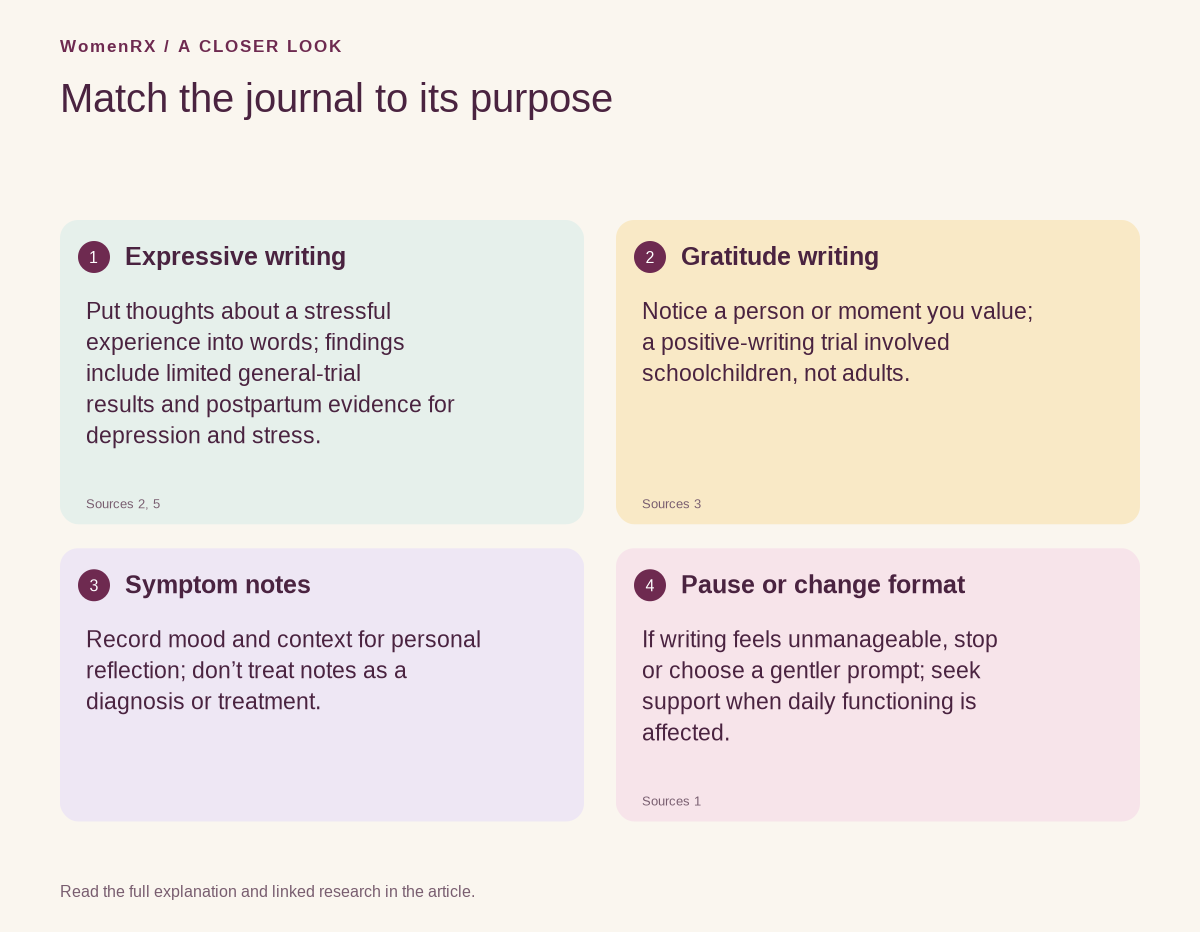
Match the journal to its purpose
Expressive writing: Put thoughts about a stressful experience into words; findings include limited general-trial results and postpartum evidence for depression and stress.25
Gratitude writing: Notice a person or moment you value; a positive-writing trial involved schoolchildren, not adults.3
Symptom notes: Record mood and context for personal reflection; don’t treat notes as a diagnosis or treatment.
Pause or change format: If writing feels unmanageable, stop or choose a gentler prompt; seek support when daily functioning is affected.1
Read the figure as text
These formats have different aims, and research findings for one approach or population don’t automatically apply to another.- Expressive writing: Put thoughts about a stressful experience into words; findings include limited general-trial results and postpartum evidence for depression and stress.25
- Gratitude writing: Notice a person or moment you value; a positive-writing trial involved schoolchildren, not adults.3
- Symptom notes: Record mood and context for personal reflection; don’t treat notes as a diagnosis or treatment.
- Pause or change format: If writing feels unmanageable, stop or choose a gentler prompt; seek support when daily functioning is affected.1
Sources you can check
- Mental Health: MedlinePlusAccessed 2026-09-25Return to first citation
- Effects of replay and rehearsal expressive writing on mental health: a randomized controlled trial.Zhang W, Jhang J, Greenwell MR. · Journal of mental health (Abingdon, England) · 2023Return to first citation
- Efficacy of positive expressive writing in reducing depression and social anxiety symptoms among schoolchildren during COVID-19: A randomized controlled trial.Hu CS, Zhang H, Hu L, Nadiiev A, Yan J, Liu M. · Journal of health psychology · 2025Return to first citation
- Comparing the Effectiveness of Expressive Writing and Relaxation on Mental Health and Treatment Success in Women Undergoing Assisted Reproductive Technology: A Randomized Controlled Trial.Najdgholami Z, Amini L, Montazeri A, Mohammadnoori M. · Journal of family & reproductive health · 2025Return to first citation
- Effectiveness of expressive writing therapy for postpartum women with psychological distress: Meta-analysis and narrative review.Lim X, Ang MQ, Foo A, Chng KKY, Koh SSL. · International journal of gynaecology and obstetrics: the official organ of the International Federation of Gynaecology and Obstetrics · 2025Return to first citation