Mental Health: Find the Support That Fits Your Concern
What you’re feeling, how long it lasts, and when it happens can help you find a useful place to start.
Mental health concerns aren’t one condition, and hormones aren’t the explanation for every change in mood. Persistent low mood, overwhelming worry, and symptoms that recur before a period or follow childbirth raise different questions. Notice the pattern and how it affects daily life, then choose a reading path or seek care that fits what’s happening now. 12345

Start with what has changed
A hard week doesn’t automatically mean you have a mental health disorder. But a change in sleep or eating, pulling away from people, feeling hopeless, or struggling to manage ordinary tasks deserves attention. Mental health includes how you feel, think, relate to others, and cope with life. Stressful experiences, physical health, family history, and substance use can all play a part. 1
If low mood or loss of interest is the main change, the distinction is whether it persists and affects daily life. Major depression involves depressed mood or loss of interest, with symptoms affecting daily activities for at least two weeks. It may also show up as exhaustion, sleep or appetite changes, irritability, or unexplained aches, not just sadness. A medical condition or medicine can sometimes cause similar symptoms. For a broad starting point, read MedlinePlus’s Depression guide. 2
If fear or worry is taking over, notice both the thoughts and what you’ve started avoiding. Anxiety can bring a pounding heart, dizziness, tension, or shortness of breath. Anxiety disorders differ from an anxious response to stress because symptoms persist, may worsen, and interfere with work, relationships, or other daily activities. Physical conditions, including thyroid problems and heart rhythm problems, can also matter. MedlinePlus’s Anxiety guide explains the main types and treatment options. 3
You don’t have to settle on a diagnosis before asking for help. A primary care provider can be a starting point when you’re unsure whether mood, anxiety, physical health, or a combination is involved. Talk therapy and medicines are established treatment options for depression and anxiety disorders; the right approach depends on the concern being assessed. 123
When timing changes the question
Before a period: Severe emotional and physical symptoms that repeatedly begin about one to two weeks before a period and improve within a few days after it starts may point toward premenstrual dysphoric disorder, or PMDD. If low mood or worry is present throughout the month, don’t assume the premenstrual days explain all of it. Start with When Preperiod Mood Symptoms May Be PMDD if the pattern feels pronounced, or How to Track Mood Across Your Menstrual Cycle if you’re still trying to see what repeats. PMS Mood Changes: What Helps on Harder Days is a route for managing difficult days while you work out the larger pattern. 235
During pregnancy or after birth: Depression can begin during pregnancy and continue after delivery. After birth, brief mood swings and crying spells, often called the baby blues, commonly fade within days to a week. More severe symptoms lasting longer than two weeks may be postpartum depression, which can begin anytime in the first year after childbirth. Sleep loss, limited support, physical changes, and stress may all contribute; this isn’t a question of willpower. Getting Help for Postpartum Depression or Anxiety offers a route for deciding whom to contact and when help is urgent. 4
Around menopause: Mood concerns still deserve to be considered on their own terms. Depression can occur around menopause, but that timing alone doesn’t establish its cause. If sleep is the concern that brought you here, Can CBT-I Help With Sleep Problems Around Menopause? is the more focused reading path. If low mood or persistent worry is the main problem, begin with the depression or anxiety guides above rather than assuming sleep or hormones explain everything. 23
A long-term physical condition can be part of the picture too. In a systematic review of randomized trials involving adults with depression or anxiety alongside a chronic physical condition, some primary-care and community approaches produced small average improvements in depressive symptoms. The useful takeaway is that physical and mental health don’t have to be treated as separate conversations. 6
Match the next step to the level of concern
For symptoms that persist, worsen, or disrupt your ability to work, connect with others, or care for yourself or your family, reach out for an assessment rather than relying on a self-help practice alone. If you’re considering journaling, Can Journaling Support Mental Health? Choose by Purpose helps you choose what you want writing to do without treating it as a replacement for care. If you’re here because someone you care about has depression, How to Support a Friend Who Has Depression is the relevant route. 12
Safety changes the next step. If you’re thinking of hurting yourself or your baby, get help right away. In the US, call or text 988 for crisis support. If there’s immediate danger to you, your baby, or anyone else, call 911 in the US or go to the nearest emergency department. New confusion or hallucinations after childbirth may be postpartum psychosis and need emergency care too. Outside the US, use local emergency services for immediate danger or a local crisis service for support. 24
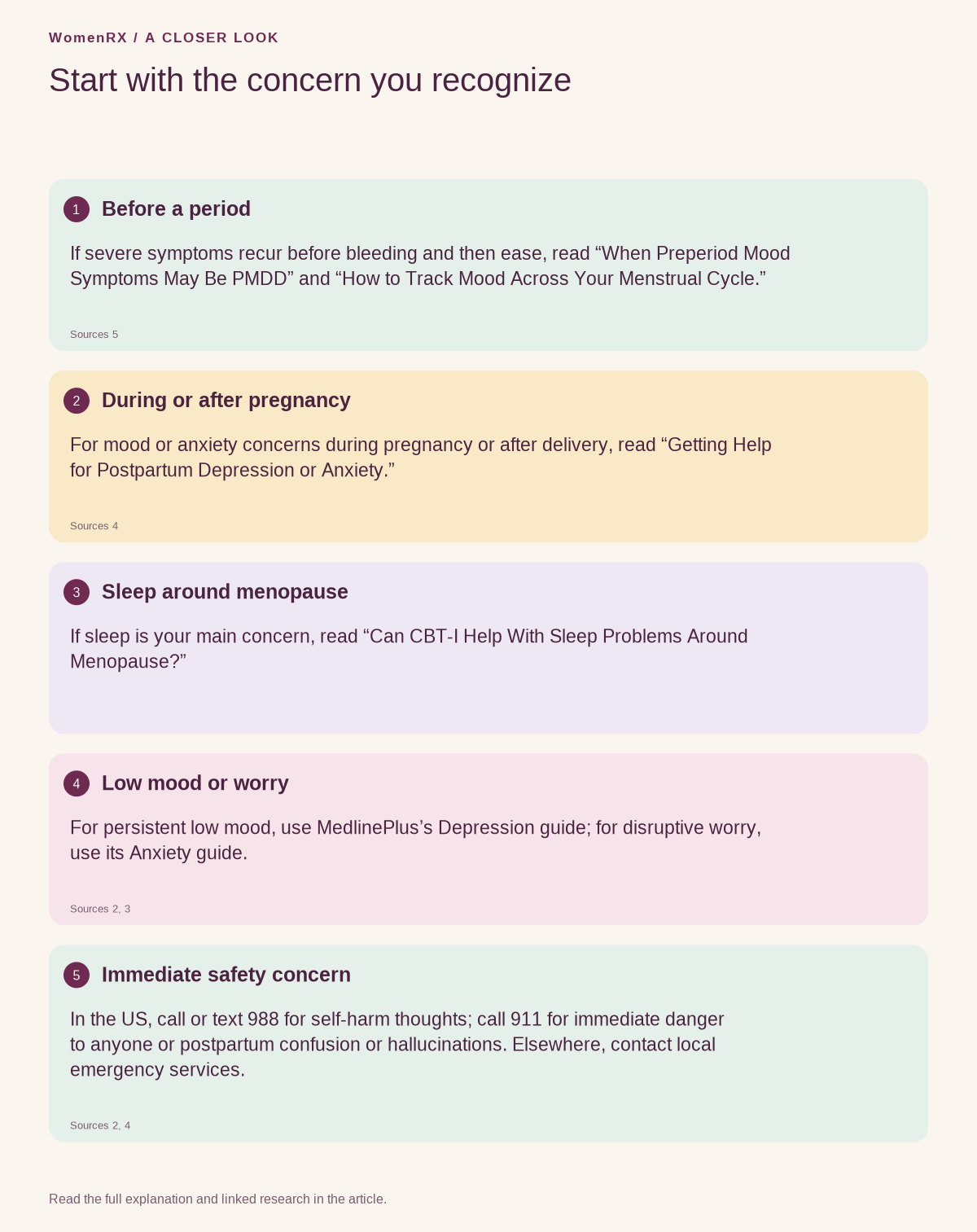
Start with the concern you recognize
Before a period: If severe symptoms recur before bleeding and then ease, read “When Preperiod Mood Symptoms May Be PMDD” and “How to Track Mood Across Your Menstrual Cycle.”5
During or after pregnancy: For mood or anxiety concerns during pregnancy or after delivery, read “Getting Help for Postpartum Depression or Anxiety.”4
Sleep around menopause: If sleep is your main concern, read “Can CBT-I Help With Sleep Problems Around Menopause?”
Low mood or worry: For persistent low mood, use MedlinePlus’s Depression guide; for disruptive worry, use its Anxiety guide.23
Immediate safety concern: In the US, call or text 988 for self-harm thoughts; call 911 for immediate danger to anyone or postpartum confusion or hallucinations. Elsewhere, contact local emergency services.24
Read the figure as text
These are entry points, not a test or a sequence you must follow.- Before a period: If severe symptoms recur before bleeding and then ease, read “When Preperiod Mood Symptoms May Be PMDD” and “How to Track Mood Across Your Menstrual Cycle.”5
- During or after pregnancy: For mood or anxiety concerns during pregnancy or after delivery, read “Getting Help for Postpartum Depression or Anxiety.”4
- Sleep around menopause: If sleep is your main concern, read “Can CBT-I Help With Sleep Problems Around Menopause?”
- Low mood or worry: For persistent low mood, use MedlinePlus’s Depression guide; for disruptive worry, use its Anxiety guide.23
- Immediate safety concern: In the US, call or text 988 for self-harm thoughts; call 911 for immediate danger to anyone or postpartum confusion or hallucinations. Elsewhere, contact local emergency services.24
Sources you can check
- Mental Health: MedlinePlusAccessed 2026-09-25Return to first citation
- Depression: MedlinePlusAccessed 2026-09-25Return to first citation
- Anxiety: MedlinePlusAccessed 2026-09-25Return to first citation
- Postpartum Depression: MedlinePlusAccessed 2026-09-25Return to first citation
- PMDD (premenstrual dysphoric disorder) - NHSAccessed 2026-09-25Return to first citation
- Primary care and community interventions for multimorbidity involving depression or anxiety: systematic review with meta-analysis.Sweeney K, Gilarova M, Ng L, Baker J, Maxwell S, Macrae C, Mercer SW, Anand A, Guthrie B, Stirland LE. · BMJ medicine · 2026Return to first citation