Starting Yoga: Find a Class That Fits You
The best first class is one whose pace, transitions, and teaching support work for your body and your day.
Start by choosing how you want to move: ask whether a chair-based class stays seated or includes floor transitions, while a flowing class links poses in a moving sequence. A prop-supported class may offer another way to participate. Ask how the instructor handles beginners and alternatives before you book, and, if you’re doing exercises for back pain, stop if the pain gets worse. 4562
Choose the movement, not just the class name
A class labeled “beginner” tells you less than you might hope. The more useful questions are: Will you move continuously or spend time setting up each pose? Will you need to get down to the floor and back up? Can the teacher offer an alternative when a position doesn’t work for you?
Hatha is a broad term for physical yoga practices, not a promise about pace or difficulty. Vinyasa generally links postures in flowing sequences coordinated with breathing. An Iyengar-style class may use chairs, straps, or blocks to support positions; the classes described in one study also included active poses, so props don’t necessarily mean an easy class. If floor work is a barrier, ask whether a chair-based yoga class stays seated or includes floor transitions. These descriptions are starting points, not guarantees about a particular teacher’s class. 465
For example, if your main concern is repeatedly getting up from the floor, ask whether a class includes floor transitions rather than choosing one because its name sounds gentle. If you’d like time to learn positions and try props, ask a studio how its introductory, prop-supported classes are taught. If continuous movement appeals to you, ask a flowing class whether it expects you to know the poses already. Those questions are more useful than trying to find one universally “best” style.
Ask what happens when you need an alternative
Before signing up, you can send a short message: “I’m new to yoga. How quickly does the class move? Do you offer chair or prop options? Can I skip a pose and rejoin?” If a joint or position is a particular concern, name it. For example: “I’m uncomfortable putting weight on my wrists. Would this class have other ways to participate?”
The answer matters more than a style label. A review of studies involving people with back or neck pain found that Iyengar yoga performed better than comparison groups on pain or function shortly after treatment, but found little evidence about long-term effects. That doesn’t establish that any drop-in Iyengar class will suit someone with back pain, or that you should push through a painful pose. Guidance on back-pain exercises says to stop if pain gets worse. 32
You don’t need to perform every pose to take part. Ask the instructor for a supported version, take a pause, or leave out a movement that isn’t working. For a first class, there’s no need to attempt advanced positions to prove you belong: a review of published yoga injury case reports advises beginners to avoid extreme practices such as headstands, lotus position, and forceful breathing. Case reports cannot tell us how often injuries occur, but they offer a sound reason not to rush into those practices. 4
Decide whether you want to be in the room
A live online class can remove the trip to a studio, while an in-person class may make it easier to get individual attention. In a small study of 24 women receiving an Iyengar intervention, participants reported more individual attention in person than online; the study measured perceptions of instruction, not which format produced better health outcomes. Interviews with older adults in an online chair-yoga program also found a tradeoff: some appreciated easier access and fewer distractions, while others missed the teacher’s physical presence and the social side of class. 65
If you try a live online class, ask whether you can speak to the instructor about alternatives and whether they’ll be able to see you if you want feedback. If you’d rather have help figuring out a position as you go, an in-person introductory class may fit better. Neither format is automatically the right one.
Make pregnancy a separate question
If you’re pregnant, don’t assume that a general beginner class offers pregnancy-specific adaptations. Ask whether the instructor teaches a pregnancy-focused class or can explain how they adapt the class for pregnant participants. This research doesn’t establish which poses or class formats are appropriate at different points in pregnancy, so a general style comparison can’t answer that question for you.
Whatever brings you to yoga, choose a class where you can say what isn’t working and get a clear alternative. If you’re starting because of back pain, yoga is one possible activity, not a substitute for finding out why pain is severe, follows an injury, or isn’t improving. 12
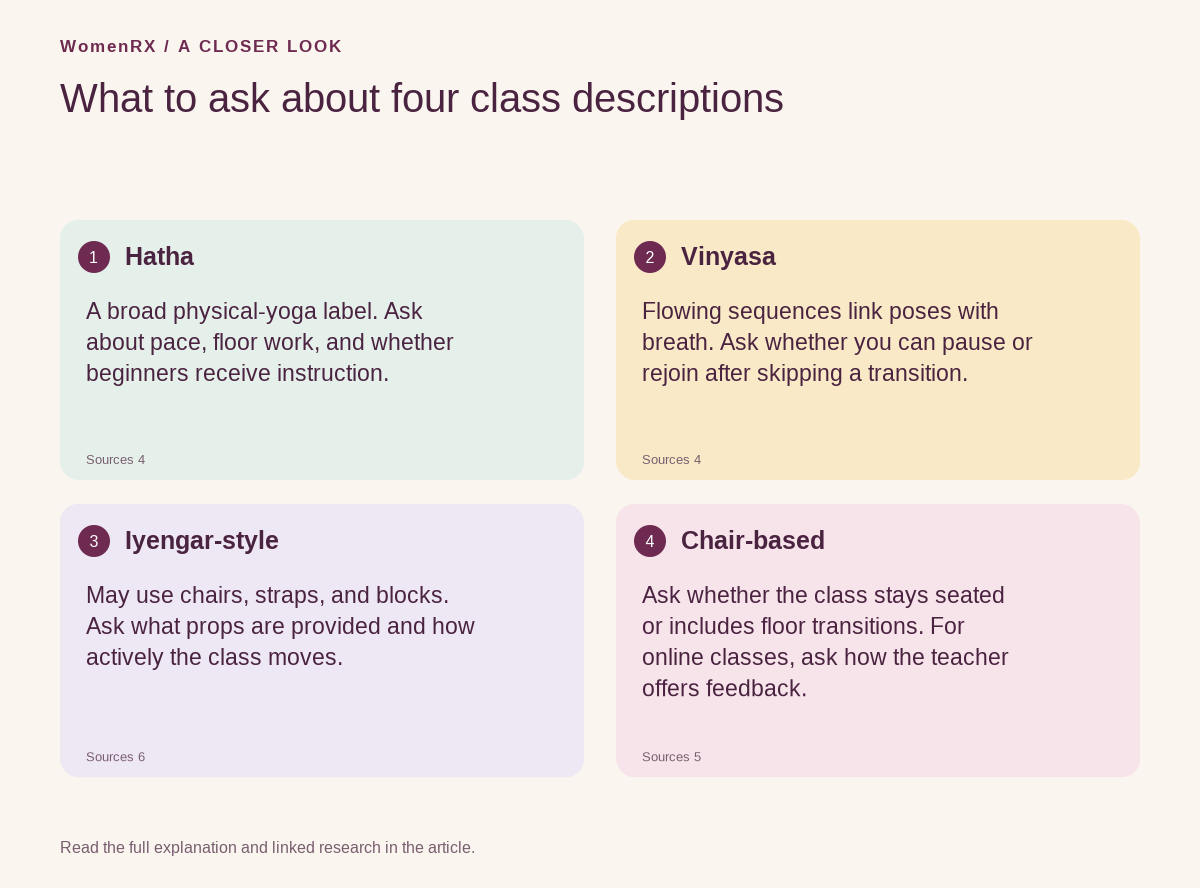
What to ask about four class descriptions
Hatha: A broad physical-yoga label. Ask about pace, floor work, and whether beginners receive instruction.4
Vinyasa: Flowing sequences link poses with breath. Ask whether you can pause or rejoin after skipping a transition.4
Iyengar-style: May use chairs, straps, and blocks. Ask what props are provided and how actively the class moves.6
Chair-based: Ask whether the class stays seated or includes floor transitions. For online classes, ask how the teacher offers feedback.5
Read the figure as text
Style names offer clues, but the teacher’s pace and available alternatives determine what a particular class asks of you.- Hatha: A broad physical-yoga label. Ask about pace, floor work, and whether beginners receive instruction.4
- Vinyasa: Flowing sequences link poses with breath. Ask whether you can pause or rejoin after skipping a transition.4
- Iyengar-style: May use chairs, straps, and blocks. Ask what props are provided and how actively the class moves.6
- Chair-based: Ask whether the class stays seated or includes floor transitions. For online classes, ask how the teacher offers feedback.5
Sources you can check
- Back PainAccessed 2026-09-25Return to first citation
- Back pain - NHSAccessed 2026-09-25Return to first citation
- Effectiveness of Iyengar yoga in treating spinal (back and neck) pain: A systematic review.Crow EM, Jeannot E, Trewhela A. · International journal of yoga · 2015Return to first citation
- Adverse events associated with yoga: a systematic review of published case reports and case series.Cramer H, Krucoff C, Dobos G. · PloS one · 2013Return to first citation
- Acceptability and feasibility of online delivery of chair-based yoga for older adults with multimorbidity - lessons from a process evaluation of the gentle years yoga trial.Ward L, Bissell L, Howsam J, Tew GA, Wiley L, Rose F, Sofía C, Palacios M, Rapley T. · BMC complementary medicine and therapies · 2025Return to first citation
- Perceived delivery of essential yoga properties within in-person and remote weight loss maintenance interventions.Sherman SA, Quinn TD, Bock BC, Braun TD, Unick JL. · PloS one · 2024Return to first citation