Sexual and Reproductive Health: Find Your Starting Point
Start with what’s happening now, then use pregnancy possibility and life stage to decide whether to read further or seek care.
Start with the question closest to yours: a period or bleeding change, pelvic pain, contraception, sexual symptoms, or pregnancy plans. The next step can change if pregnancy is possible. Bleeding during pregnancy calls for prompt contact with a care provider; a missed period followed by unusual bleeding and abdominal pain needs urgent assessment. Bleeding after menopause also needs evaluation. 7139

You don’t need a diagnosis to find a useful starting point. Describe what’s happening first. Then consider whether pregnancy is possible and whether the change is happening during your cycling years, after childbirth, or after menopause. Those details can turn a general question into a more focused one.
A period change or unusual bleeding
A cycle runs from the first day of one period to the first day of the next. It can be shorter or longer than 28 days and still be normal. Periods may take a few years to become regular after they begin, and patterns can change after childbirth or while breastfeeding. Start by comparing the bleeding with what’s usual for you, rather than with someone else’s cycle. 2 Bleeding before puberty is different from a period and needs assessment. 7
Very heavy bleeding, bleeding that lasts much longer than usual, bleeding between periods, or bleeding after sex belongs in a different category from an ordinary period. Possible causes include contraception, fibroids or polyps, and infections. The pattern alone can’t identify the cause. Arrange an assessment for bleeding between periods or after sex, or for a major cycle change, very heavy bleeding, or severe pain. 2713 The MedlinePlus Menstruation guide explains cycles; its Vaginal Bleeding guide addresses bleeding outside the usual pattern.
Pregnancy changes the priority. If you’re pregnant and bleeding, contact your pregnancy care provider right away. If you’ve recently missed a period and have unusual bleeding plus abdominal or pelvic pain, seek urgent medical assessment. That combination can signal an ectopic pregnancy. 713
After menopause, vaginal bleeding needs to be checked even if it’s only spotting or happens once. It can have several causes, including thinning tissue or polyps, but it can also be a sign of cancer. Don’t treat it as another irregular period. 9 The NHS Postmenopausal Bleeding guide explains this distinction.
Pelvic pain: notice what happens alongside it
Pelvic pain might occur with a period, during sex, or when you pee. It can come from reproductive organs, but bowel or bladder problems and infections are also possibilities. Pain that keeps returning or doesn’t go away deserves an assessment; pain with difficulty peeing or passing stool calls for urgent medical help. 10 If a missed period and unusual bleeding accompany the pain, use the urgent bleeding route above instead of assuming it’s a period symptom. 13 The NHS Pelvic Pain guide offers a closer look at these patterns.
Contraception: routine choice or time-sensitive question?
If you’re choosing ongoing birth control, first decide what matters most to you: effectiveness, how much day-to-day attention a method takes, side effects, reversibility, and protection against sexually transmitted infections (STIs). Most contraceptive methods don’t prevent STIs; external latex condoms also help protect against HIV and other STIs. 112 Use the MedlinePlus Birth Control guide to compare types.
If sex happened without contraception or a condom broke, look at emergency contraception now rather than starting with a routine method comparison. A copper IUD is one emergency-contraception option that can be placed within five days of unprotected sex; emergency contraceptive pills are another option. 112
After childbirth, breastfeeding may affect your choice, but breastfeeding by itself isn’t a guarantee against pregnancy. The breastfeeding-based method provides temporary contraception only while all three conditions apply: you haven’t had a period since birth, you’re fully or nearly fully breastfeeding, and you’re under six months postpartum. If any one no longer applies, another method is needed if you want to prevent pregnancy. 12
Sex, intimacy, or a change in discharge
Sexual health isn’t only about contraception. Pain or difficulty enjoying sex, STI concerns, chronic illness, medicines, and worries about pregnancy or fertility can point to different questions. 3 The MedlinePlus Sexual Health guide is a broad starting point; if pelvic pain is the main symptom, use the pain route above too.
Discharge is another place where the change matters. Clear or white discharge without a strong, unpleasant smell is often normal. Its amount and texture can vary, including around ovulation and during pregnancy. A change in smell, color, or texture, particularly with itching, soreness, pain when urinating, pelvic pain, or bleeding, is worth getting assessed. Appearance alone can’t reliably tell you which infection, if any, is responsible. 8 The NHS Vaginal Discharge guide helps separate common variation from symptoms to bring to care.
Planning pregnancy, trying to conceive, or already pregnant
If pregnancy is a goal, preconception care is a place to address existing conditions such as diabetes or high blood pressure and discuss folic acid before pregnancy. 11 If you’re having trouble conceiving, fertility can involve ovulation, the uterus or fallopian tubes, sperm, or more than one factor. MedlinePlus describes infertility as not becoming pregnant after a year of frequent, unprotected sex, or after six months at age 35 or older. It advises an earlier conversation for some concerns, including irregular periods, a history of pelvic inflammatory disease, past fertility concerns, or being over 40. 4 Its Infertility guide explains what an evaluation may involve.
If you’re already pregnant, the MedlinePlus Pregnancy guide covers prenatal care and changing symptoms. For a medicine question, use its separate Pregnancy and Medicines guide. Prescription medicines, over-the-counter products, herbs, and supplements may all need review. Don’t assume stopping a needed medicine is safer than continuing it; the risks of both choices matter. 56
The focused WomenRX reading routes below go deeper where the current library has relevant articles, especially birth control decisions. For bleeding, pelvic pain, discharge, and fertility, the topic guides named in each section are the more direct next read.
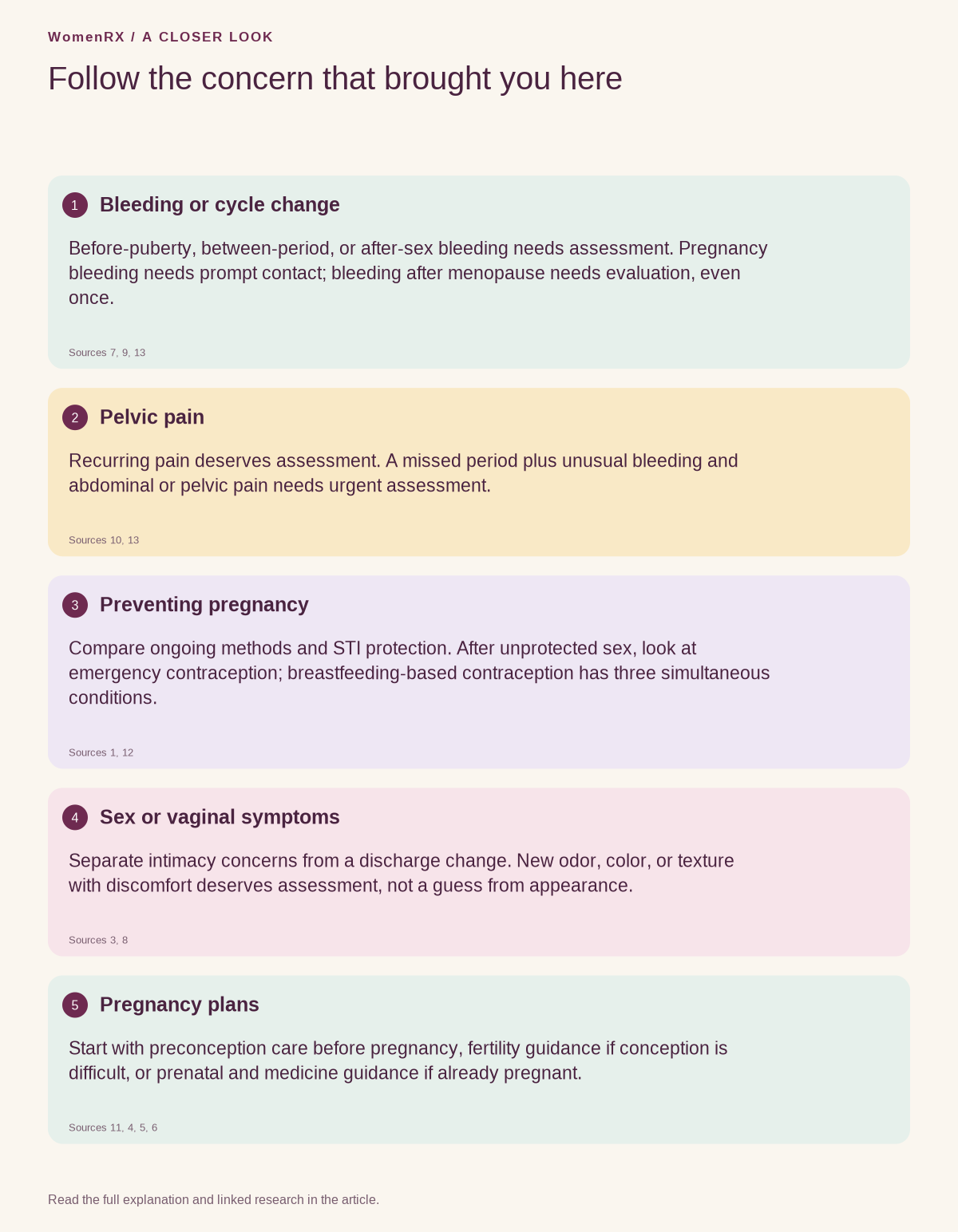
Follow the concern that brought you here
Bleeding or cycle change: Before-puberty, between-period, or after-sex bleeding needs assessment. Pregnancy bleeding needs prompt contact; bleeding after menopause needs evaluation, even once.7913
Pelvic pain: Recurring pain deserves assessment. A missed period plus unusual bleeding and abdominal or pelvic pain needs urgent assessment.1013
Preventing pregnancy: Compare ongoing methods and STI protection. After unprotected sex, look at emergency contraception; breastfeeding-based contraception has three simultaneous conditions.112
Sex or vaginal symptoms: Separate intimacy concerns from a discharge change. New odor, color, or texture with discomfort deserves assessment, not a guess from appearance.38
Pregnancy plans: Start with preconception care before pregnancy, fertility guidance if conception is difficult, or prenatal and medicine guidance if already pregnant.11456
Read the figure as text
Choose a route by symptom or decision, then check whether pregnancy possibility or life stage changes the priority.- Bleeding or cycle change: Before-puberty, between-period, or after-sex bleeding needs assessment. Pregnancy bleeding needs prompt contact; bleeding after menopause needs evaluation, even once.7913
- Pelvic pain: Recurring pain deserves assessment. A missed period plus unusual bleeding and abdominal or pelvic pain needs urgent assessment.1013
- Preventing pregnancy: Compare ongoing methods and STI protection. After unprotected sex, look at emergency contraception; breastfeeding-based contraception has three simultaneous conditions.112
- Sex or vaginal symptoms: Separate intimacy concerns from a discharge change. New odor, color, or texture with discomfort deserves assessment, not a guess from appearance.38
- Pregnancy plans: Start with preconception care before pregnancy, fertility guidance if conception is difficult, or prenatal and medicine guidance if already pregnant.11456
Sources you can check
- Birth Control | Contraception | Contraceptives | MedlinePlusAccessed 2026-09-25Return to first citation
- Menstruation | Period | MedlinePlusAccessed 2026-09-25Return to first citation
- Sexual Health | MedlinePlusAccessed 2026-09-25Return to first citation
- Infertility | Infertility Treatments | MedlinePlusAccessed 2026-09-25Return to first citation
- Pregnancy | Pregnant | Prenatal Care | MedlinePlusAccessed 2026-09-25Return to first citation
- Pregnancy and Medicines | MedlinePlusAccessed 2026-09-25Return to first citation
- Vaginal Bleeding | Uterine Fibroids | MedlinePlusAccessed 2026-09-25Return to first citation
- Vaginal discharge - NHSAccessed 2026-09-25Return to first citation
- Postmenopausal bleeding - NHSAccessed 2026-09-25Return to first citation
- Pelvic pain - NHSAccessed 2026-09-25Return to first citation
- Preconception Care: MedlinePlusAccessed 2026-09-25Return to first citation
- CDC: Birth control methods, barrier methods, fertility awareness and breastfeedingAccessed 2026-09-25Return to first citation
- Vaginal bleeding between periods or after sex - NHSAccessed 2026-09-25Return to first citation