How to Choose a Weight Management Starting Point
Start with the health change you want, then choose a step you can live with and a way to tell whether it’s helping.
You don’t need to pick a target weight before you begin. Name the change you’re hoping for, such as more energy or addressing a weight-related health concern, and consider whether weight loss is necessary for that goal. If it is, a manageable change in eating or activity is a reasonable first step. Review how you feel and function, not only what the scale says.26
Start with the reason, not a number
Maybe you’re thinking about weight loss because a health condition has changed. Maybe you want more energy, or you’ve noticed an unexpected change in your weight. Those aren’t all the same question. Body weight includes muscle, bone, fat, and water, so the scale alone can’t tell you what’s happening with your health. Your health history and risk factors also matter when deciding whether a weight goal makes sense.2
Try naming the outcome you actually care about. For example, if your goal is to feel stronger in daily life, building a regular activity habit may be a useful place to start whether or not your weight changes. If you’re concerned about cholesterol or another health condition, that gives you a more specific reason to discuss what role, if any, weight loss should play in your care.26
An unplanned change deserves a different response from an intentional goal. Certain medicines, including steroids and some antidepressants, and conditions such as polycystic ovary syndrome can contribute to weight gain. If you’re losing or gaining weight without trying, talk with your healthcare provider about the change rather than assuming you need a weight-loss plan. Sudden, unexpected weight loss should be checked rather than treated as a welcome result of a new routine.26
Choose a first step you can repeat
If weight loss fits your goal, you can begin with a change to your eating pattern or physical activity that works in your actual week. For example, you might plan a walk on days when you have time or make a satisfying meal at home more often. The useful question isn’t whether the step sounds impressive. It’s whether you can repeat it and notice how it’s working for you. Healthy eating patterns and regular physical activity can support weight management and lower the chance of weight-related health conditions.6
Behavioral support can add more than a set of rules. A systematic review of 65 randomized studies, involving approximately 10,000 adults with overweight or obesity, found that behavioral interventions produced an average of about 3.25 kg (roughly 7 lb) more weight loss than control approaches at follow-ups of at least six months. Techniques associated with better outcomes included setting goals, monitoring behavior, and getting feedback. The review did not find a statistically significant advantage for maintaining an initial loss during subsequent follow-up. That’s a reason to choose support and habits you can continue, not to expect a quick plan to do the lasting work for you.3
A weight-loss supplement is not a shortcut with the same evidence behind it. Research on common ingredients is often limited, short-term, or difficult to apply to products that combine several ingredients. Some ingredients also have safety concerns. A supplement label can’t tell you that a product will work or be safe for you.1
Let your circumstances change the question
Pregnancy: Your body and nutritional needs are changing. Prenatal care focuses on your health and your baby’s development, including nutrition and activity that fit your pregnancy.7 The findings on adult behavioral weight-loss programs discussed above do not establish a pregnancy plan.3 Bring questions about weight or activity into your prenatal visits.7
Breastfeeding or recent postpartum: Before starting a weight-focused plan, discuss the goal and your circumstances with your healthcare provider. That conversation can help you decide whether weight loss belongs in your plan now and what support fits. General advice to set weight goals around your health does not establish a breastfeeding-specific approach.26
Perimenopause or menopause: Weight loss isn’t automatically the right goal because you’re in this stage of life. If your main concern is how you feel day to day, eating well, regular activity, rest, and looking after your mental wellbeing may help with perimenopause or menopause symptoms whether or not your weight changes. Weight-bearing and resistance activity also have a particular purpose here: supporting strength and bone health. That may make an activity goal more useful to you than a scale target. If a health condition is driving your question, use that condition and your health history to decide whether a weight goal belongs in the plan.82
A history of disordered eating: If tracking food or weight, or restricting what you eat, has caused distress before, these studies do not establish whether a program built around those methods would be suitable for you. One small behavioral-program pilot excluded people who reported an eating disorder within the previous five years, so its experience cannot establish how that program would work for them. In a separate study of adults aged 50 and older, measures of shape concern and binge eating decreased during a structured program, while a measure of dietary restraint increased. Those results cannot predict how a program will affect you.45 You don’t have to begin with food or weight tracking. If you’d like help sorting out the health change you want, you could talk it through with a clinician familiar with eating disorders and ask about options that avoid methods that have caused you distress.
Review the outcome you meant to improve
Before choosing a measure, return to your reason for starting. If you wanted more energy for an afternoon walk, notice whether that activity feels easier to fit into your week. If your concern is a health condition, its relevant health measures may tell you more than weight alone. You can also use the scale if it’s useful to you; it’s one piece of information, not the whole story.2
Then ask two questions: Is the change helping with the goal I named? And can I keep doing it without giving up too much of my time, enjoyment, or wellbeing? If the answer is no, you can change the approach rather than assume you failed. Weight maintenance can be difficult even after an effective behavioral program, so a plan that fits your life matters beyond its first results.3
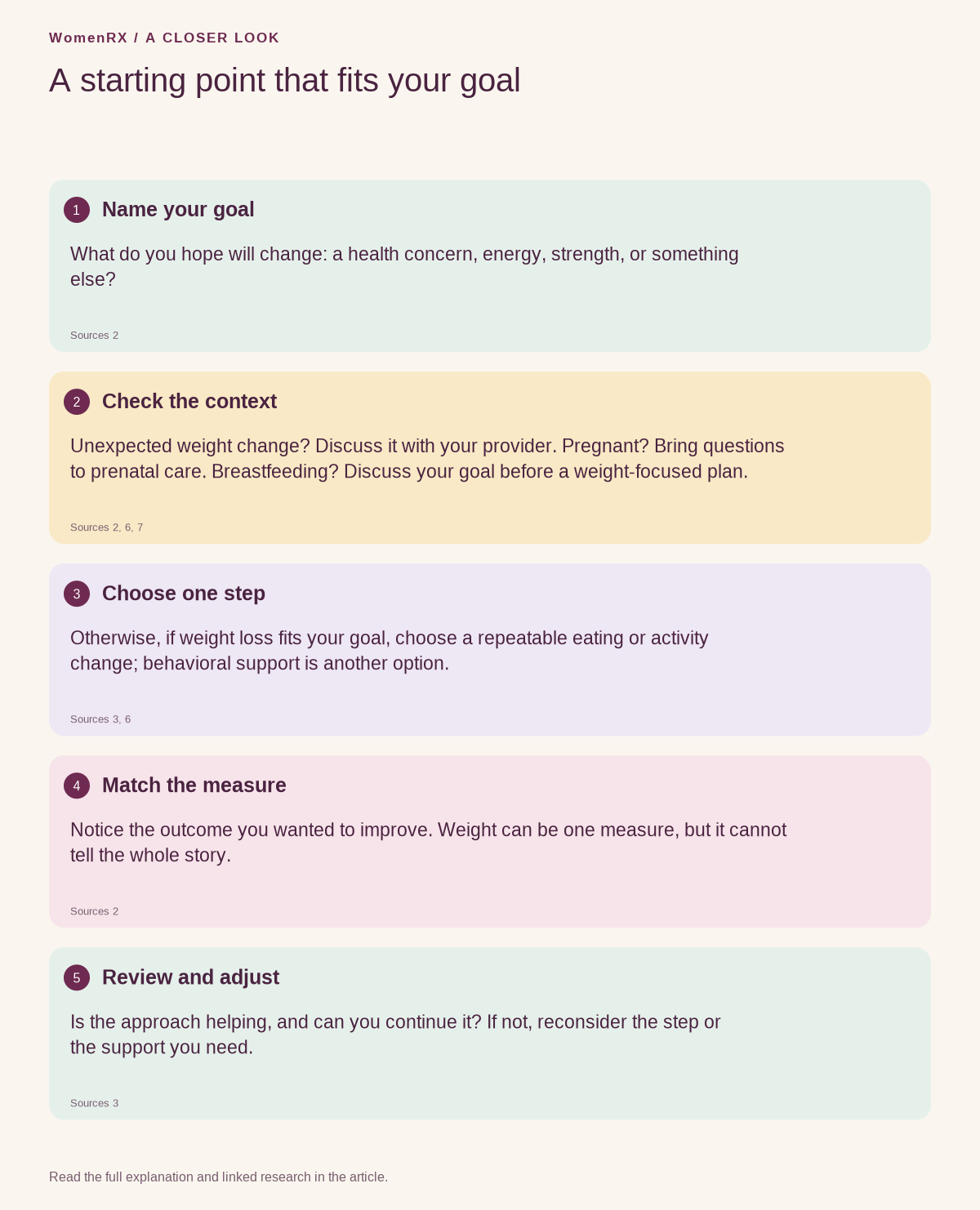
A starting point that fits your goal
Name your goal: What do you hope will change: a health concern, energy, strength, or something else?2
Check the context: Unexpected weight change? Discuss it with your provider. Pregnant? Bring questions to prenatal care. Breastfeeding? Discuss your goal before a weight-focused plan.267
Choose one step: Otherwise, if weight loss fits your goal, choose a repeatable eating or activity change; behavioral support is another option.36
Match the measure: Notice the outcome you wanted to improve. Weight can be one measure, but it cannot tell the whole story.2
Review and adjust: Is the approach helping, and can you continue it? If not, reconsider the step or the support you need.3
Read the figure as text
Move through these questions in order. Some answers call for a conversation about your health before choosing a weight-loss step.- Name your goal: What do you hope will change: a health concern, energy, strength, or something else?2
- Check the context: Unexpected weight change? Discuss it with your provider. Pregnant? Bring questions to prenatal care. Breastfeeding? Discuss your goal before a weight-focused plan.267
- Choose one step: Otherwise, if weight loss fits your goal, choose a repeatable eating or activity change; behavioral support is another option.36
- Match the measure: Notice the outcome you wanted to improve. Weight can be one measure, but it cannot tell the whole story.2
- Review and adjust: Is the approach helping, and can you continue it? If not, reconsider the step or the support you need.3
More questions, answered
Do I need a particular diet to get started?
You don’t have to choose a particular diet to begin. Healthy eating patterns and regular activity can support weight management; choose a practical change based on your goal and circumstances.6
When do medicines or surgery enter the conversation?
They’re treatment options for some people, not required next steps after trying a habit change. Weight-management medicines may be used for people with weight-related health conditions alongside eating and activity changes. Surgery may be considered for severe obesity or serious obesity-related health problems when sufficient weight loss hasn’t been achieved.6
Sources you can check
- Dietary Supplements for Weight Loss - Health Professional Fact SheetAccessed 2026-09-25Return to first citation
- Body Weight: MedlinePlusAccessed 2026-09-25Return to first citation
- Effective Behavior Change Techniques for Successful Weight Loss and Weight Loss Maintenance Among Adults With Overweight and Obesity: A Systematic Review and Meta-Analysis.Preuhs K, Eekhout I, Andree R, van Keulen H, van Empelen P. · Obesity reviews : an official journal of the International Association for the Study of Obesity · 2026Return to first citation
- Pilot of a Micro-Randomized Factorial Trial of Self-Monitoring Feedback in a Behavioral Weight Loss Intervention.Ross KM, Ruiz J, Shankar MN, Qiu P, Tian Z, Anthony L, Day KR, Krukowski RA. · Obesity science & practice · 2026Return to first citation
- Changes to Weight Bias Internalization and Eating Behaviors in Adults Aged 50+ With Overweight or Obesity During a Structured 12-Week Behavioral Weight Management Intervention.Howes E, Howard KR, Laskaridou E, Parker M, D'Angelo A, Warnock J, Heidary C, Lambert S, Thakur V, Davy BM. · Obesity science & practice · 2026Return to first citation
- Weight Control: MedlinePlusAccessed 2026-09-25Return to first citation
- Pregnancy | Pregnant | Prenatal Care | MedlinePlusAccessed 2026-09-25Return to first citation
- Things you can do to help menopause and perimenopause symptoms - NHSAccessed 2026-09-25Return to first citation