Walnuts and Weight Management: How to Choose a Portion
Walnuts can fit a weight-conscious eating pattern, but research doesn’t show that eating them by itself causes weight loss.
Walnut studies overall have not found a meaningful change in body weight, and a two-year trial in healthy older adults found no significant weight difference between people assigned walnuts and those assigned to avoid them. If you enjoy walnuts, measure an amount that fits your meal and use it in place of something else rather than automatically adding it. Study amounts aren’t a personal prescription. 2 3
What the research says about walnuts and weight
Walnuts aren’t a weight-loss treatment, and you don’t need to treat them as off-limits. A systematic review and meta-analysis of randomized trials found no overall change in body weight, BMI, waist circumference, or fat mass with walnut intake. The walnut amounts and study durations varied widely, so the pooled result is best read as “no clear effect on these measures,” not proof that every amount works the same way for everyone. 2
The same review’s dose-response analysis did find reductions in weight, BMI, and waist circumference with walnut intakes up to 35 grams a day. The authors cautioned that the number of studies available for those individual analyses may be limited. That finding is worth knowing, but it doesn’t overturn their overall conclusion that there’s no clear evidence to use walnuts for weight loss. 2
A two-year randomized trial offers a useful real-world comparison. Healthy older adults were assigned either to include walnuts in their usual diet or to avoid them. In the walnut group, participants received 28, 42, or 56 grams a day, amounts the study described as 1, 1.5, or 2 ounces. After two years, the difference in weight between groups was not statistically significant. The study supports the idea that walnuts can fit into a diet without necessarily leading to weight gain, but it doesn’t show that they produce weight loss. 3
Portion them as part of the meal, not an extra
Walnuts are nuts, and nuts are energy-dense. That makes the distinction between replacing and adding useful: adding a topping or snack without changing anything else increases what you eat; replacing something you would otherwise have eaten can help keep the overall pattern in view. Body weight reflects many factors, including how food energy compares with what the body uses, and that balance differs from person to person. 1 3
For example, you could put a measured amount of walnuts on oatmeal instead of using your usual topping, or have them as your snack in place of another snack rather than alongside it. Those are practical ways to make room for walnuts, not proven weight-loss swaps or claims that the foods are nutritionally or energetically equivalent. If you’re comparing packaged foods, their nutrition labels can help you judge the tradeoff.
The study amounts of 28, 42, and 56 grams are reference points, not serving instructions. In that trial, participants were older adults and the study supplied walnuts as a set share of estimated daily energy needs. Your own portion can depend on what else you eat, your appetite, and your needs. 3
What the findings mean for women
The two-year trial included a majority of women, with a mean age of 69, but its reported weight results were for the group overall, not a separate women-only analysis. The pooled results cited here from the meta-analysis are not separated by sex. So these findings are relevant to adults, including many older women, but they don’t establish a particular effect in women as a group or in a specific life stage. 2 3
The practical takeaway is simple: walnuts can be one part of your eating pattern. Choose an amount that feels satisfying and fits what you’re eating, and think about what it replaces. These studies don’t show that women need to avoid walnuts to manage weight or eat more of them to lose weight. 2 3
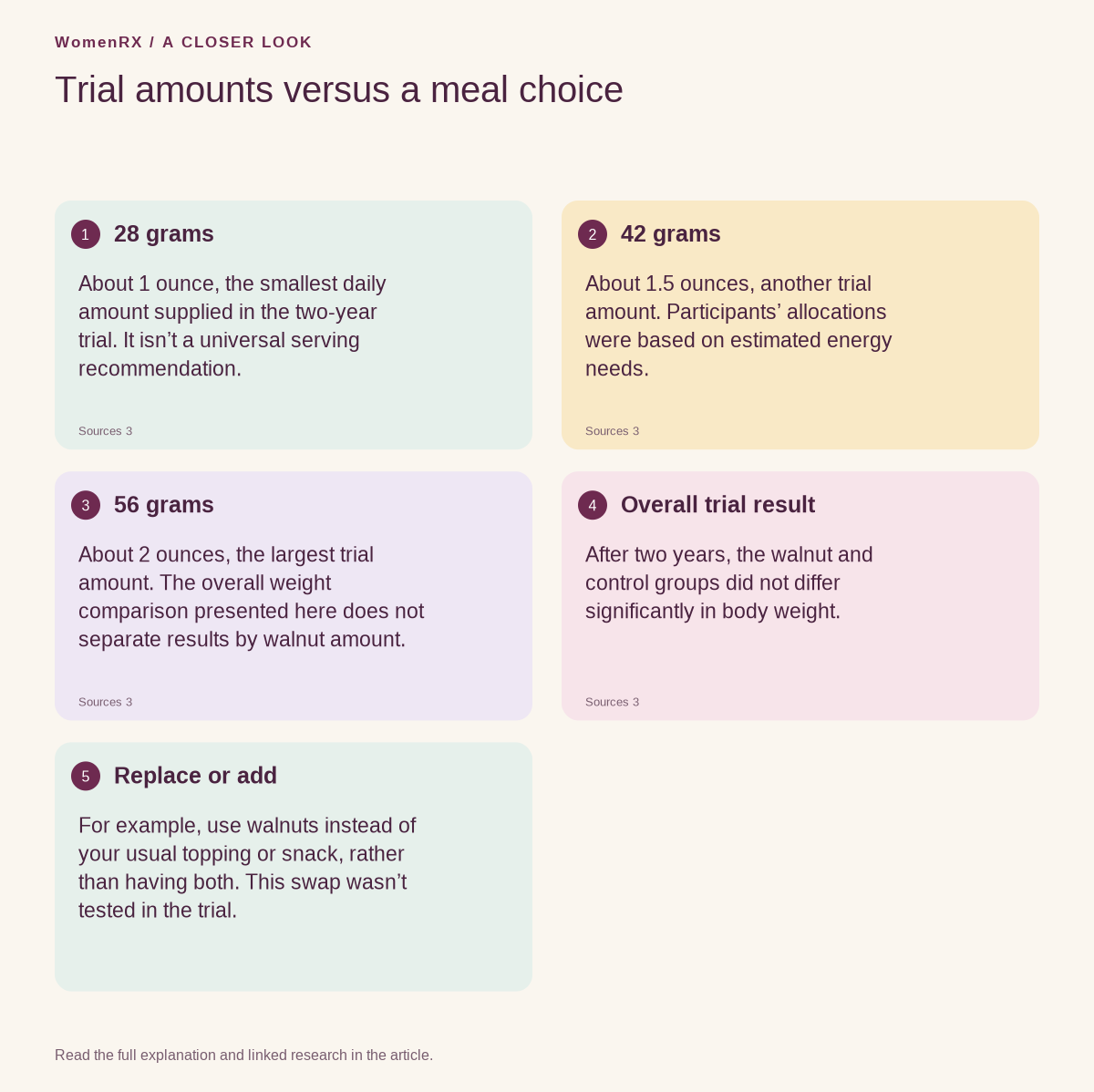
Trial amounts versus a meal choice
28 grams: About 1 ounce, the smallest daily amount supplied in the two-year trial. It isn’t a universal serving recommendation.3
42 grams: About 1.5 ounces, another trial amount. Participants’ allocations were based on estimated energy needs.3
56 grams: About 2 ounces, the largest trial amount. The overall weight comparison presented here does not separate results by walnut amount.3
Overall trial result: After two years, the walnut and control groups did not differ significantly in body weight.3
Replace or add: For example, use walnuts instead of your usual topping or snack, rather than having both. This swap wasn’t tested in the trial.
Read the figure as text
These measured amounts were supplied in an older-adult study, not set as a serving guide. The final comparison shows a practical choice the trial did not test.- 28 grams: About 1 ounce, the smallest daily amount supplied in the two-year trial. It isn’t a universal serving recommendation.3
- 42 grams: About 1.5 ounces, another trial amount. Participants’ allocations were based on estimated energy needs.3
- 56 grams: About 2 ounces, the largest trial amount. The overall weight comparison presented here does not separate results by walnut amount.3
- Overall trial result: After two years, the walnut and control groups did not differ significantly in body weight.3
- Replace or add: For example, use walnuts instead of your usual topping or snack, rather than having both. This swap wasn’t tested in the trial.
Sources you can check
- Obesity: MedlinePlusAccessed 2026-09-25Return to first citation
- Effects of walnut intake on anthropometric characteristics: A systematic review and dose-response meta-analysis of randomized controlled trials.Fang Z, Dang M, Zhang W, Wang Y, Kord-Varkaneh H, Nazary-Vannani A, O Santos H, Tan SC, C T Clark C, Zanghelini F, Borges do Nascimento IJ, Yang Y. · Complementary therapies in medicine · 2020Return to first citation
- Effects of Long-Term Walnut Supplementation on Body Weight in Free-Living Elderly: Results of a Randomized Controlled Trial.Bitok E, Rajaram S, Jaceldo-Siegl K, Oda K, Sala-Vila A, Serra-Mir M, Ros E, Sabaté J. · Nutrients · 2018Return to first citation