Does Glucomannan Help With Weight Management?
Short trials of glucomannan alone haven’t shown a meaningful weight-loss advantage, while a promising combination-fiber trial can’t tell us what glucomannan contributed.
Glucomannan is a water-absorbing fiber, but trials of glucomannan alone haven’t shown a significant weight-loss advantage over placebo. A longer trial found weight loss with a blend that also contained inulin and psyllium, so it can’t establish that glucomannan was responsible. If you’re considering it, check the product form and fluid directions, especially if you take medicines by mouth. 148
What the weight-loss studies actually tested
Glucomannan comes from the konjac plant. It absorbs water and forms a thick mixture, which helps explain why it’s marketed as a fiber that might make meals feel more filling. That mechanism is plausible; a change on the scale is a separate question. 4
The trials of glucomannan on its own are not persuasive for weight management. In one four-week study, 63 healthy men taking glucomannan did not lose significantly more weight than those taking a placebo. In another, 53 adults with overweight or obesity continued their usual eating and activity habits for eight weeks; glucomannan again did not significantly reduce weight compared with placebo. The NIH Office of Dietary Supplements summarizes its weight effect as little to none. The first trial studied only men, and the second does not establish a weight-loss benefit specifically in women. 1
A newer study offers a useful contrast, not a reversal of that finding. It randomized 112 adults with obesity who carried certain obesity-associated genetic variants to a blend of glucomannan, inulin, and psyllium or placebo, alongside a lifestyle intervention. After 180 days, the blend group’s body-weight change differed from the placebo group’s by 4.9 percentage points. Because the fibers were given together, the trial can’t identify glucomannan’s individual contribution. Its selected population and combination product also differ from the shorter glucomannan-only trials. The result does not establish how the blend works specifically for women. 8
The practical distinction: a label that highlights a successful fiber blend study hasn’t shown that a glucomannan-only product will do the same thing. Nor do these trials establish lasting weight loss after supplementation stops. 18
Constipation is a different reason to consider it
Glucomannan’s ability to hold water also makes bowel symptoms a reasonable subject of study, but constipation findings shouldn’t be counted as weight-loss evidence. An eight-week placebo-controlled trial found improvements in constipation symptoms and bowel-movement frequency among elite male Taekwondo athletes with functional constipation. That’s relevant to those athletes, not proof of the same benefit for women or for people without constipation. 45
Results in children show why it’s worth keeping the claim narrow. One small trial reported better constipation outcomes with glucomannan than placebo, while a later trial found no improvement in its main measure of treatment success. Neither study answers whether an adult woman will find it helpful for constipation. If bowel comfort is your main goal, judge the product against that goal rather than a weight-loss promise. 67
The form and your medicines change the decision
This fiber’s water-absorbing property has a less appealing side: tablet forms were linked to reported cases of esophageal obstruction. The NIH account identifies seven cases in Australia in 1984-1985. That history doesn’t mean every current product has the same risk, but it is a concrete reason not to treat tablets and powder mixed into water as interchangeable. Check the form before buying. If you’re considering a powder, follow that product’s mixing and fluid directions rather than taking it dry or guessing how much water to use. In the combination-fiber trial, participants dissolved the powder in a glass of water; that trial procedure is not a tested fluid rule for every glucomannan product. 148
Short-term digestive effects can include bloating, gas, loose stools, constipation, and abdominal discomfort. Glucomannan may also reduce absorption of medicines taken by mouth and has been reported to lower blood glucose, which could matter if you take diabetes medication. There isn’t one verified medicine-spacing interval that can be applied to every drug here. Before adding it to a routine that includes oral medicines, have a pharmacist check the specific product and your medication schedule rather than guessing at a gap between them. 1
Pregnancy and breastfeeding call for a different calculation. The weight studies above don’t establish glucomannan’s safety or usefulness for weight loss during either period. Pregnancy has specific nutritional demands, and breastfeeding supports an infant’s nutrition. If your weight is on your mind at either time, that broader nutritional picture deserves attention before an optional weight-loss supplement does. 1238
For most readers deciding on weight management alone, the choice is fairly clear: glucomannan by itself has not delivered a convincing weight benefit in the cited short trials. A blend may be a different proposition, but its results cannot be credited to glucomannan alone. 18
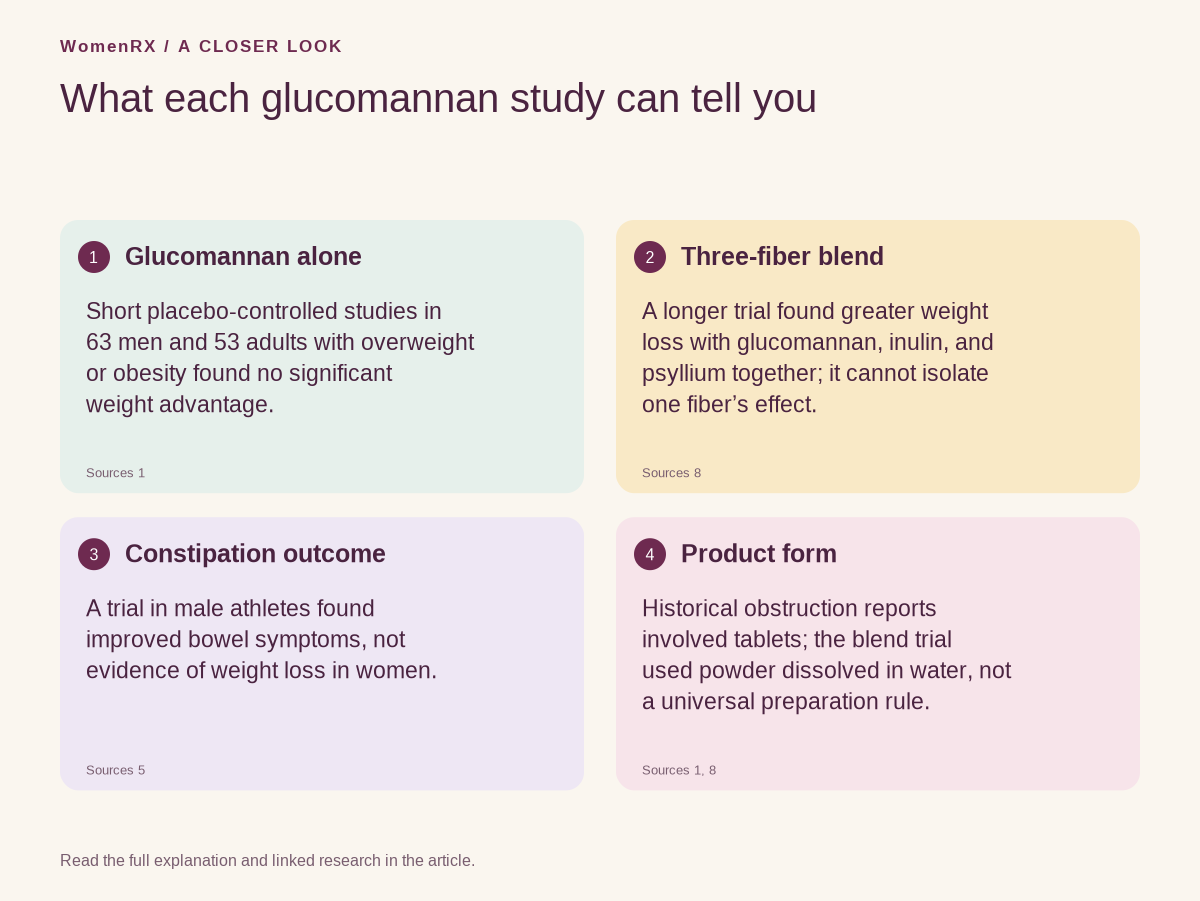
What each glucomannan study can tell you
Glucomannan alone: Short placebo-controlled studies in 63 men and 53 adults with overweight or obesity found no significant weight advantage.1
Three-fiber blend: A longer trial found greater weight loss with glucomannan, inulin, and psyllium together; it cannot isolate one fiber’s effect.8
Constipation outcome: A trial in male athletes found improved bowel symptoms, not evidence of weight loss in women.5
Product form: Historical obstruction reports involved tablets; the blend trial used powder dissolved in water, not a universal preparation rule.18
Read the figure as text
Study population, outcome, and preparation determine whether a finding helps answer a weight-management question.- Glucomannan alone: Short placebo-controlled studies in 63 men and 53 adults with overweight or obesity found no significant weight advantage.1
- Three-fiber blend: A longer trial found greater weight loss with glucomannan, inulin, and psyllium together; it cannot isolate one fiber’s effect.8
- Constipation outcome: A trial in male athletes found improved bowel symptoms, not evidence of weight loss in women.5
- Product form: Historical obstruction reports involved tablets; the blend trial used powder dissolved in water, not a universal preparation rule.18
Sources you can check
- Dietary Supplements for Weight Loss - Health Professional Fact SheetAccessed 2026-09-25Return to first citation
- Breastfeeding | Benefits of Breastfeeding | MedlinePlusAccessed 2026-09-25Return to first citation
- Dietary Supplements and Life Stages: Pregnancy - Health Professional Fact SheetAccessed 2026-09-25Return to first citation
- [Glucomannan: properties and therapeutic applications].González Canga A, Fernández Martínez N, Sahagún AM, García Vieitez JJ, Díez Liébana MJ, Calle Pardo AP, Castro Robles LJ, Sierra Vega M. · Nutricion hospitalaria · 2004Return to first citation
- Effects of konjac glucomannan on gastrointestinal symptoms and gut microbiota in athletes with functional constipation: a double-blind randomized controlled trial.Zhu Y, Chen X, Song G. · European journal of nutrition · 2025Return to first citation
- Glucomannan is not effective for the treatment of functional constipation in children: a double-blind, placebo-controlled, randomized trial.Chmielewska A, Horvath A, Dziechciarz P, Szajewska H. · Clinical nutrition (Edinburgh, Scotland) · 2011Return to first citation
- Fiber (glucomannan) is beneficial in the treatment of childhood constipation.Loening-Baucke V, Miele E, Staiano A. · Pediatrics · 2004Return to first citation
- The Impact of Glucomannan, Inulin, and Psyllium Supplementation (SolowaysTM) on Weight Loss in Adults with FTO, LEP, LEPR, and MC4R Polymorphisms: A Randomized, Double-Blind, Placebo-Controlled Trial.Pokushalov E, Ponomarenko A, Garcia C, Pak I, Shrainer E, Seryakova M, Johnson M, Miller R. · Nutrients · 2024Return to first citation