Glucomannan for Weight Loss: What the Evidence Shows
Glucomannan may help you feel full, but the better question is whether a specific product has shown meaningful weight change and can be taken safely.
Glucomannan is a water-absorbing fiber, but clinical results for weight loss are mixed. In one small, eight-week trial of glucomannan alone, participants did not lose significantly more weight than those taking a placebo. A longer trial found weight loss with a blend of three fibers, so it cannot show that glucomannan was responsible. Tablet-related esophageal obstruction and digestive symptoms also deserve attention. 1 2 3
What weight-loss studies actually show
Glucomannan absorbs water and may increase fullness. That makes appetite reduction a plausible explanation for why it’s marketed for weight management, but a plausible mechanism isn’t the same as a demonstrated, dependable weight-loss effect. The NIH Office of Dietary Supplements summarizes clinical trials of varying quality as showing little to no effect on body weight. 1
One randomized, placebo-controlled trial tested glucomannan on its own in 53 adults ages 18 to 65 with overweight or moderate obesity. After eight weeks, the glucomannan group had not lost significantly more weight than the placebo group. Researchers also found no significant group differences in body composition, hunger or fullness, or the measured blood lipids and glucose. This is a useful comparison because it tested the ingredient against a placebo, but it was a small, relatively short study. 3
A 2024 randomized trial reported a more favorable result after 180 days, but participants took glucomannan along with inulin and psyllium. The 112 participants had obesity and specified genetic variants. The result belongs to that particular blend and study group; it can’t tell you how much, if any, of the change came from glucomannan alone or whether it applies to people outside that group. 2
Taken together, these findings don’t support a reliable deadline such as “you’ll see results in a few weeks.” A study’s length tells you when researchers measured outcomes, not when an individual should expect weight loss. Be cautious when an advertisement promises a specific amount or speed without showing a comparable study of the same ingredient and product.
How to judge a product claim
When you see a weight-loss claim, look for the details that make the result interpretable:
- Was glucomannan tested alone? If it was combined with other fibers or ingredients, the effect of glucomannan itself is unclear. The NIH notes that supplement formulas and ingredient amounts can vary, which makes results harder to compare. 1 2
- Was there a control group? A change from a person’s starting weight isn’t enough to show the supplement caused it. A placebo comparison helps separate the supplement’s effect from changes that may happen over time.
- What outcome was measured, and when? Weight, body composition, and appetite are different outcomes. Check the study period and the difference between groups, not just whether one group changed from its starting point. 3
- Who was studied? The standalone trial included adults ages 18 to 65, but its reported results don’t separate women from men or describe results by menopause stage. The genetic-variant trial studied a selected group with obesity and a three-fiber blend. Neither establishes a distinct effect for women in cycling years, perimenopause, or postmenopause. 2 3
The US Food and Drug Administration doesn’t review or approve dietary supplements for safety and effectiveness before they’re marketed. Products can also vary in their ingredients and amounts. So a study of one preparation may not tell you what to expect from a different product on a store shelf. 1
Safety: form and digestion matter
Glucomannan can cause digestive symptoms, including loose stools, gas, diarrhea, constipation, and abdominal discomfort. In the standalone trial, belching, bloating, and stomach fullness were reported more often with glucomannan than placebo, although symptoms were transient and didn’t lead participants to stop the study. 1 3
The form matters, too. The NIH Office of Dietary Supplements flags glucomannan tablets for possible esophageal obstruction. This is a potentially serious swallowing risk, not just a question of whether the supplement feels comfortable. If swallowing pills is difficult for you, ask a pharmacist about the specific product and form before using it. Don’t assume safety results for one type of preparation apply to another. 1
In the standalone trial, participants took capsules with water, but that study protocol isn’t a safety guarantee for every product. Check the product’s full ingredient list and directions, and don’t treat a blended supplement as equivalent to glucomannan alone. If a claim depends on a blend, ask what evidence supports that exact combination rather than attributing the result to one ingredient. 1 3
A practical bottom line: regard glucomannan as a fiber supplement with uncertain weight-loss benefit, not a shortcut with a predictable timetable. Before choosing one, weigh the quality and relevance of the product’s evidence against its digestive effects and the swallowing risk of its form.
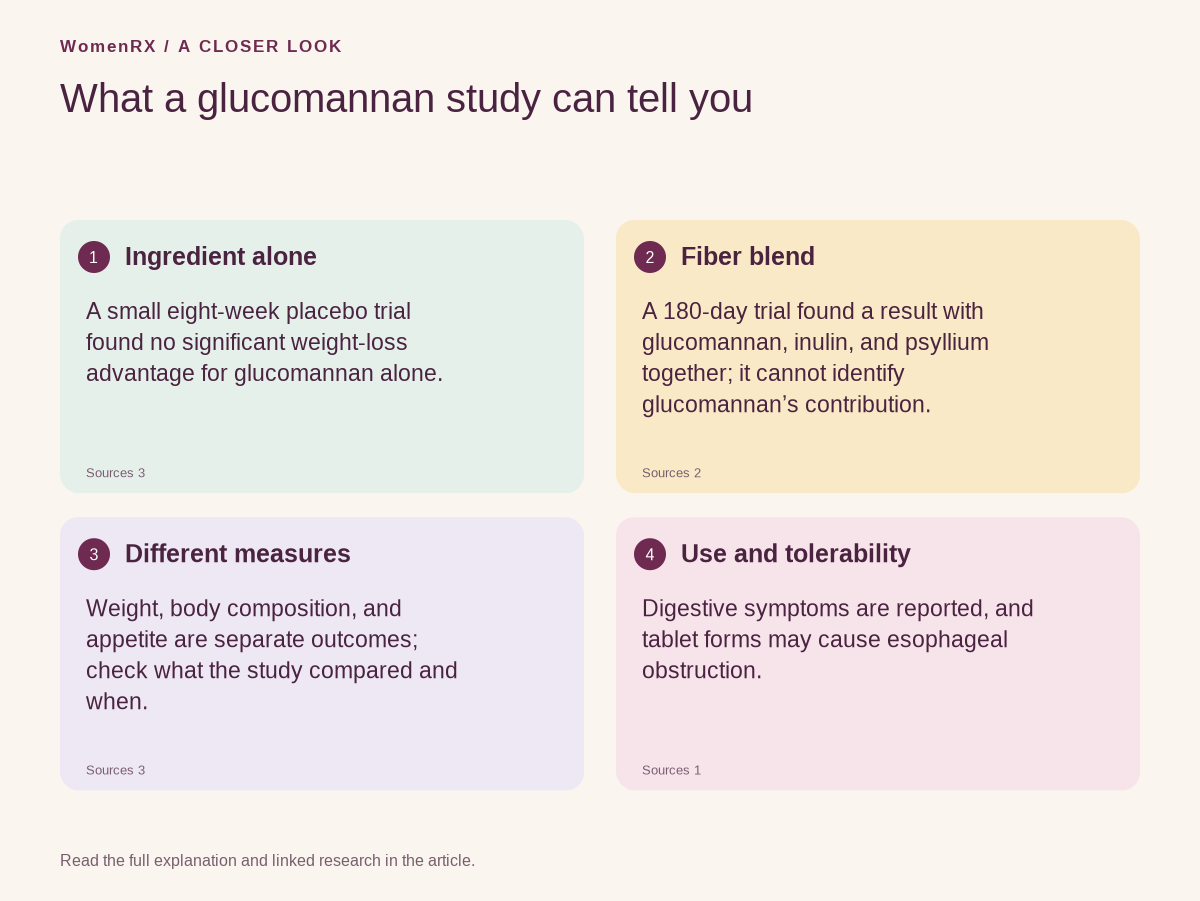
What a glucomannan study can tell you
Ingredient alone: A small eight-week placebo trial found no significant weight-loss advantage for glucomannan alone.3
Fiber blend: A 180-day trial found a result with glucomannan, inulin, and psyllium together; it cannot identify glucomannan’s contribution.2
Different measures: Weight, body composition, and appetite are separate outcomes; check what the study compared and when.3
Use and tolerability: Digestive symptoms are reported, and tablet forms may cause esophageal obstruction.1
Read the figure as text
Compare what each type of evidence measures with what it can, and cannot, say about a product or its safe use.- Ingredient alone: A small eight-week placebo trial found no significant weight-loss advantage for glucomannan alone.3
- Fiber blend: A 180-day trial found a result with glucomannan, inulin, and psyllium together; it cannot identify glucomannan’s contribution.2
- Different measures: Weight, body composition, and appetite are separate outcomes; check what the study compared and when.3
- Use and tolerability: Digestive symptoms are reported, and tablet forms may cause esophageal obstruction.1
More questions, answered
Does glucomannan work by making you feel full?
Increasing fullness is a proposed mechanism: glucomannan absorbs water and may prolong stomach emptying. That explanation doesn’t establish that taking it leads to meaningful weight loss; in one placebo-controlled trial, glucomannan alone did not produce significantly greater weight loss. 1 3
Do studies show a different effect for women?
The standalone trial reports results for adults ages 18 to 65 without separating outcomes by sex or menopause stage. These results don’t establish whether effects differ for women or across life stages. 3
Sources you can check
- Dietary Supplements for Weight Loss - Health Professional Fact SheetAccessed 2026-09-25Return to first citation
- The Impact of Glucomannan, Inulin, and Psyllium Supplementation (SolowaysTM) on Weight Loss in Adults with FTO, LEP, LEPR, and MC4R Polymorphisms: A Randomized, Double-Blind, Placebo-Controlled Trial.Pokushalov E, Ponomarenko A, Garcia C, Pak I, Shrainer E, Seryakova M, Johnson M, Miller R. · Nutrients · 2024Return to first citation
- Safety and efficacy of glucomannan for weight loss in overweight and moderately obese adults.Keithley JK, Swanson B, Mikolaitis SL, DeMeo M, Zeller JM, Fogg L, Adamji J. · Journal of obesity · 2013Return to first citation