When Should You Take Glucomannan?
The practical questions are how to take it with fluid and whether it overlaps with oral medicines, not simply morning versus night.
Glucomannan absorbs water, and a review cautions that taking viscous fiber supplements at the same time as some oral medicines may interfere with absorption.2 Supplements can also affect how medicines work more generally.3 There’s no established morning-versus-evening advantage. For fullness, before or with a meal is the relevant timing studied; follow your product’s directions for fluid and check medicine timing separately.2
Let your reason for taking it lead
If you’re deciding between breakfast and dinner, start with what you want glucomannan to do. It’s a konjac-derived soluble fiber that absorbs water and forms a thick mixture in the digestive tract. That helps explain why taking it before or with a meal is relevant to studies of fullness. It doesn’t establish that a morning dose works better than an evening one.2
If weight loss is your goal, timing isn’t a shortcut to a large effect. A systematic review of randomized, placebo-controlled trials found a small average weight difference for glucomannan versus placebo, below the review authors’ threshold for clinical significance. The review does not establish a best time of day.5
Water matters at the time you take it
Because glucomannan swells as it takes up water, adequate fluid is part of taking it safely, not an optional detail to fit in later. The directions on your particular powder, capsule, tablet, or mixed product matter: formulations differ, and the review does not provide one fluid amount that applies to all of them.2
That swelling also makes this more than a scheduling question if you have trouble swallowing, a known narrowing of the esophagus, severe delayed stomach emptying, or an intestinal obstruction. These are situations the review flags as potentially inappropriate for glucomannan or requiring careful supervision.2
Keep oral medicines in a separate decision
Viscous fiber supplements may interfere with the absorption of some oral medicines when taken at the same time. That’s a reason not to assume that swallowing glucomannan alongside a morning pill is convenient and harmless. It isn’t evidence that every medicine interacts with glucomannan, though, and the review does not establish one separation interval that works for every medicine.2 If a medicine has strict timing instructions, check its directions and ask a pharmacist how to fit your specific glucomannan product around it rather than moving the medicine on your own.
Pregnancy and breastfeeding change the safety question
If you’re pregnant, the question isn’t whether breakfast or dinner is better. Check before starting the supplement: pregnancy guidance advises discussing herbs and supplements before taking them, and glucomannan-specific pregnancy safety isn’t established by that guidance.1
If you’re breastfeeding, LactMed reports no data on glucomannan’s safety or effectiveness in nursing mothers or infants. It considers exposure through breast milk very unlikely because glucomannan itself is not absorbed, but that is not the same as a clinical safety study. Mixed-ingredient products add another reason to check what you’re taking.4
For most readers, the useful choice is therefore a meal that fits the product directions and doesn’t conflict with an oral medicine. Morning versus evening can follow your routine; water, swallowing safety, and medicine timing deserve the closer look.2
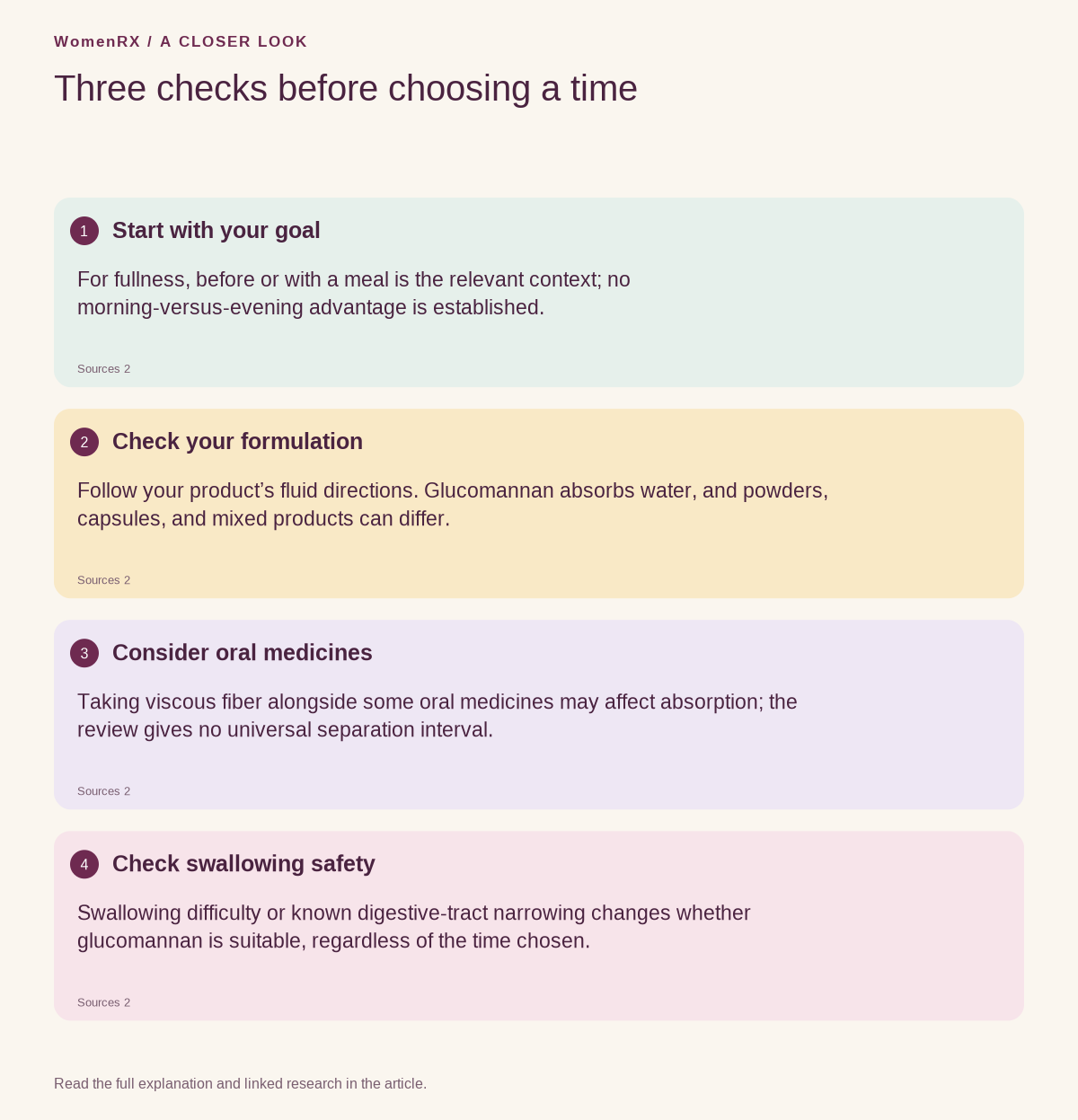
Three checks before choosing a time
Start with your goal: For fullness, before or with a meal is the relevant context; no morning-versus-evening advantage is established.2
Check your formulation: Follow your product’s fluid directions. Glucomannan absorbs water, and powders, capsules, and mixed products can differ.2
Consider oral medicines: Taking viscous fiber alongside some oral medicines may affect absorption; the review gives no universal separation interval.2
Check swallowing safety: Swallowing difficulty or known digestive-tract narrowing changes whether glucomannan is suitable, regardless of the time chosen.2
Read the figure as text
Use these distinctions to choose a practical time without treating morning or evening as a proven advantage.- Start with your goal: For fullness, before or with a meal is the relevant context; no morning-versus-evening advantage is established.2
- Check your formulation: Follow your product’s fluid directions. Glucomannan absorbs water, and powders, capsules, and mixed products can differ.2
- Consider oral medicines: Taking viscous fiber alongside some oral medicines may affect absorption; the review gives no universal separation interval.2
- Check swallowing safety: Swallowing difficulty or known digestive-tract narrowing changes whether glucomannan is suitable, regardless of the time chosen.2
Sources you can check
- Pregnancy and Medicines | MedlinePlusAccessed 2026-09-25Return to first citation
- Psyllium and Glucomannan as Viscous Fiber Modulators of the Gut-Microbiome-Incretin Axis: Molecular Links to Metabolic Inflammation, Barrier Function, and GLP-1 Receptor Agonist Therapy.Yoon Y, Hwang J, Yang CM, Moon M, Lee JJ, Lam KHS, Castro JC, Suryadi T, Suhaimi A, Lee J. · International journal of molecular sciences · 2026Return to first citation
- How Medications and Supplements Can Interact | NCCIHAccessed 2026-09-25Return to first citation
- Glucomannan2006Return to first citation
- Efficacy of dietary supplements containing isolated organic compounds for weight loss: a systematic review and meta-analysis of randomised placebo-controlled trials.Bessell E, Maunder A, Lauche R, Adams J, Sainsbury A, Fuller NR. · International journal of obesity (2005) · 2021Return to first citation