Glucomannan: What Timing and Water Really Change
A premeal schedule didn’t improve weight loss in one small trial, while water and swallowing ability remain central to safer use.
In an eight-week trial, adults took glucomannan capsules with 8 ounces of water one hour before meals, but they didn’t lose significantly more weight than the placebo group. 3 That schedule isn’t a universal instruction. Glucomannan absorbs water and expands, so don’t take a dry preparation or assume the trial’s routine is safe if you have trouble swallowing or intestinal narrowing. 23
Before meals isn’t a proven shortcut to weight loss
Glucomannan is a water-soluble fiber that absorbs water and expands in the digestive tract. That property helps explain why it’s marketed for fullness, but a plausible mechanism isn’t the same as a demonstrated weight-loss benefit. 3
In a randomized trial, 53 adults with overweight or obesity were assigned glucomannan or placebo capsules one hour before breakfast, lunch, and dinner, each time with 8 ounces of water. After eight weeks, the groups did not differ significantly in weight loss or reported hunger and fullness. The trial tells you what was tested, not the best time to take every glucomannan product. 3
Water and swallowing come before timing
A supplement that expands when wet needs careful attention to its form and fluid directions. Don’t swallow glucomannan dry or treat the trial’s 8 ounces as a guaranteed safe amount for every product. Dehydrated konjac products intended to rehydrate after swallowing have also drawn a specific safety concern in a European food-additive assessment. 23
The concern is especially practical if you have difficulty swallowing: an expanding preparation could be hard to get down or pass through a narrowed area. The weight-loss trial excluded people with swallowing difficulty and those with intestinal narrowing or obstruction, so its finding that participants generally tolerated the capsules doesn’t establish safety for people with those conditions. If either applies to you, check whether glucomannan is appropriate before using it rather than relying on a capsule-and-water routine. 3
Even when swallowing isn’t a problem, glucomannan may not feel comfortable. A European assessment reported abdominal discomfort, including diarrhea or constipation, in some adults taking glucomannan in a 12-week study. That study’s amount isn’t a suggested dose. 2
Keep medicine timing a separate question
“One hour before meals” describes meal timing in the weight-loss trial. It does not mean one hour away from an oral medicine. That trial did not establish a drug interaction or test a spacing interval. If you take an oral medicine with timing instructions, check the directions for both products and ask a pharmacist about that specific combination rather than guessing a number of hours. 3
If your goal is bowel function
Weight-loss results don’t answer a constipation question. A review of three randomized trials involving 122 children with constipation found more frequent bowel movements with glucomannan, but no significant improvement in stool consistency or overall treatment success. Those findings don’t establish that it will relieve constipation in adult women. 1
Pregnancy, breastfeeding, and recent birth change the decision
During pregnancy: The adult weight-loss trial excluded pregnant participants. Its premeal schedule and findings therefore don’t establish whether glucomannan is safe or useful in pregnancy. A weight-loss routine shouldn’t be carried into pregnancy on the strength of that study. 3
While breastfeeding: Lactating participants were also excluded. The trial cannot answer whether taking glucomannan while breastfeeding is appropriate, whether the goal is fullness or bowel function. 3
After birth: People less than six months postpartum were excluded as well. That cutoff was a trial eligibility rule, not a finding that weight-focused supplement use becomes appropriate afterward. If constipation is the concern, it makes more sense to address that question directly than to borrow a weight-loss schedule that wasn’t studied in this period. 3
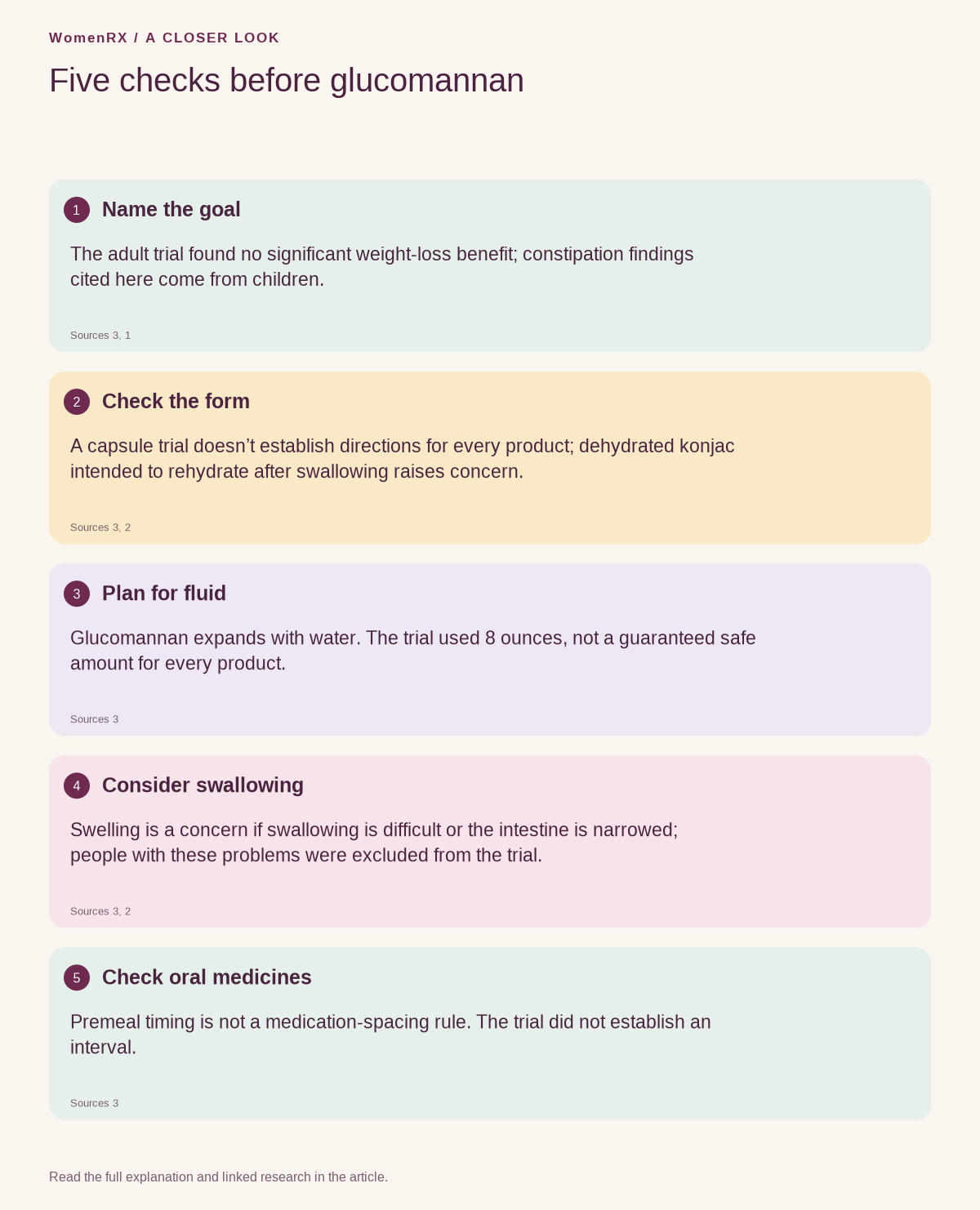
Five checks before glucomannan
Name the goal: The adult trial found no significant weight-loss benefit; constipation findings cited here come from children.31
Check the form: A capsule trial doesn’t establish directions for every product; dehydrated konjac intended to rehydrate after swallowing raises concern.32
Plan for fluid: Glucomannan expands with water. The trial used 8 ounces, not a guaranteed safe amount for every product.3
Consider swallowing: Swelling is a concern if swallowing is difficult or the intestine is narrowed; people with these problems were excluded from the trial.32
Check oral medicines: Premeal timing is not a medication-spacing rule. The trial did not establish an interval.3
Read the figure as text
The trial’s premeal routine answers only part of the question. These checks show what else changes the decision.- Name the goal: The adult trial found no significant weight-loss benefit; constipation findings cited here come from children.31
- Check the form: A capsule trial doesn’t establish directions for every product; dehydrated konjac intended to rehydrate after swallowing raises concern.32
- Plan for fluid: Glucomannan expands with water. The trial used 8 ounces, not a guaranteed safe amount for every product.3
- Consider swallowing: Swelling is a concern if swallowing is difficult or the intestine is narrowed; people with these problems were excluded from the trial.32
- Check oral medicines: Premeal timing is not a medication-spacing rule. The trial did not establish an interval.3
Sources you can check
- Effect of glucomannan on functional constipation in children: a systematic review and meta-analysis of randomised controlled trials.Han Y, Zhang L, Liu XQ, Zhao ZJ, Lv LX. · Asia Pacific journal of clinical nutrition · 2017Return to first citation
- Re-evaluation of konjac gum (E 425 i) and konjac glucomannan (E 425 ii) as food additives.EFSA Panel on Food Additives and Nutrient Sources added to Food (ANS), Mortensen A, Aguilar F, Crebelli R, Di Domenico A, Frutos MJ, Galtier P, Gott D, Gundert-Remy U, Lambré C, Le... · EFSA journal. European Food Safety Authority · 2017Return to first citation
- Safety and efficacy of glucomannan for weight loss in overweight and moderately obese adults.Keithley JK, Swanson B, Mikolaitis SL, DeMeo M, Zeller JM, Fogg L, Adamji J. · Journal of obesity · 2013Return to first citation