Glucomannan After 40: Does Age Change the Evidence?
Some glucomannan studies included women in their 40s, but they don’t show that it works differently after 40 or during menopause.
There’s no clear evidence that being over 40 or going through menopause makes glucomannan more effective. Studies included some midlife adults, but generally didn’t report menopause status or compare results by age. For weight, an NIH evidence summary finds little to no effect overall. Cholesterol findings are less conclusive, so glucomannan shouldn’t be treated as a proven substitute for cholesterol care. 2 6 7
What “after 40” means in the studies
Glucomannan is a soluble fiber from konjac. It absorbs water and may increase fullness, but a plausible effect on appetite doesn’t establish meaningful or lasting weight loss. The NIH Office of Dietary Supplements summarizes weight-loss trials of glucomannan as showing little to no effect on body weight overall. 2
The age question is harder to answer than supplement marketing suggests. One study of a glucomannan-containing diet included women ages 18 to 52, with an average age of about 33. It reported results for women and men, but didn’t report menopause status or whether results differed for participants over 40. 7 Another randomized trial included 66 women among 83 adults, but its abstract doesn’t give participants’ ages or menopause status. 6
So these studies offer some overlap with midlife, not direct evidence about perimenopause or menopause. They don’t show that age changes the effect, or that glucomannan treats menopause-related weight changes.
Weight results depend on what else was happening
The overall evidence summary matters more than an isolated positive result. For example, one short trial reported weight loss among overweight adults taking glucomannan while following a calorie-restricted diet. That result doesn’t establish what glucomannan does on its own, or whether it applies to women after 40. 5
A different randomized study found no significant difference between the glucomannan and placebo groups in its main comparisons. Favorable differences appeared only after researchers separated participants by reported adherence. That subgroup finding is less decisive than a clear difference in the main analysis. The study also didn’t report a menopause-specific result. 6
In another study, adults followed a diet supplemented with glucomannan, with or without exercise. Women lost weight in both groups, but because both groups received glucomannan, the design can’t show whether the fiber itself caused the change. 7 Taken together, these trials don’t justify choosing glucomannan specifically for midlife weight gain.
Cholesterol is a separate question
Glucomannan has also been studied for blood lipids, but these studies don’t establish a dependable cholesterol-lowering effect in women over 40. In the trial described above, differences in total and LDL cholesterol were reported only in the adherence-based subgroup, not in the overall primary comparison. 6 The exercise study measured cholesterol too, but everyone received glucomannan as part of the diet, so it can’t isolate the fiber’s effect. 7
After menopause, women’s cholesterol risk can change. That makes a measured lipid panel more useful than assuming a supplement will address the change. Cholesterol is assessed with a blood test, and the right response depends on the results and a person’s other risk factors. 1 4
If you’re weighing whether to try it
Start with the outcome you care about. For weight, the NIH’s overall assessment finds little to no effect, and there’s no demonstrated extra benefit after 40. For cholesterol, this research is not strong enough to rely on glucomannan as a treatment. Either way, an age-based claim isn’t a reason to expect a different result.
Also check the product form. The NIH fact sheet flags a risk of esophageal obstruction with glucomannan tablets. Other reported side effects include loose stools, gas, diarrhea, constipation, and abdominal discomfort. 2
If your concern is cholesterol, use a lipid-panel result and your overall risk as the starting point. If it’s weight, consider the whole picture rather than treating a midlife change as proof that you need a particular supplement. Body weight alone doesn’t describe health, and it can reflect muscle, bone, fat, and water. 3
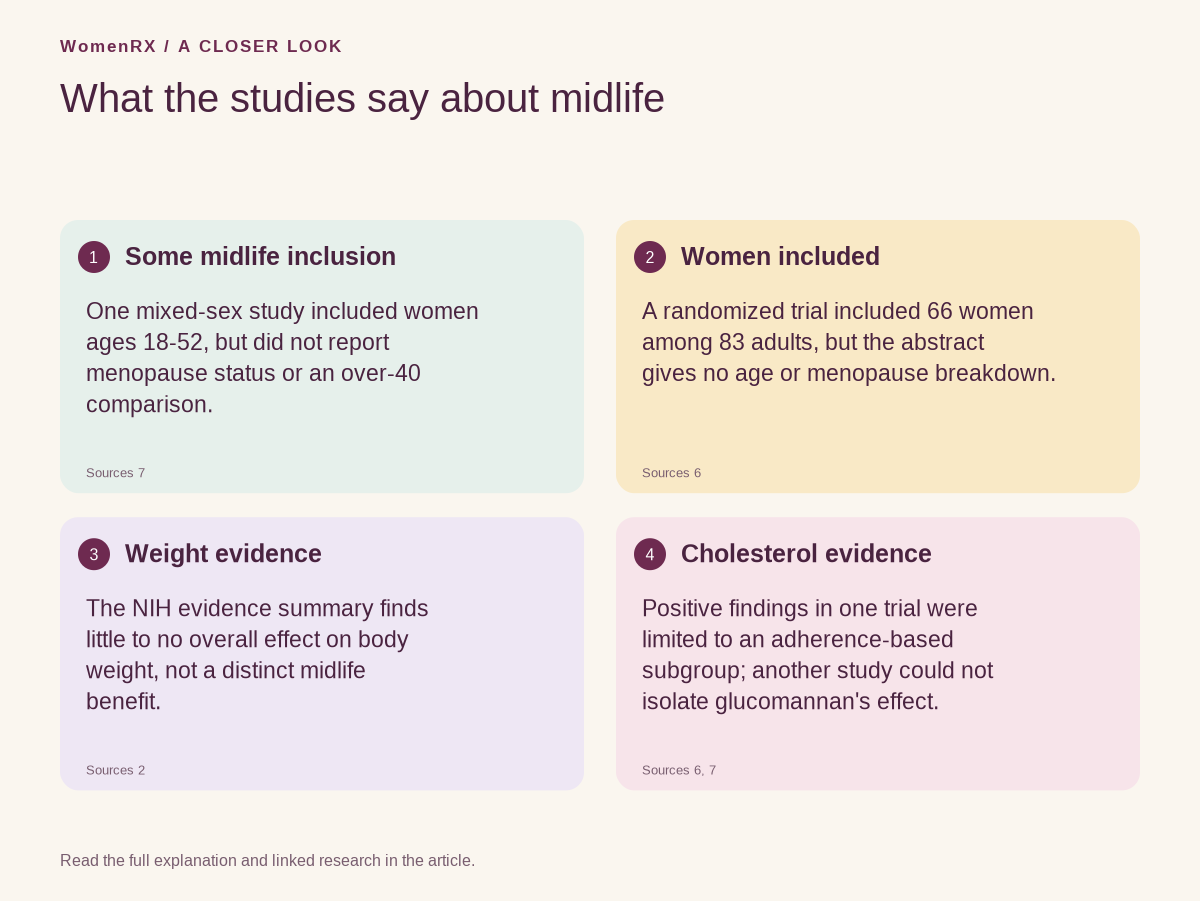
What the studies say about midlife
Some midlife inclusion: One mixed-sex study included women ages 18-52, but did not report menopause status or an over-40 comparison.7
Women included: A randomized trial included 66 women among 83 adults, but the abstract gives no age or menopause breakdown.6
Weight evidence: The NIH evidence summary finds little to no overall effect on body weight, not a distinct midlife benefit.2
Cholesterol evidence: Positive findings in one trial were limited to an adherence-based subgroup; another study could not isolate glucomannan's effect.67
Read the figure as text
The key distinction is whether a study merely included some midlife adults or actually reported outcomes by age or menopause status.- Some midlife inclusion: One mixed-sex study included women ages 18-52, but did not report menopause status or an over-40 comparison.7
- Women included: A randomized trial included 66 women among 83 adults, but the abstract gives no age or menopause breakdown.6
- Weight evidence: The NIH evidence summary finds little to no overall effect on body weight, not a distinct midlife benefit.2
- Cholesterol evidence: Positive findings in one trial were limited to an adherence-based subgroup; another study could not isolate glucomannan's effect.67
More questions, answered
Did glucomannan trials study menopausal women specifically?
These studies include some midlife adults, but they don’t report menopause status or a menopause-specific result. That means they can’t tell us whether the effect differs during perimenopause or after menopause. 6 7
Could glucomannan replace cholesterol medicine?
Research described here doesn’t establish glucomannan as a reliable cholesterol treatment. Cholesterol is measured with a blood test, and treatment decisions depend on the result and other risk factors. 1 4 6
Sources you can check
- Cholesterol Levels: What You Need to Know: MedlinePlusAccessed 2026-09-25Return to first citation
- Dietary Supplements for Weight Loss - Health Professional Fact SheetAccessed 2026-09-25Return to first citation
- Body Weight: MedlinePlusAccessed 2026-09-25Return to first citation
- Cholesterol | MedlinePlusAccessed 2026-09-25Return to first citation
- Experiences with three different fiber supplements in weight reduction.Birketvedt GS, Shimshi M, Erling T, Florholmen J. · Medical science monitor : international medical journal of experimental and clinical research · 2005Return to first citation
- Konjac Glucomannan Dietary Supplementation Causes Significant Fat Loss in Compliant Overweight Adults.Kaats GR, Bagchi D, Preuss HG. · Journal of the American College of Nutrition · 2015Return to first citation
- Effect of adding exercise to a diet containing glucomannan.Kraemer WJ, Vingren JL, Silvestre R, Spiering BA, Hatfield DL, Ho JY, Fragala MS, Maresh CM, Volek JS. · Metabolism: clinical and experimental · 2007Return to first citation