Quercetin After 40: Does Age Change the Evidence?
Human trial results don’t establish that being over 40, or being in menopause, makes quercetin more beneficial.
Being over 40 doesn’t by itself make quercetin a better-supported choice. Human trials examine specific situations, such as gingivitis or long COVID, rather than age-related or menopausal health; these reports don’t establish a perimenopause or postmenopause result. Start with your health goal, then check whether the people, product and outcome studied match it. 3 4
Age isn’t the reason to take it
Quercetin is a plant flavonoid, but that doesn’t mean a supplement has a proven role in the changes that can come with aging or menopause. The cited human trials don’t test whether women over 40 benefit more than younger women, or report results separately for perimenopausal or postmenopausal participants. 1 2 3 4
That distinction matters: a study of a particular condition can’t show that quercetin is useful as a general “over 40” supplement. A more useful starting point is a specific health goal, followed by checking whether the form of quercetin and the people studied match your situation.
What the human trials actually tested
The examples differ in both population and product. A small trial of 45 dental students aged 18-27 tested a quercetin mouthwash for gingivitis over 30 days. It reported improvements in gingival scores compared with placebo, but this topical treatment in young adults doesn’t establish a benefit from taking an oral supplement after 40. The study also did not formally test whether quercetin was no worse than chlorhexidine. 3
A randomized trial in 110 healthy men, with an average age of about 27 and an age range of 20-40, studied a quercetin-containing bar during ascent to high altitude. Its results concern acute mountain sickness in that setting, not menopause or routine health after 40. 2
Other studies offer little help with an age-specific decision. A small, uncontrolled study followed 15 adults with long COVID taking quercetin together with curcumin; because there was no comparison group and two ingredients were combined, it can’t show what quercetin alone did or whether age or menopause changes its effects. 4 In a randomized trial of adults with autism, the between-group difference in the main social-responsiveness outcome was not statistically significant. The report doesn’t establish a separate result for women over 40. 1
A dental rinse, a high-altitude bar and an uncontrolled combination study answer different questions; none tested quercetin for menopause symptoms or whether age creates a special need for it. They also don’t settle whether it might help a particular person for a particular condition.
Does the quercetin study match your reason for taking it?
Name the goal. Are you considering quercetin for a diagnosed condition, a symptom, or general wellness? The examples above don’t support taking it just because you’ve turned 40 or reached menopause.
Check whether the match is close. Compare the condition, product form, and outcome studied with what you’re considering. A mouthwash trial doesn’t establish what an oral capsule does; a study during high-altitude travel doesn’t answer a question about everyday symptoms. 2 3
Make medicines part of the discussion. These trial reports don’t provide dependable guidance about combining quercetin supplements with prescription or over-the-counter medicines. That’s not proof that combinations are safe. If you take medicines, you could bring the full product label to a pharmacist or prescriber and ask whether anything on it raises a concern alongside what you take. The trials’ different product forms aren’t interchangeable evidence. 1 2 3 4
If the goal is menopause-related, look for evidence that actually measures that symptom in people at a similar life stage. The cited trial results don’t provide that comparison. For now, age alone isn’t a research-based reason to add quercetin.
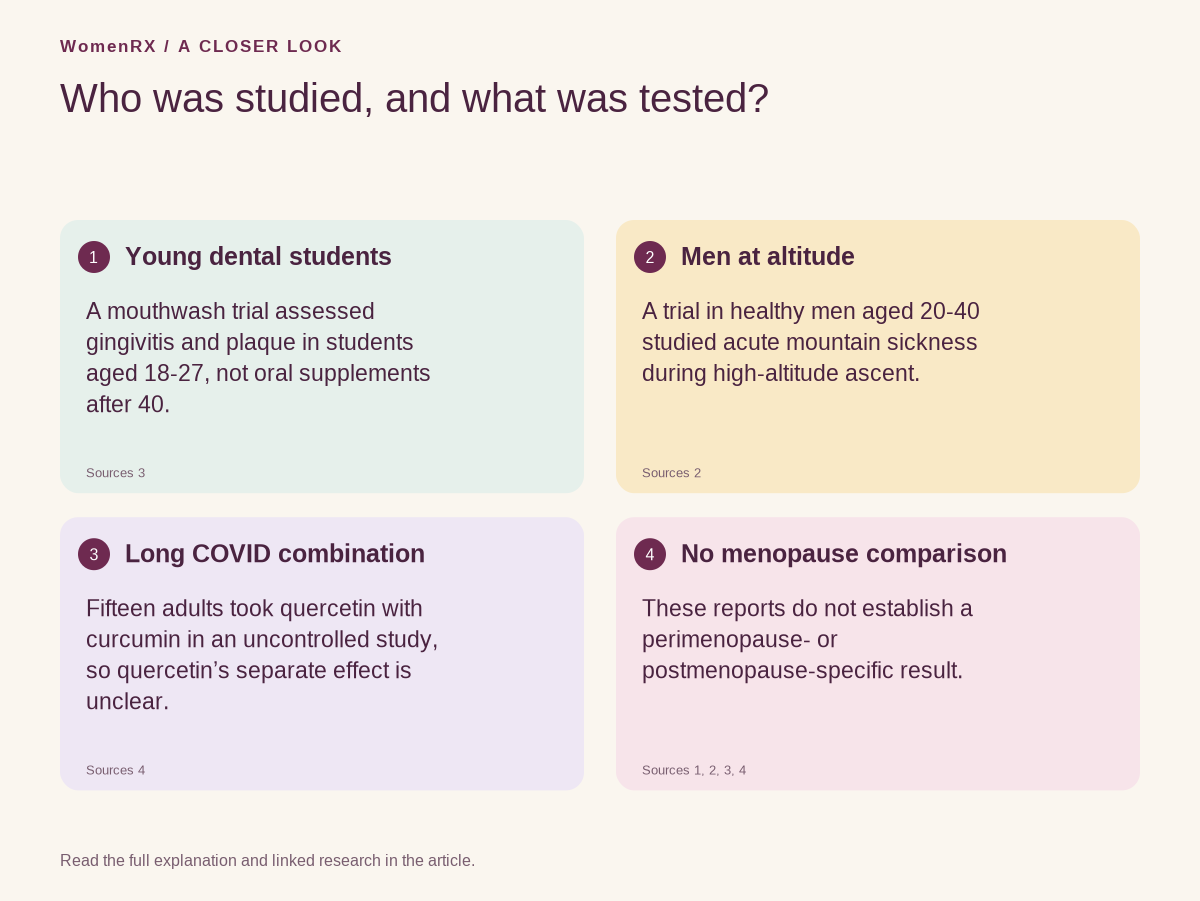
Who was studied, and what was tested?
Young dental students: A mouthwash trial assessed gingivitis and plaque in students aged 18-27, not oral supplements after 40.3
Men at altitude: A trial in healthy men aged 20-40 studied acute mountain sickness during high-altitude ascent.2
Long COVID combination: Fifteen adults took quercetin with curcumin in an uncontrolled study, so quercetin’s separate effect is unclear.4
No menopause comparison: These reports do not establish a perimenopause- or postmenopause-specific result.1234
Read the figure as text
These examples show why results from a specific group or product cannot establish a menopause or over-40 benefit.- Young dental students: A mouthwash trial assessed gingivitis and plaque in students aged 18-27, not oral supplements after 40.3
- Men at altitude: A trial in healthy men aged 20-40 studied acute mountain sickness during high-altitude ascent.2
- Long COVID combination: Fifteen adults took quercetin with curcumin in an uncontrolled study, so quercetin’s separate effect is unclear.4
- No menopause comparison: These reports do not establish a perimenopause- or postmenopause-specific result.1234
Sources you can check
- Assessment of the Efficacy of Quercetin in Adult Patients With Autism Spectrum Disorder: A Randomized, Triple-Blind, Placebo-Controlled Trial.Rezaeifar A, Motamed M, Mohebbi N. · Human psychopharmacology · 2026Return to first citation
- Quercetin prophylaxis in prevention of acute mountain sickness (AMS): a randomized, double blind, placebo controlled phase-II clinical trials.Sagi SSK, Kirar V, Prasad J, Singh S, Rathi V, Sultana K, Singh VK, Verma SK, Kumar D, Kumar V, Saxena S, Mishra R, Singh VV, Chopra S, Varshney R. · European journal of nutrition · 2026Return to first citation
- Quercetin as a Natural Adjunct in Managing Plaque and Gingivitis in Adults: A Randomized Controlled Trial.Rawal A, Asawa K, Das SS, Gadhia D, Sharma D, Pathak P. · Cureus · 2026Return to first citation
- Potential Adjunctive Effects of Quercetin-Curcumin Co-Supplementation in Adults with Mild-to-Moderate Long COVID: Results from a Pragmatic Exploratory Real-World Clinical Study.Khan A, Rabbani F, Mumtaz SU, Javed R, Ujjan I, Kanwal A, Conti G. · Pharmaceuticals (Basel, Switzerland) · 2026Return to first citation