Vitamin C After 40: Does Age Change Your Need?
For most women, turning 40 or reaching menopause doesn’t change the recommended vitamin C intake; your usual food intake matters more.
For nonsmoking, nonpregnant women, the U.S. recommended dietary allowance for vitamin C is 75 mg a day from age 19 onward, with no separate target listed after 40 or menopause. People who smoke need 35 mg more per day. A supplement may help if your diet regularly provides little vitamin C, but age alone isn’t a reason to add one. 1
The target doesn’t rise at 40
The U.S. recommended dietary allowance (RDA) for vitamin C is 75 mg a day for nonsmoking women age 19 and older. The guidance gives the same target for women in their 20s, 40s, and later adulthood, rather than setting a higher amount for perimenopause or menopause. People who smoke need 35 mg more vitamin C per day than people who don’t. Pregnancy and breastfeeding also have different targets, but those are separate life stages, not age-related increases. 1
That means a supplement isn’t automatically worthwhile just because you’ve passed 40 or your periods have changed. The practical question is whether your typical diet provides enough vitamin C. The RDA is a planning target for healthy people, not a personalized test of your vitamin status. 1
Food can cover the target
Vitamin C is found in many familiar foods. One medium orange provides about 70 mg; half a cup of raw red pepper provides 95 mg, and three-quarters of a cup of orange juice provides 93 mg. Those examples show why a varied diet can meet the target without a dedicated vitamin C pill. 1
A simple way to assess your routine is to look at what you eat across a usual day or two, rather than judging by one meal. Do fruit or vegetables such as peppers, broccoli, strawberries, or kiwifruit show up regularly? If so, you may already be getting a useful amount. Cooking and prolonged storage can reduce vitamin C in foods, so fresh or gently cooked options can help preserve it. 1
There’s no need to make this an exact daily tally if you eat a varied diet. But if your meals are often limited, you avoid most fruits and vegetables, or low appetite makes it hard to eat enough, checking your intake can be more useful than relying on an age-based supplement claim.
What age-related evidence can and can’t tell you
The U.S. intake guidance lists no separate vitamin C target for perimenopause or menopause. That recommendation doesn’t mean an individual’s food intake can’t change with age: appetite or food choices can affect what someone actually eats, without showing that the recommended requirement has increased. 1
For example, a cross-sectional study of 583 community-dwelling older adults in Japan found that poor appetite was associated with insufficient vitamin C intake relative to that country’s recommendations. It can’t show that poor appetite caused low intake, and it doesn’t establish a menopause-specific need or a supplement benefit for U.S. women over 40. It does support a practical distinction: if eating less is the issue, look at the diet and appetite rather than assuming age itself raises the requirement. 2
Read the label, not the age-based pitch
If you’re considering a supplement, check milligrams per serving and the serving size. The U.S. adult Daily Value on labels is 90 mg. That’s a label-comparison reference, not the same as the 75 mg RDA for nonsmoking adult women or the higher intake recommended for people who smoke. A product showing 100% Daily Value therefore isn’t a personalized target, and it doesn’t mean every woman needs that amount from a pill. 1
Also check whether a multivitamin or another product you take already contains vitamin C. Add the amounts together before deciding whether a separate product would fill a real gap. The most common supplement form, ascorbic acid, has bioavailability equivalent to vitamin C from food; the evidence summarized in the NIH reference does not establish that a specialty form is necessary for most people. 1
The clearest reason to consider a supplement is a consistent shortfall in your usual diet, not the number on your birthday cake or a menopause marketing claim. If you eat little or have difficulty eating enough, focus first on the specific barrier and on practical vitamin C-rich foods you can manage. If you’re pregnant or breastfeeding, use the separate life-stage guidance rather than the standard adult target. 1
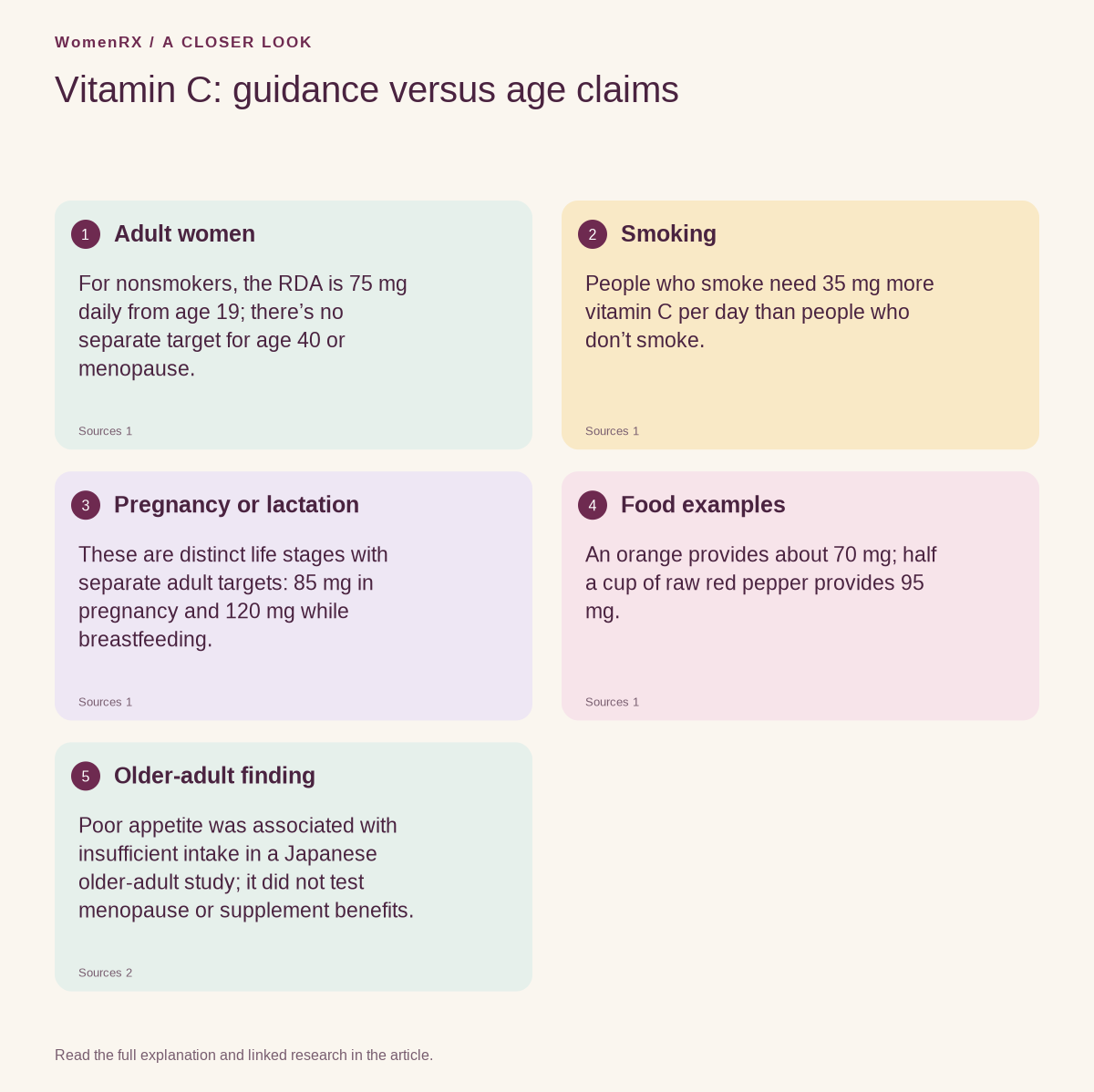
Vitamin C: guidance versus age claims
Adult women: For nonsmokers, the RDA is 75 mg daily from age 19; there’s no separate target for age 40 or menopause.1
Smoking: People who smoke need 35 mg more vitamin C per day than people who don’t smoke.1
Pregnancy or lactation: These are distinct life stages with separate adult targets: 85 mg in pregnancy and 120 mg while breastfeeding.1
Food examples: An orange provides about 70 mg; half a cup of raw red pepper provides 95 mg.1
Older-adult finding: Poor appetite was associated with insufficient intake in a Japanese older-adult study; it did not test menopause or supplement benefits.2
Read the figure as text
These distinctions separate the established adult intake target from other intake considerations, food sources, and what older-adult research can actually show.- Adult women: For nonsmokers, the RDA is 75 mg daily from age 19; there’s no separate target for age 40 or menopause.1
- Smoking: People who smoke need 35 mg more vitamin C per day than people who don’t smoke.1
- Pregnancy or lactation: These are distinct life stages with separate adult targets: 85 mg in pregnancy and 120 mg while breastfeeding.1
- Food examples: An orange provides about 70 mg; half a cup of raw red pepper provides 95 mg.1
- Older-adult finding: Poor appetite was associated with insufficient intake in a Japanese older-adult study; it did not test menopause or supplement benefits.2
More questions, answered
Does menopause change the vitamin C recommendation?
The U.S. intake guidance lists one RDA for nonpregnant women age 19 and older and doesn’t give a separate target for perimenopause or menopause. People who smoke need 35 mg more vitamin C per day than people who don’t. 1
Is vitamin C from a supplement absorbed differently from food?
The NIH reference says ascorbic acid in supplements has bioavailability equivalent to ascorbic acid naturally present in foods. It doesn’t establish that a specialty supplement form is needed for most people. 1
Sources you can check
- Vitamin C - Health Professional Fact SheetAccessed 2026-09-25Return to first citation
- Association between Poor Appetite and Nutrient Intake in Community-Dwelling Older Adults: The Otassha Study.Mikami Y, Motokawa K, Shirobe M, Iwasaki M, Gomi T, Hayakawa M, Käläntär L, Sakata Y, Watanabe Y, Kawai H, Obuchi S, Fujiwara Y, Ihara K, Hirano H. · JMA journal · 2026Return to first citation