Vitamin C Needs for Women: Food, Pregnancy, and Supplements
For most women, everyday foods can cover vitamin C needs, while pregnancy, breastfeeding, and smoking change the daily reference amount.
For women 19 and older, the recommended daily amount is 75 mg of vitamin C. It rises to 85 mg during pregnancy and 120 mg while breastfeeding; smoking adds 35 mg to the relevant amount. A medium orange provides about 70 mg, so check what you usually eat before deciding a supplement is needed. 1
The daily target is higher than the deficiency threshold
For adult women, the recommended dietary allowance (RDA) is 75 mg a day. It’s 65 mg for girls ages 14-18, 85 mg during pregnancy at age 19 or older, and 120 mg while breastfeeding. For pregnancy and breastfeeding at ages 14-18, the respective amounts are 80 mg and 115 mg. People who smoke need 35 mg more per day than people who don’t smoke, added to the relevant age or life-stage amount. 1
The RDA is a planning target intended to meet the needs of nearly all healthy people. It’s not the minimum amount that prevents scurvy: overt deficiency can occur after intake stays below about 10 mg a day for many weeks. That low threshold is a warning about deficiency, not a useful daily goal. 1
A few familiar foods can add up
Vitamin C comes mainly from fruits and vegetables. A medium orange has about 70 mg; half a cup of raw red pepper has 95 mg; and three-quarters of a cup of orange juice has 93 mg. Other options include kiwi, strawberries, broccoli, and Brussels sprouts. 1
For example, an orange plus half a cup of sliced strawberries provides about 119 mg. That’s more than the usual adult-woman target, but it’s still a food example, not a reason to aim for a particular total. Look at your overall eating pattern rather than assuming you need a pill because one meal is low in vitamin C. 1
Vitamin C dissolves in water and can be reduced by heat and prolonged storage. If you cook vegetables, steaming or microwaving may reduce losses compared with longer cooking. You don’t need to make every source raw: cooked broccoli and Brussels sprouts still provide vitamin C. 1
When a supplement may be worth considering
If your usual diet regularly falls short of the amount for your age and life stage, a supplement can help fill that gap. The common supplemental form, ascorbic acid, has bioavailability equivalent to vitamin C from food. Check the amount in the product and count it alongside what you eat, rather than treating a large dose as automatically better. 1
The NIH fact sheet reports that cells appear to be saturated at daily intakes around 100 mg, and that plasma vitamin C rises only marginally at intakes of 200 mg or more. Those observations don’t establish that a larger supplement improves skin, immunity, or another outcome. They do help explain why a high-dose product isn’t the default choice when food already covers your reference amount. 1
Pregnancy deserves a little extra attention, but it doesn’t mean every pregnant woman needs a separate vitamin C pill. In a national US survey analysis of 1,003 pregnant women ages 20-40, 11.5% had total usual vitamin C intake from foods and supplements below the Estimated Average Requirement (EAR). The EAR is a population assessment benchmark, not a way to diagnose an individual’s deficiency. The finding suggests that most women in this sample were above that benchmark, while some may have had room to improve their intake. 2
If you’re pregnant or breastfeeding, compare your usual foods and any supplement you already take with the relevant amount above. If you smoke, remember that the reference amount increases by 35 mg. These are planning values, not individualized treatment instructions. 1
What a bigger dose does, and doesn’t, tell you
A supplement label showing far more than your daily target isn’t evidence that you need that amount. Compare the dose on the label with vitamin C from your usual foods and your life-stage reference amount to see whether it fills a gap. The RDA is a target for planning intake, not a safety ceiling, and a larger dose isn’t automatically more beneficial. 1
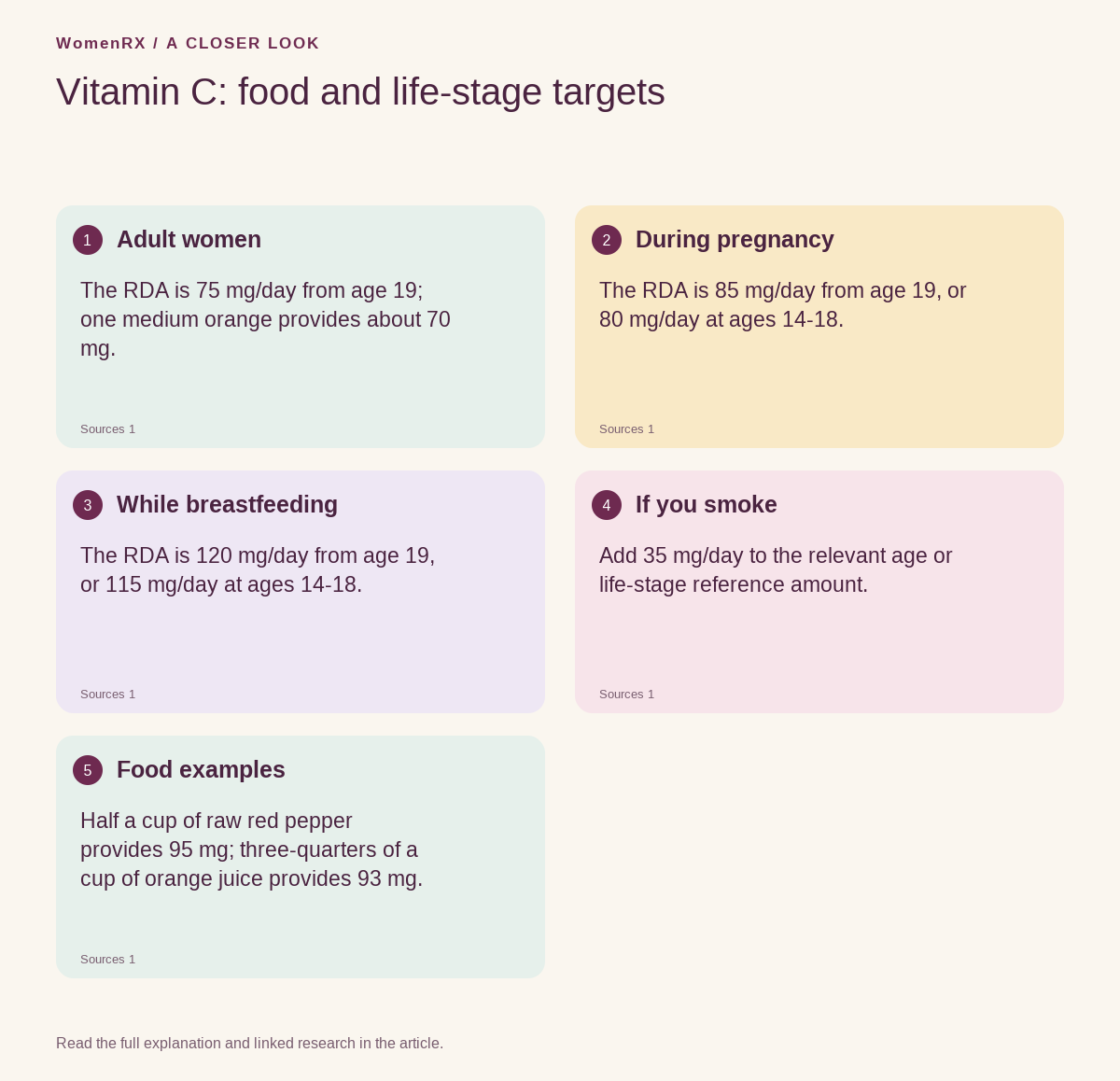
Vitamin C: food and life-stage targets
Adult women: The RDA is 75 mg/day from age 19; one medium orange provides about 70 mg.1
During pregnancy: The RDA is 85 mg/day from age 19, or 80 mg/day at ages 14-18.1
While breastfeeding: The RDA is 120 mg/day from age 19, or 115 mg/day at ages 14-18.1
If you smoke: Add 35 mg/day to the relevant age or life-stage reference amount.1
Food examples: Half a cup of raw red pepper provides 95 mg; three-quarters of a cup of orange juice provides 93 mg.1
Read the figure as text
Compare common food portions with the daily reference amount for adult women and see how pregnancy, breastfeeding, and smoking change that amount.- Adult women: The RDA is 75 mg/day from age 19; one medium orange provides about 70 mg.1
- During pregnancy: The RDA is 85 mg/day from age 19, or 80 mg/day at ages 14-18.1
- While breastfeeding: The RDA is 120 mg/day from age 19, or 115 mg/day at ages 14-18.1
- If you smoke: Add 35 mg/day to the relevant age or life-stage reference amount.1
- Food examples: Half a cup of raw red pepper provides 95 mg; three-quarters of a cup of orange juice provides 93 mg.1
More questions, answered
Does vitamin C from a supplement count the same as vitamin C from food?
The NIH Office of Dietary Supplements reports that ascorbic acid, the most common supplemental form, has bioavailability equivalent to ascorbic acid in foods. Food sources also provide a range of other nutrients, so a supplement and a varied diet aren’t interchangeable in every respect. 1
Sources you can check
- Vitamin C - Health Professional Fact SheetAccessed 2026-09-25Return to first citation
- Estimation of Total Usual Dietary Intakes of Pregnant Women in the United States.Bailey RL, Pac SG, Fulgoni VL, Reidy KC, Catalano PM. · JAMA network open · 2019Return to first citation