Can You Get Enough Vitamin C From Food?
For most women, a few familiar fruits and vegetables can add up to the daily target without a vitamin C pill.
Yes. A varied diet can meet vitamin C needs: women 19 and older need 75 mg a day, rising to 85 mg during pregnancy and 120 mg while breastfeeding. For example, one medium orange and half a cup of cooked broccoli provide about 121 mg together. Food and ordinary vitamin C supplements have equivalent bioavailability, so a supplement isn’t automatically better absorbed. 1
Start with a target, then add foods
If you’re an adult woman who isn’t pregnant or breastfeeding, the recommended dietary allowance (RDA) for vitamin C is 75 milligrams (mg) a day. It’s 85 mg during pregnancy and 120 mg while breastfeeding. These are planning targets for healthy people, not a score you need to hit perfectly at every meal. People who smoke need 35 mg more per day than people who don’t. 1
The numbers are achievable with ordinary foods. One medium orange provides about 70 mg; half a cup of cooked broccoli provides about 51 mg. Together, that example adds up to about 121 mg. You don’t need to choose those exact foods: red pepper, kiwifruit, strawberries, Brussels sprouts, juice, tomatoes and other produce can contribute too. 1
The estimates are useful for getting a sense of scale, not for treating every piece of produce as identical. Food variety, storage and preparation affect the amount you get. The NIH Office of Dietary Supplements notes that five varied servings of fruits and vegetables can provide more than 200 mg of vitamin C. 1
A quick way to estimate your day
- Choose the target that fits your life stage: 75 mg for adult women, 85 mg during pregnancy or 120 mg while breastfeeding. Add 35 mg if you smoke. 1
- Look at the foods you actually eat, and use representative portions to estimate their vitamin C. For instance, the reference amounts are about 95 mg in half a cup of raw red pepper, 64 mg in one kiwifruit, 49 mg in half a cup of sliced strawberries, and 33 mg in three-quarters of a cup of tomato juice. 1
- Add a couple of contributions rather than expecting one “superfood” to cover every day. An orange plus broccoli is one example; pepper in a meal and fruit as a snack is another. 1
Food labels may not make this easy: US labels don’t have to list vitamin C unless it has been added to the food. For a closer estimate, look up the food and portion in USDA FoodData Central, which the NIH fact sheet identifies as a nutrient-content database. 1
Fresh choices, cooked meals and real-life variation
Vitamin C dissolves in water and can be reduced by heat and prolonged storage. That doesn’t mean cooked vegetables don’t count: the reference values include vitamin C in cooked broccoli and Brussels sprouts. If you’re cooking produce, steaming or microwaving may lessen losses compared with some other cooking methods. Raw fruits and vegetables are also convenient sources. 1
There’s no need to make the calculation depend on one food or one perfect menu. A mix of fruit and vegetables across meals gives you more than one route to the target. Still, serving a recommended amount of one food group doesn’t guarantee that every nutrient target is met. In dietary studies from Greece, participants meeting recommended fruit portions did not always meet vitamin C intake recommendations. Those findings are a reminder about variety, not proof that fruit portions fail to provide vitamin C for most people. 2
When a supplement may fit
If your usual eating pattern rarely includes vitamin C-rich produce, or access and food preferences make it hard to get a variety of sources, a supplement can be another way to add vitamin C. That doesn’t make it inherently better than food: the NIH fact sheet reports equivalent bioavailability for the ascorbic acid in supplements and naturally occurring ascorbic acid in foods. The practical comparison is whether your overall intake is likely to meet your target, not whether one source is automatically superior. 1
If you’re pregnant or breastfeeding, use the target for that life stage rather than the general adult-woman target. If you smoke, account for the additional 35 mg. And if you want to estimate what you’re getting, add up familiar portions across a usual day instead of relying on a single food or supplement label.
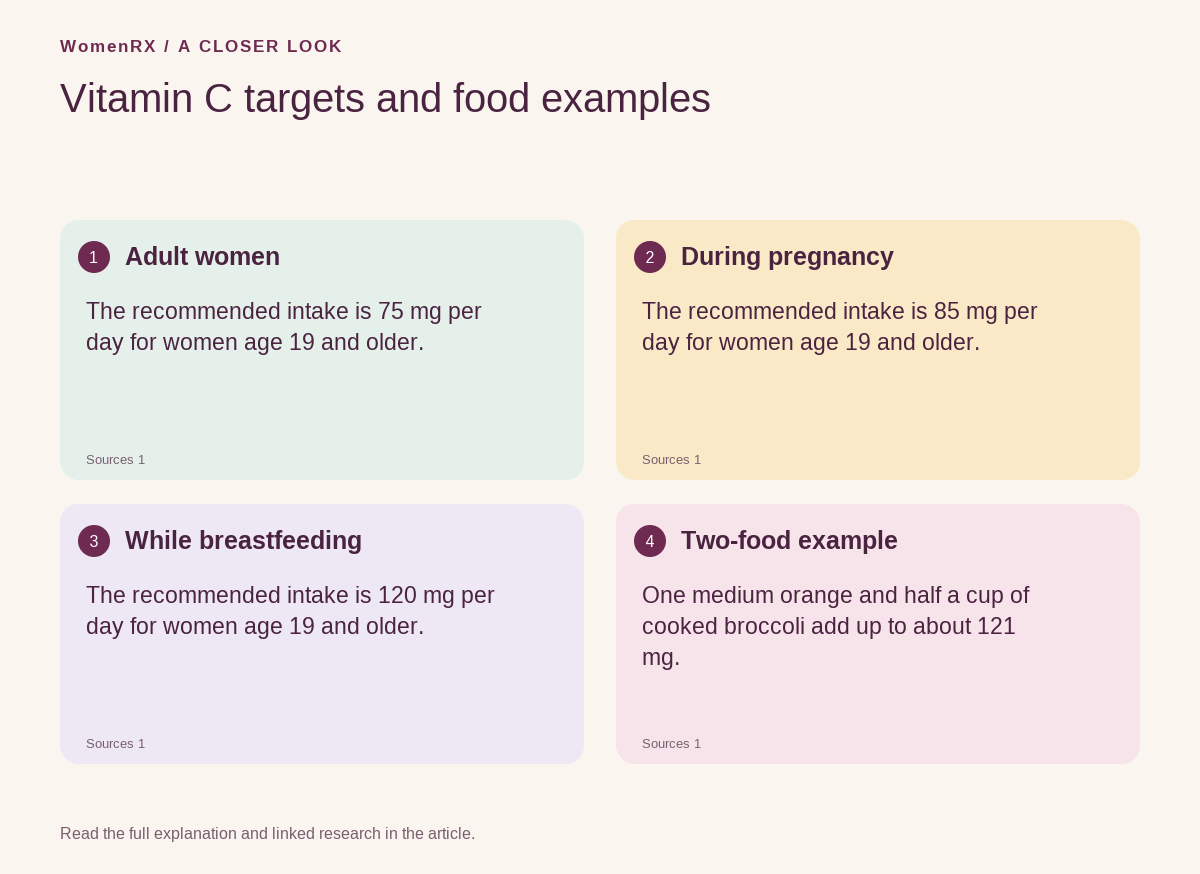
Vitamin C targets and food examples
Adult women: The recommended intake is 75 mg per day for women age 19 and older.1
During pregnancy: The recommended intake is 85 mg per day for women age 19 and older.1
While breastfeeding: The recommended intake is 120 mg per day for women age 19 and older.1
Two-food example: One medium orange and half a cup of cooked broccoli add up to about 121 mg.1
Read the figure as text
Compare the daily target for different life stages with a simple food combination. Values are representative portions, not a guarantee of the amount in every serving.- Adult women: The recommended intake is 75 mg per day for women age 19 and older.1
- During pregnancy: The recommended intake is 85 mg per day for women age 19 and older.1
- While breastfeeding: The recommended intake is 120 mg per day for women age 19 and older.1
- Two-food example: One medium orange and half a cup of cooked broccoli add up to about 121 mg.1
Sources you can check
- Vitamin C - Health Professional Fact SheetAccessed 2026-09-25Return to first citation
- Food group and micronutrient intake adequacy among children, adults and elderly women in Greece.Manios Y, Moschonis G, Grammatikaki E, Mavrogianni C, van den Heuvel EG, Bos R, Singh-Povel C. · Nutrients · 2015Return to first citation