What Vitamin C Deficiency Can Look Like
Bleeding gums or unusual bruising deserve a closer look when they occur alongside a very limited diet or a condition that affects absorption.
Vitamin C deficiency can cause inflamed or bleeding gums, pinpoint spots or larger bruises, joint pain, poor wound healing, rough, thickened skin, and corkscrew-shaped hairs. These signs are more concerning alongside weeks of very low vitamin C intake or an absorption problem. When deficiency is identified, treatment focuses on restoring vitamin C. 12
Vitamin C deficiency is uncommon, but it can happen when someone gets very little vitamin C for weeks. The most useful clue isn’t one bruise or a tired day. It’s a pattern of changes in the gums, skin, or healing alongside a reason vitamin C intake or absorption may be low. 1
Why gums, skin, and healing can change
Vitamin C is needed to make collagen, which helps support connective tissue and blood vessels. When vitamin C stays very low, those tissues can weaken. Early signs may include fatigue, feeling unwell, or inflamed gums. As deficiency progresses, fragile small blood vessels can lead to pinpoint spots, larger bruises, or purple areas under the skin. Joint pain and poor wound healing can also occur. 1
Other possible clues include rough, thickened skin and hairs that curl into a corkscrew shape. Gums may swell or bleed, and advanced scurvy can loosen teeth. These findings are possible features, not a self-diagnosis checklist. Bruising, gum bleeding, fatigue, and slow healing can have other explanations, so the combination of signs and the dietary or health context matter. 1
Who may be at risk
Fruits and vegetables are the best sources of vitamin C. A diet with very little variety can make it harder to get enough; severe intestinal malabsorption and some chronic illnesses can also increase the risk of inadequate vitamin C. Smoking and secondhand smoke exposure are additional risk factors for inadequacy. Being at risk doesn’t mean someone has scurvy. 1
It helps to distinguish inadequate intake from overt deficiency. Intake can fall below the recommended amount without becoming low enough to cause scurvy. The characteristic signs are associated with very low intake sustained over time, rather than simply eating fewer vitamin-C-rich foods for a short while. 1
Vitamin C deficiency isn’t defined by sex. During pregnancy, as at other times, a useful question is whether food restrictions have left you eating an unusually narrow range of foods. If so, mention that alongside any persistent symptoms. Pregnancy itself doesn’t establish a vitamin C deficiency.
What assessment and treatment can involve
An assessment can consider symptoms, eating patterns, and conditions that may affect absorption rather than treating one finding as proof. Vitamin C status is typically assessed with a plasma vitamin C measurement. 1
If deficiency is identified, restoring vitamin C is the treatment goal. A varied diet that includes fruits and vegetables can help provide it; citrus fruits and juices were historically used to cure scurvy. One case report described improvement in a man with a low blood level after supplementation, but a single case can’t set a general adult dose or schedule. 12
For children with symptoms, a retrospective hospital study recommended dietary assessment, a vitamin C assay, and supplementation when appropriate. Its patients were children, and treatment practices varied, so its findings don’t establish an adult regimen. 3
In one published adult case, a man with chronic diarrhea had bleeding gums and distinctive skin and hair findings; a blood test showed low vitamin C. That single case illustrates how the pieces can fit together, not how commonly scurvy presents in women. 2
If you have persistent gum bleeding, unusual bruising or skin changes, or poor wound healing alongside a very limited diet or a condition that may affect absorption, bring up both parts of the picture when seeking care. Taking vitamin C on your own shouldn’t stand in for finding the cause of an unexplained symptom.
When the pattern deserves attention
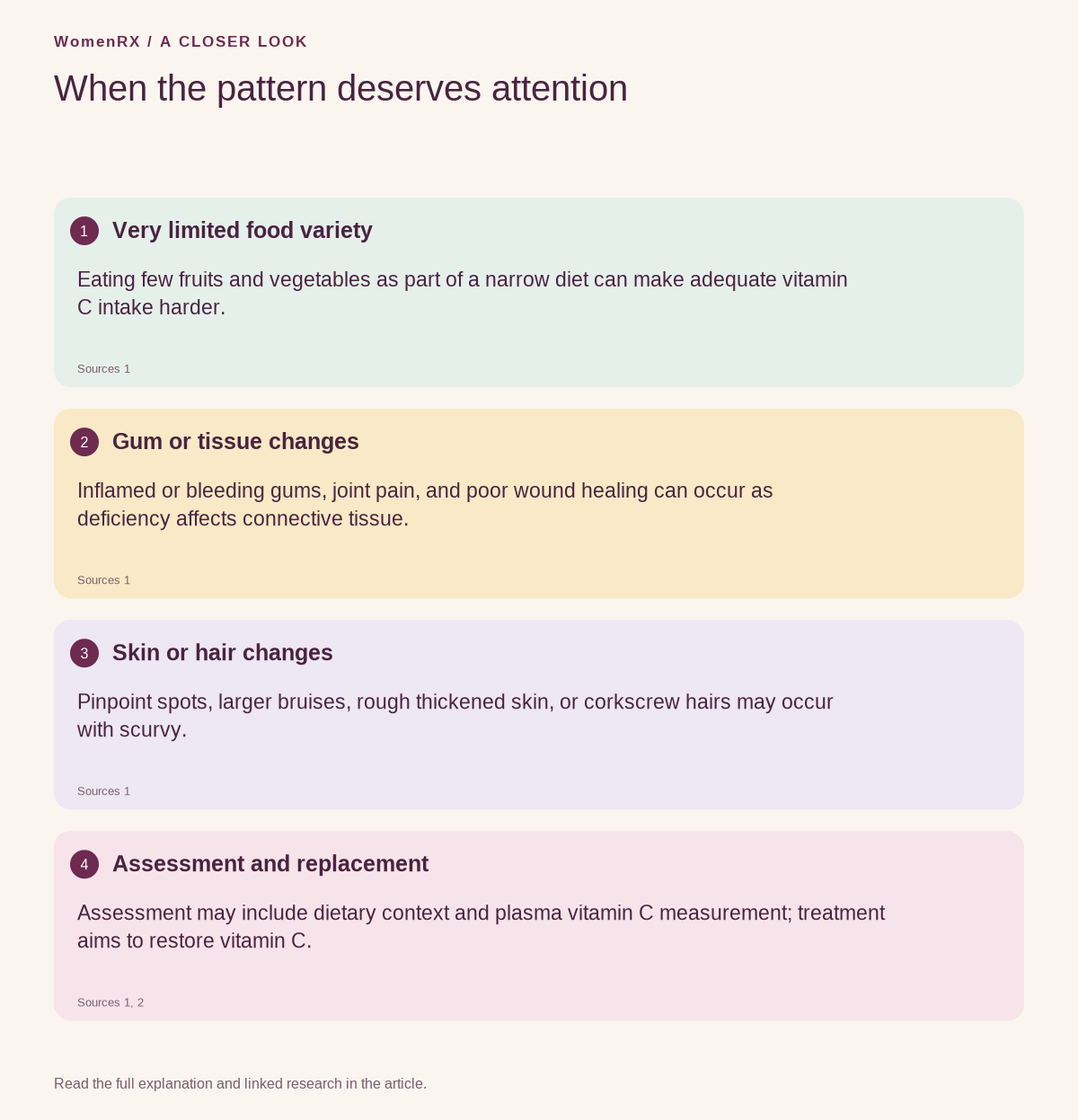
Very limited food variety: Eating few fruits and vegetables as part of a narrow diet can make adequate vitamin C intake harder.1
Gum or tissue changes: Inflamed or bleeding gums, joint pain, and poor wound healing can occur as deficiency affects connective tissue.1
Skin or hair changes: Pinpoint spots, larger bruises, rough thickened skin, or corkscrew hairs may occur with scurvy.1
Assessment and replacement: Assessment may include dietary context and plasma vitamin C measurement; treatment aims to restore vitamin C.12
Read the figure as text
Look at compatible signs together with dietary and health context, rather than treating one symptom as a diagnosis.- Very limited food variety: Eating few fruits and vegetables as part of a narrow diet can make adequate vitamin C intake harder.1
- Gum or tissue changes: Inflamed or bleeding gums, joint pain, and poor wound healing can occur as deficiency affects connective tissue.1
- Skin or hair changes: Pinpoint spots, larger bruises, rough thickened skin, or corkscrew hairs may occur with scurvy.1
- Assessment and replacement: Assessment may include dietary context and plasma vitamin C measurement; treatment aims to restore vitamin C.12
Sources you can check
- Vitamin C - Health Professional Fact SheetAccessed 2026-09-25Return to first citation
- Dermoscopic Clues of Scurvy in Clinical Practice.Jaiswal S, Uprety S, Thapa P, Lamichhane P. · Clinical case reports · 2026Return to first citation
- Scurvy and vitamin C deficiency in an Australian tertiary children's hospital.van Heerden C, Cheng DR, McNab S, Burgess R, Russell A, Wang Y, Bleathman F, Maharaj I, Zhang J, Easterbrook M, Papadopulos M, Ibrahim LF. · Journal of paediatrics and child health · 2024Return to first citation