Do You Need a Vitamin C Supplement?
For most women, the useful question is whether food meets their life-stage needs, not whether a high-dose pill offers extra protection.
If you eat fruits or vegetables regularly, you may already get enough vitamin C without a separate supplement. For women 19 and older, the recommended intake is 75 mg daily, rising to 85 mg during pregnancy and 120 mg while breastfeeding. These are total daily targets, not supplement doses. If you do supplement, plain ascorbic acid is a reasonable option; higher amounts aren’t automatically more helpful. 1
Start with the reason you’re considering it
A vitamin C supplement can make sense when your usual diet doesn’t reliably provide enough, or when a specific health situation changes your needs. But the recommended intake is a target for your total daily intake from food and supplements, not a dose everyone should take as a pill. The National Institutes of Health advises meeting nutrient needs primarily through food, with supplements useful when food alone isn’t enough. 1
For a concrete example, one medium orange has about 70 mg of vitamin C, and half a cup of raw red pepper has about 95 mg. Strawberries, kiwi, broccoli, Brussels sprouts, and some juices are also good sources. Cooking and prolonged storage can reduce vitamin C in food, so including some uncooked fruit or vegetables is one practical way to get it. 1
If your diet has little variety, or you have a condition that affects absorption, it’s worth looking at your intake more closely. Smoking also changes the target: people who smoke need 35 mg more vitamin C per day than people who don’t. 1
Your target depends on life stage
For women 19 and older, the recommended daily allowance is 75 mg. It’s 65 mg for girls ages 14 to 18, 85 mg during pregnancy at age 19 and older, and 120 mg while breastfeeding. For pregnant or breastfeeding teens, the respective amounts are 80 mg and 115 mg. These recommendations describe total intake from food and supplements together. 1
Pregnancy and breastfeeding are reasons to check whether your usual intake and any prenatal or other supplement cover your needs, rather than assuming every woman needs an extra vitamin C pill. The amount already present in a multivitamin counts toward the total. 1
A 2012 review of nutrient supplements in pregnancy noted a possible link between low vitamin C concentrations and preeclampsia, but described potential supplementation benefits as needing further study. That review does not establish that routine extra vitamin C improves pregnancy outcomes. 2
Match the supplement to the gap, not a big number
If food and any multivitamin already bring you near your target, a separate high-dose product may add little. If you’re falling short, the sensible comparison is how much vitamin C you need to make up the difference, not which product advertises the largest amount. That’s a practical way to use the recommended intake without treating it as a prescription for a supplement dose. 1
Vitamin C supplements commonly use ascorbic acid. NIH reports that supplemental ascorbic acid has bioavailability equivalent to the vitamin C naturally present in food. A few human comparisons of other forms, such as mineral ascorbates or products with added ingredients, have not established a clear general advantage. If you choose to take a supplement, plain ascorbic acid is a straightforward option; the limited human comparisons summarized do not establish a general advantage for more elaborate forms. 1
Be clear about the goal
Vitamin C has essential roles in the body, including collagen production and helping the body absorb iron from plant foods. Those roles don’t mean that taking extra vitamin C has been shown to prevent a particular disease in someone who already gets enough. For example, trials have generally not shown that vitamin C supplements prevent cardiovascular disease, and most randomized trials have not found that supplementation prevents cancer. In a large trial of women with a history of cardiovascular disease, 500 mg daily for an average of 9.4 years did not reduce cardiovascular events. 1
Colds are a more familiar reason people reach for vitamin C. In studies of regular preventive doses of at least 200 mg per day, supplementation did not significantly reduce the risk of colds in the general population, though it may modestly shorten their duration. Starting it after cold symptoms begin doesn’t appear to reduce duration or severity. That makes it a limited, optional choice for this goal, not a dependable way to avoid getting sick. 1
Consider tolerability and health conditions
Higher supplemental amounts can cause diarrhea, nausea, abdominal cramps, or other stomach and bowel discomfort. The adult upper limit is 2,000 mg a day from food and supplements combined; that’s a ceiling for intake, not a target to aim for. 1
Some people need more individualized advice before using a high-dose product. High intakes may increase urinary oxalate, and the concern is greatest for people with pre-existing hyperoxaluria or certain kidney disorders. In hereditary hemochromatosis, high-dose vitamin C can worsen iron overload. If you’re receiving chemotherapy or radiation, ask your oncology team before adding an antioxidant supplement because its effects alongside treatment are uncertain. 1
A useful decision is often simple: estimate what you get from food and existing supplements, compare that with your life-stage target, and use a supplement only if there’s a gap or a specific reason to discuss one. If you’re unsure how a medical condition or treatment changes that choice, bring the product label and your usual intake into the conversation.
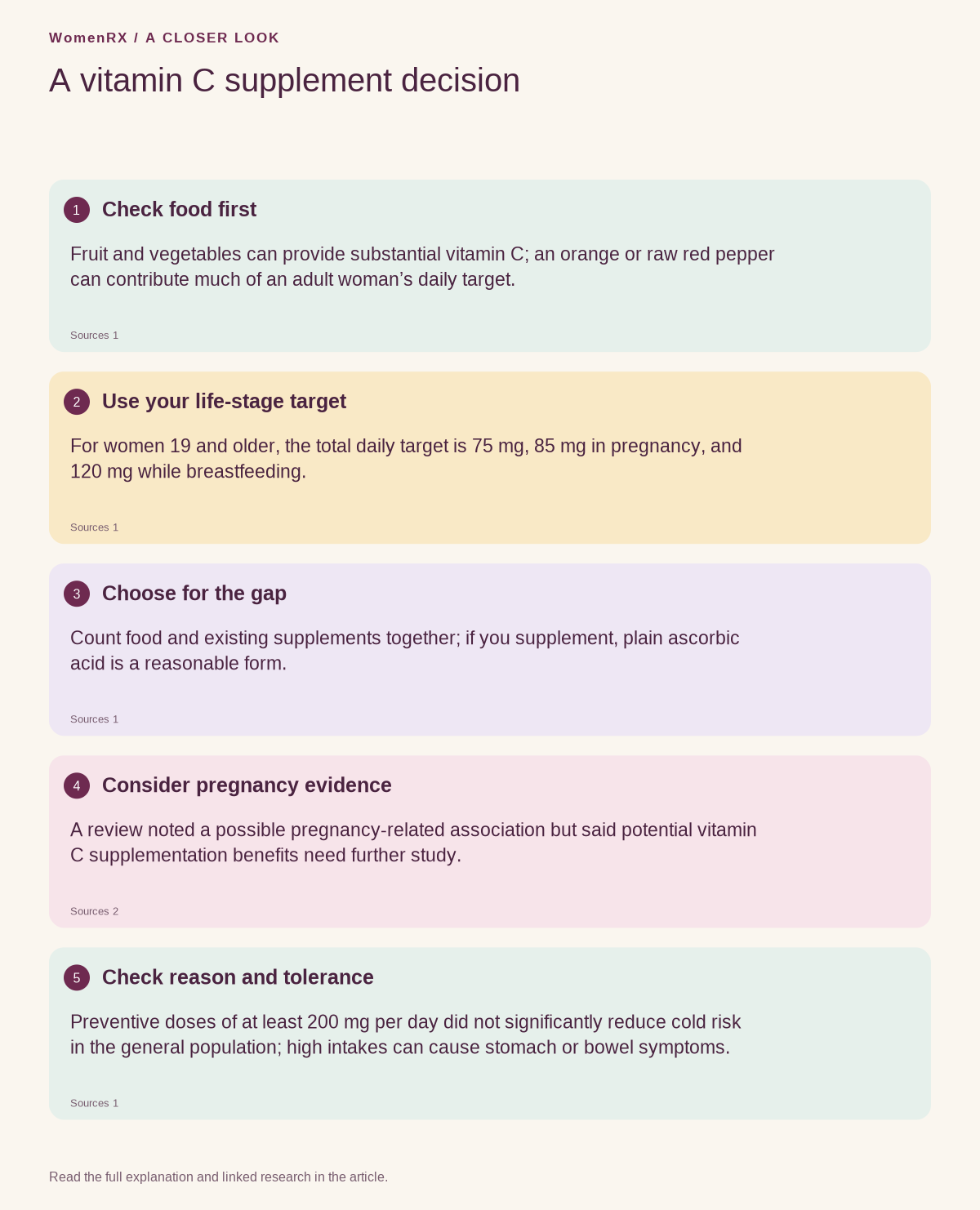
A vitamin C supplement decision
Check food first: Fruit and vegetables can provide substantial vitamin C; an orange or raw red pepper can contribute much of an adult woman’s daily target.1
Use your life-stage target: For women 19 and older, the total daily target is 75 mg, 85 mg in pregnancy, and 120 mg while breastfeeding.1
Choose for the gap: Count food and existing supplements together; if you supplement, plain ascorbic acid is a reasonable form.1
Consider pregnancy evidence: A review noted a possible pregnancy-related association but said potential vitamin C supplementation benefits need further study.2
Check reason and tolerance: Preventive doses of at least 200 mg per day did not significantly reduce cold risk in the general population; high intakes can cause stomach or bowel symptoms.1
Read the figure as text
Follow the question from your usual intake to your reason for considering a supplement, then check life-stage needs and relevant safety concerns.- Check food first: Fruit and vegetables can provide substantial vitamin C; an orange or raw red pepper can contribute much of an adult woman’s daily target.1
- Use your life-stage target: For women 19 and older, the total daily target is 75 mg, 85 mg in pregnancy, and 120 mg while breastfeeding.1
- Choose for the gap: Count food and existing supplements together; if you supplement, plain ascorbic acid is a reasonable form.1
- Consider pregnancy evidence: A review noted a possible pregnancy-related association but said potential vitamin C supplementation benefits need further study.2
- Check reason and tolerance: Preventive doses of at least 200 mg per day did not significantly reduce cold risk in the general population; high intakes can cause stomach or bowel symptoms.1
Sources you can check
- Vitamin C - Health Professional Fact SheetAccessed 2026-09-25Return to first citation
- Influence of mineral and vitamin supplements on pregnancy outcome.Hovdenak N, Haram K. · European journal of obstetrics, gynecology, and reproductive biology · 2012Return to first citation