When Vitamin E Deficiency Deserves a Closer Look
Nerve, muscle, vision, or coordination changes matter more when a condition or surgery could affect fat absorption.
Vitamin E deficiency is rare in otherwise healthy people, even when they get little vitamin E from food. It’s more relevant to consider when fat absorption may be impaired, such as with certain digestive conditions or after some stomach surgeries, especially alongside nerve, muscle, vision, or coordination problems. Symptoms alone can’t confirm deficiency; clinicians interpret blood findings in the context of a person’s health history. 1 3 4
Why absorption history matters
Vitamin E is fat-soluble, so the digestive tract needs to absorb fat for the body to absorb it. That makes a condition affecting fat absorption a more meaningful risk clue than a low dietary intake by itself. Frank vitamin E deficiency is rare in healthy people, and overt deficiency symptoms have not been found in healthy people who get little vitamin E from their diets. 1
Crohn’s disease, cystic fibrosis, and problems with bile reaching the digestive tract are examples of circumstances that can involve fat malabsorption. Stomach surgery can also be relevant. In studies of people who had gastrectomy for gastric cancer, some participants had low blood vitamin E levels; one study found low levels more often after total than subtotal gastrectomy. These results describe specific surgical groups, not everyone with digestive symptoms. 1 3 5
What symptoms add to the picture
When deficiency causes problems, they can involve peripheral nerves, coordination, skeletal muscles, or the retina. Examples include peripheral neuropathy, ataxia (difficulty coordinating movement), muscle problems, and retinopathy. These symptoms don’t establish the cause on their own. They make vitamin E worth considering when there’s also a plausible reason the body may not be absorbing fat normally. 1
The useful question isn’t whether one symptom matches a list. It’s whether your health history makes poor absorption plausible and whether clinical findings support deficiency. The clinical descriptions and studies cited here don’t establish a distinct women-specific symptom pattern, so assessment is based on individual risk and findings rather than sex alone. 1 3 4 5
How history and blood findings fit together
If you’re discussing nerve, muscle, vision, or coordination changes, mention conditions that affect digestion or fat absorption and any history of stomach surgery. A clinician may measure alpha-tocopherol, the form of vitamin E maintained in the blood. Studies of people after gastrectomy have measured blood vitamin E levels, but the NIH nutrient reference also describes uncertainty about biomarkers for assessing vitamin E requirements. 1 3 4 5
Results and symptoms don’t always line up neatly. In one study of 39 people after gastrectomy for gastric cancer, 7 had low vitamin E levels within a year, and none of those 7 had neuropathy. In a separate study of 96 gastrectomy patients, 20 had low levels and 10 of those 20 had neurological symptoms. These small studies involve a particular surgical population; they don’t predict what will happen to everyone with symptoms or a digestive condition. 3 4
Low vitamin E levels were also associated with low total cholesterol in studies after gastrectomy. That finding comes from those surgical groups, not a universal rule for interpreting an individual test. 3 5
Why symptoms alone aren’t a reason to self-treat
Tingling, weakness, or vision changes alone don’t show that vitamin E is the cause. If you also have a condition that may affect fat absorption or have had stomach surgery, discussing whether assessment is relevant can help connect symptoms with the right context. Vitamin E supplements may be harmful for people taking blood thinners and some other medicines. High supplemental amounts used for rare inherited conditions aren’t a guide for self-treatment. 1 2
A practical way to think about assessment is to connect three things: a possible barrier to fat absorption, symptoms that can occur with deficiency, and clinical or blood findings considered together. No single symptom or result tells the whole story. 1 3 4
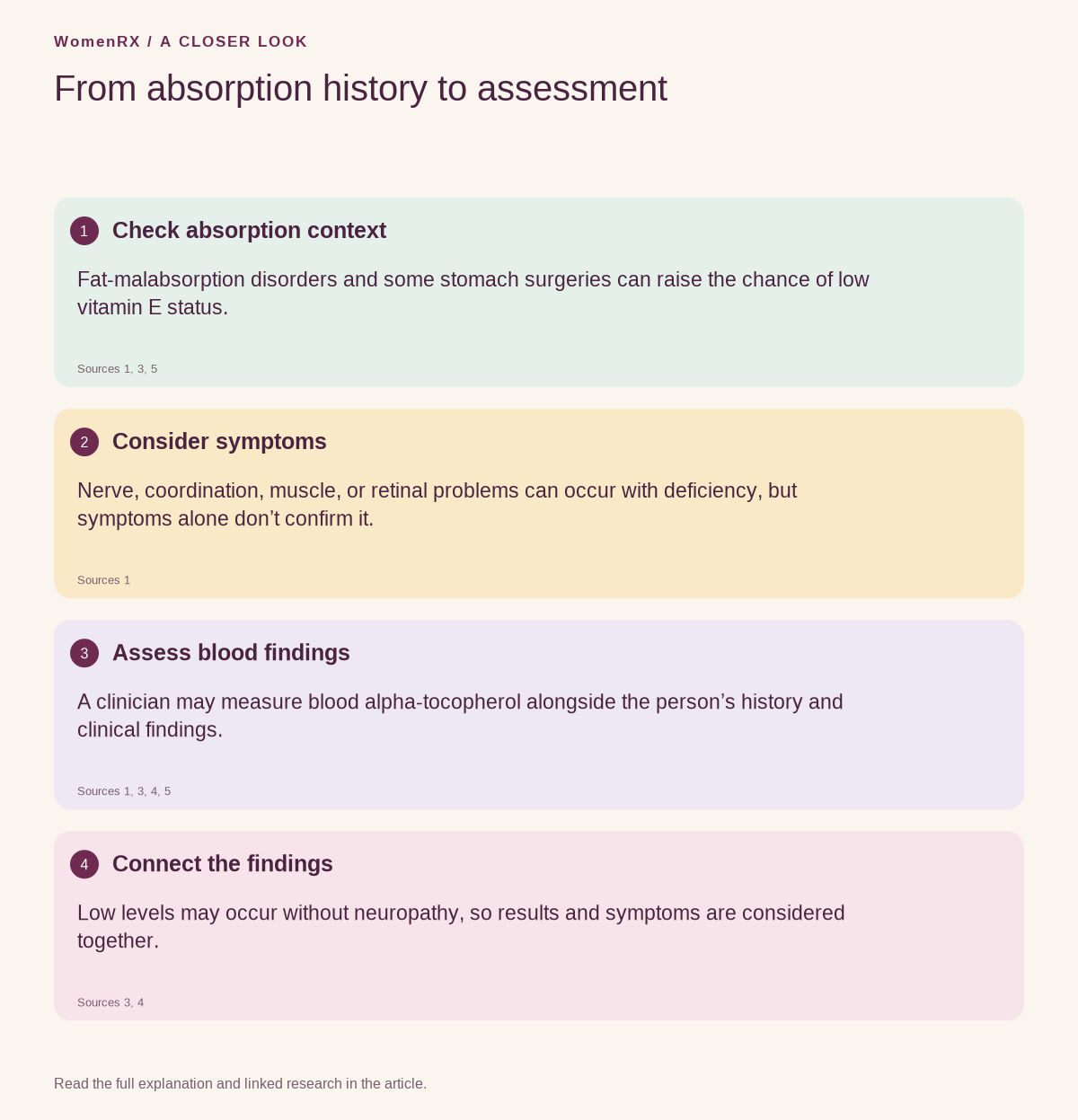
From absorption history to assessment
Check absorption context: Fat-malabsorption disorders and some stomach surgeries can raise the chance of low vitamin E status.135
Consider symptoms: Nerve, coordination, muscle, or retinal problems can occur with deficiency, but symptoms alone don’t confirm it.1
Assess blood findings: A clinician may measure blood alpha-tocopherol alongside the person’s history and clinical findings.1345
Connect the findings: Low levels may occur without neuropathy, so results and symptoms are considered together.34
Read the figure as text
A possible vitamin E deficiency is considered through absorption risk, relevant symptoms, and clinical findings, not a symptom list alone.- Check absorption context: Fat-malabsorption disorders and some stomach surgeries can raise the chance of low vitamin E status.135
- Consider symptoms: Nerve, coordination, muscle, or retinal problems can occur with deficiency, but symptoms alone don’t confirm it.1
- Assess blood findings: A clinician may measure blood alpha-tocopherol alongside the person’s history and clinical findings.1345
- Connect the findings: Low levels may occur without neuropathy, so results and symptoms are considered together.34
More questions, answered
Can a low vitamin E result occur without nerve symptoms?
Yes. In a study of 39 people after gastrectomy for gastric cancer, 7 had low vitamin E levels within a year, and none of those 7 had neuropathy. The study applies to a specific surgical group, but it illustrates why symptoms and test findings are considered together. 3
Should I start vitamin E if I have tingling or weakness?
Tingling or weakness alone can’t establish vitamin E deficiency. If you also have a condition that may affect fat absorption or a history of stomach surgery, discuss whether assessment makes sense before taking a supplement. Vitamin E supplements may be harmful with blood thinners and some other medicines. 1 2
Sources you can check
- Vitamin E - Health Professional Fact SheetAccessed 2026-09-25Return to first citation
- Vitamin E: MedlinePlusAccessed 2026-09-25Return to first citation
- Vitamin E deficiency begins within 6 months after gastrectomy for gastric cancer.Rino Y, Yukawa N, Sato T, Yamamoto N, Tamagawa H, Hasegawa S, Hayashi T, Atsumi Y, Oshima T, Yoshikawa T, Masuda M, Imada T. · World journal of surgery · 2014Return to first citation
- Correlation between neurological dysfunction with vitamin E deficiency and gastrectomy.Ueda N, Suzuki Y, Rino Y, Takahashi T, Imada T, Takanashi Y, Kuroiwa Y. · Journal of the neurological sciences · 2009Return to first citation
- Vitamin E malabsorption and neurological consequences after gastrectomy for gastric cancer.Rino Y, Suzuki Y, Kuroiwa Y, Yukawa N, Saeki H, Kanari M, Wada H, Ino H, Takanashi Y, Imada T. · Hepato-gastroenterology · 2007Return to first citation