Period Pain: When It Deserves a Closer Look
Cramps can be a common part of a period, but pain that changes, disrupts daily life, or comes with other symptoms is worth discussing.
Typical period cramps often start just before or as bleeding begins, may spread to your back or thighs, and usually ease within a few days. Pain that stops your usual activities, gets worse or changes, or occurs with heavy bleeding, pain during sex, or pain when you pee or poop deserves a closer look. Those patterns don’t prove endometriosis, but they can help guide an evaluation. 2 3
What a common cramp pattern can look like
Period pain often happens as the uterus tightens. It usually starts just before or around the beginning of bleeding, may feel sharp or dull, and can spread to your back or thighs. It commonly lasts up to three days. 3
There’s no single pain score that separates ordinary cramps from a condition that needs attention. A useful distinction is what the pain does: does it settle after the first days of your period, or is it getting more painful, lasting beyond your period, or keeping you from school, work, sleep, or everyday activities? Pain that interferes with your life is worth raising, even if it began when you were a teenager. 2 3
Clues that can point to more than cramps
Endometriosis is when tissue similar to the uterine lining grows elsewhere in the body. Along with severe period pain, it can be associated with pelvic or lower-back pain at other times, pain during or after sex, pain when you pee or poop, heavy bleeding, and fatigue. These symptoms overlap with other conditions, so they are clues to discuss, not a way to diagnose yourself. 2
Adenomyosis is different: tissue from the uterine lining grows into the muscular wall of the uterus. Painful periods and heavy bleeding are common symptoms, though some people have no symptoms. It is more commonly diagnosed in people over 30, and having given birth may be one factor associated with a higher likelihood. Neither age nor pregnancy history can confirm or rule it out. 1
Other possible causes of period pain include fibroids and pelvic inflammatory disease. An IUD can also be associated with more period pain, particularly during the first three to six months after it is placed. 3
Severe pain alone doesn’t tell you which, if any, of these conditions is present. And a normal scan doesn’t necessarily settle the question: in a retrospective study of adolescents referred for severe period pain, many had normal ultrasound scans. Because that was a selected group and a particular study, its findings can’t tell us how often imaging misses a condition in everyone. If your symptoms are affecting your life, they still merit discussion. 4
Notice the pattern, not just the pain score
Before an appointment, a brief record can make it easier to describe what’s changed. You don’t need to track every detail. Note when the pain starts and ends, whether it happens outside your period, how it affects your normal activities, and whether you also have heavy bleeding, pain during sex, or pain when you pee or poop. Mention if the pattern has changed over time. These details are relevant because clinicians may ask about your symptoms and use them to decide whether further evaluation is needed. 2 3
Include context that can change how your cycle looks. Hormonal contraception can make periods lighter and ease period pain, so say what you use and whether it has changed your bleeding or pain. If you’ve given birth, mention that too; it may be relevant when adenomyosis is being considered, but it doesn’t establish a diagnosis. 1 3
What an evaluation may involve
A clinician may ask about your symptoms and family history, and may recommend an examination or imaging based on your situation. Ultrasound is one test used to look for causes of period pain. If endometriosis is suspected, further assessment may involve a specialist and, in some cases, MRI or laparoscopy. The steps depend on your symptoms and findings; a scan or symptom pattern by itself does not explain every case. 2 3
Treatment can also be part of the discussion. Anti-inflammatory medicines and hormonal contraception are among the options used for period pain; hormonal methods can thin the uterine lining and ease pain for some people. The right choice depends on the suspected cause and your circumstances, so ask what the options are intended to help with and what further evaluation may be appropriate if pain continues. 3
If your period or pelvic pain is severe or worse than usual and pain medicine hasn’t helped, seek urgent medical advice. For a non-urgent but meaningful pattern change, pain that disrupts your routine, or associated symptoms, arrange an evaluation rather than waiting for the pain to become unbearable. 1 3
Period pain patterns to mention
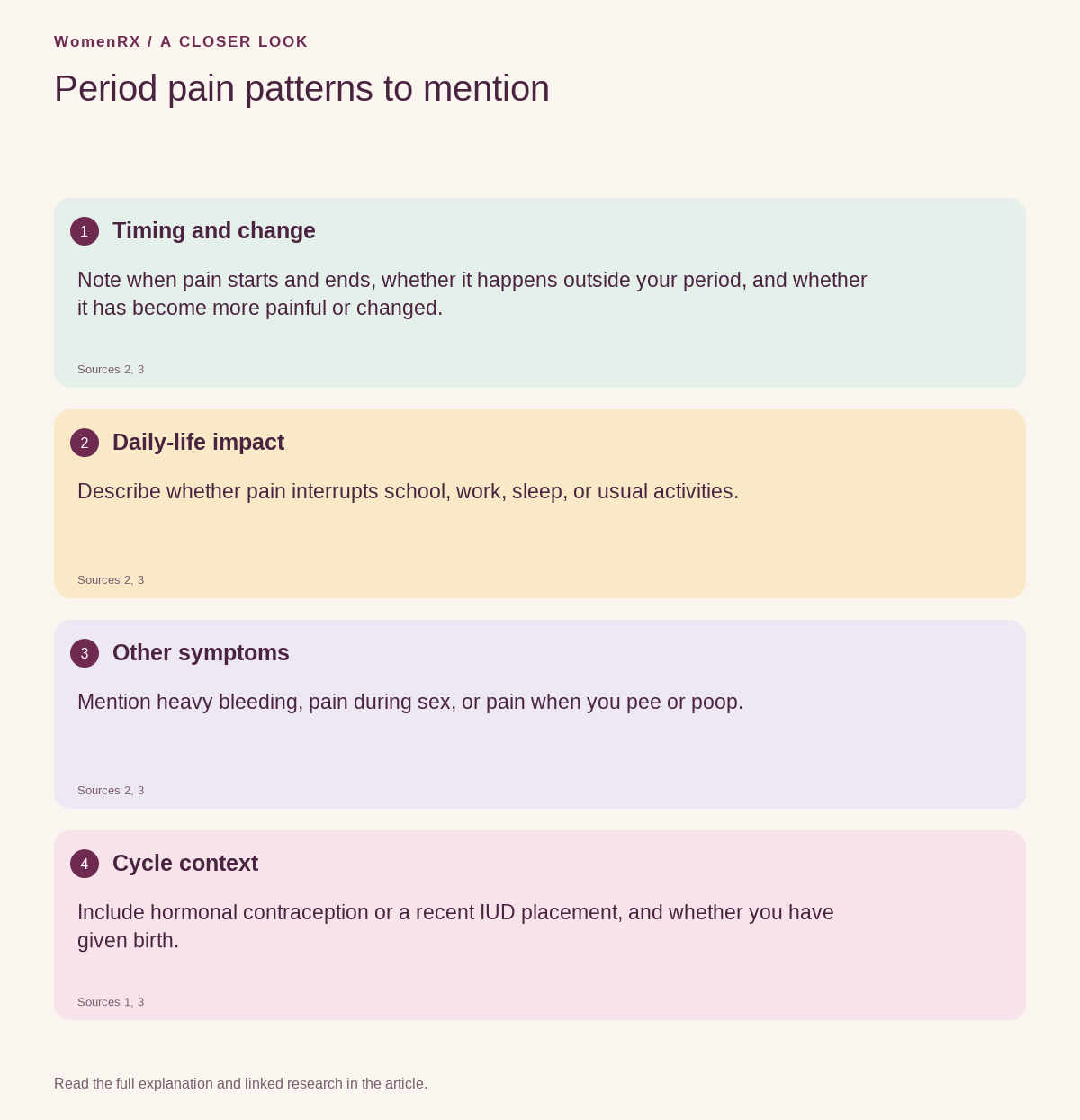
Timing and change: Note when pain starts and ends, whether it happens outside your period, and whether it has become more painful or changed.23
Daily-life impact: Describe whether pain interrupts school, work, sleep, or usual activities.23
Other symptoms: Mention heavy bleeding, pain during sex, or pain when you pee or poop.23
Cycle context: Include hormonal contraception or a recent IUD placement, and whether you have given birth.13
Read the figure as text
Use these prompts to describe how the pain behaves and what comes with it. They help organize a conversation; they do not diagnose a condition.- Timing and change: Note when pain starts and ends, whether it happens outside your period, and whether it has become more painful or changed.23
- Daily-life impact: Describe whether pain interrupts school, work, sleep, or usual activities.23
- Other symptoms: Mention heavy bleeding, pain during sex, or pain when you pee or poop.23
- Cycle context: Include hormonal contraception or a recent IUD placement, and whether you have given birth.13
More questions, answered
Does severe period pain mean I have endometriosis?
No. Severe pain can occur with endometriosis, adenomyosis, and other causes, and pain severity alone can’t identify which is responsible. It is still a good reason to seek evaluation if it disrupts your usual activities. 1 2 3
Does a normal ultrasound rule out endometriosis?
A normal scan doesn’t explain every case of period pain. In one retrospective study of adolescents referred for severe pain, many had normal scans; that selected study can’t establish how often a normal scan misses disease in other groups. If symptoms persist or affect daily life, discuss what further evaluation makes sense. 2 4
Sources you can check
- Adenomyosis - NHSAccessed 2026-09-25Return to first citation
- Endometriosis - NHSAccessed 2026-09-25Return to first citation
- Period pain - NHSAccessed 2026-09-25Return to first citation
- Severe dysmenorrhea in adolescents need non-invasive ultrasound evaluation to early detect endometriosis/adenomyosis.Exacoustos C, Mandosi C, Nocita E, Selntigia A, Iacobini F, Monaco G, Soreca G, Russo C, Martire FG. · European journal of obstetrics, gynecology, and reproductive biology · 2025Return to first citation