Nipple Pain Around Menopause: What Deserves a Closer Look
Hormone changes can make breasts tender, but the pattern of pain and any nipple changes matter more than the timing of menopause.
Nipple pain around menopause can have several causes, including breast tenderness linked to changing hormones or irritation of the nipple skin. Pain alone is unlikely to signal cancer, but don’t assume a new symptom is hormonal. If breast pain comes with nipple discharge, a nipple rash or new inversion, or a change in breast shape or skin texture, seek prompt assessment. A red, hot, swollen breast, feverish symptoms with breast pain, or a hard lump that does not move also calls for prompt care. Get discharge checked even without pain, and arrange an assessment for pain that does not improve or keeps returning in one spot. 5123
First, notice whether the pain has a pattern
It can be hard to tell whether a sore nipple is part of general breast tenderness or a problem at the nipple itself. Start with where it hurts and what else has changed.
Breast pain linked to periods typically feels dull, heavy, or aching, affects both breasts, and eases when the period ends. Hormone changes during menopause can also contribute to breast pain. In perimenopause, when you’re still having periods, a repeated pattern of tenderness around them may offer a clue. It doesn’t prove that a new nipple symptom is hormonal. 52
After periods have stopped, a new pain can’t be explained by a repeating menstrual pattern. That doesn’t mean it’s serious. It does mean that persistent pain, especially pain fixed in one spot, deserves assessment rather than being written off as menopause. A review of breast-pain care distinguishes cyclical pain from focal, noncyclical pain because the latter may need a different evaluation. 2
The nipple and the breast can hurt for different reasons
Pain felt near the nipple may come from the breast beneath it, the nipple skin, or somewhere nearby. Breast-pain causes include pregnancy, infection, some medicines, and even a neck, shoulder, or back injury felt as breast pain. The contraceptive pill and some antidepressants are among the medicines identified as possible contributors. 5
Look at the skin as well as the location of the pain. Nipple and areola skin can develop inflammatory conditions, including irritation or eczema, but more serious conditions can also affect that area. A new rash or other visible change shouldn’t be diagnosed from its appearance alone. 34 If pregnancy is possible and you’ve noticed other signs, a pregnancy test may help clarify one possible cause of breast tenderness. 5
Which changes should you act on?
Seek prompt assessment if breast pain comes with nipple discharge, a rash on or around the nipple, a nipple that has newly turned inward, or a change in breast shape or skin texture. Breast-pain guidance places these combinations in its urgent-advice category. 5 Don’t wait for pain to become constant before mentioning a visible change. A new nipple change also needs examination rather than a guess at its cause. 34 Discharge from either nipple should be checked even without pain, though guidance for discharge alone does not specify the same urgency. 1 A hard lump that does not move needs prompt attention. 5
Seek prompt care if the breast is red, hot, or swollen, or if breast pain comes with a high temperature or feeling hot, cold, or shivery. Those symptoms can occur with an infection or another condition that needs assessment. A hard lump that doesn’t move also warrants prompt attention. 5
If pain is the only change, consider its course. Pain by itself is unlikely to be a sign of cancer, and many cases settle. If it isn’t improving, or if it keeps returning in one precise spot without a clear cycle pattern, make an appointment. While you’re paying attention to the pattern, a properly fitted bra may help with breast tenderness. 52
Make the appointment useful
You don’t need to figure out the cause before you go. Be ready to show where the pain is and describe whether it’s on one side or both, at the nipple surface or deeper in the breast. Note when it started, whether it comes and goes, and whether it tracks with periods if you still have them. Mention any lump, discharge, rash, skin change, feverish feeling, possible pregnancy, or medicine you’ve started or changed. Those details help distinguish cyclical tenderness from focal pain and point the examination toward symptoms that need their own assessment. 125
An examination may be enough to clarify the next step, or you may be offered imaging or other tests depending on what’s found. For nipple discharge, possible tests include a mammogram, ultrasound, or a tissue sample. The point of getting checked is not that pain means cancer. It’s that a new finding deserves an explanation you can act on. 12
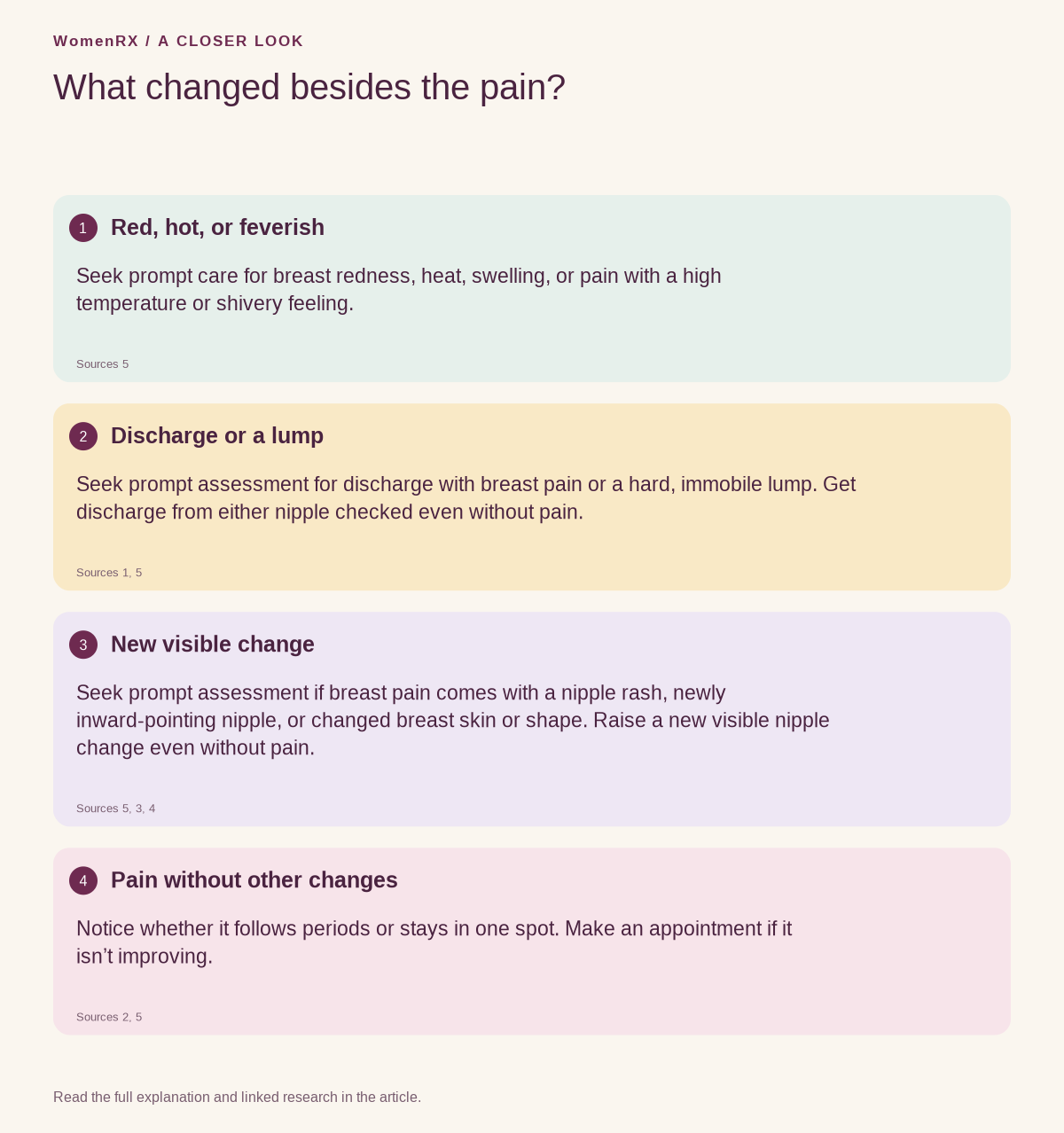
What changed besides the pain?
Red, hot, or feverish: Seek prompt care for breast redness, heat, swelling, or pain with a high temperature or shivery feeling.5
Discharge or a lump: Seek prompt assessment for discharge with breast pain or a hard, immobile lump. Get discharge from either nipple checked even without pain.15
New visible change: Seek prompt assessment if breast pain comes with a nipple rash, newly inward-pointing nipple, or changed breast skin or shape. Raise a new visible nipple change even without pain.534
Pain without other changes: Notice whether it follows periods or stays in one spot. Make an appointment if it isn’t improving.25
Read the figure as text
Use the accompanying signs and the pain pattern to decide your next step. This is a decision aid, not a diagnosis.- Red, hot, or feverish: Seek prompt care for breast redness, heat, swelling, or pain with a high temperature or shivery feeling.5
- Discharge or a lump: Seek prompt assessment for discharge with breast pain or a hard, immobile lump. Get discharge from either nipple checked even without pain.15
- New visible change: Seek prompt assessment if breast pain comes with a nipple rash, newly inward-pointing nipple, or changed breast skin or shape. Raise a new visible nipple change even without pain.534
- Pain without other changes: Notice whether it follows periods or stays in one spot. Make an appointment if it isn’t improving.25
More questions, answered
Does nipple discharge count if I only notice it when squeezing?
Yes. Discharge can appear on its own or when the nipple is squeezed, and discharge from either nipple should be checked. If it occurs with breast pain, seek prompt assessment. Tell the clinician whether it happens without squeezing and what it looks like. 15
Sources you can check
- Nipple discharge - NHSAccessed 2026-09-25Return to first citation
- A Review of Breast Pain: Causes, Imaging Recommendations, and Treatment.Sivarajah R, Welkie J, Mack J, Casas RS, Paulishak M, Chetlen AL. · Journal of breast imaging · 2020Return to first citation
- Dermatologic diseases of the breast, areola and nipple.Deluca J, Pichler M, Bataraga E, Puviani M, Eisendle K. · Journal der Deutschen Dermatologischen Gesellschaft = Journal of the German Society of Dermatology : JDDG · 2025Return to first citation
- Multimodality Imaging of Benign and Malignant Diseases of the Nipple-Areolar Complex.Guirguis MS, Arribas EM, Kapoor MM, Patel MM, Perez F, Nia ES, Ding Q, Moseley TW, Adrada BE. · Radiographics : a review publication of the Radiological Society of North America, Inc · 2024Return to first citation
- Breast pain - NHSAccessed 2026-09-25Return to first citation