Choline After 40: When Intake Deserves a Closer Look
Turning 40 doesn’t raise your choline target; your usual food pattern and life stage matter more.
Being over 40 alone isn’t a reason to take choline. For an adult woman who is neither pregnant nor breastfeeding, the Adequate Intake is 425 mg a day, with no increase at 40. It’s 450 mg during pregnancy and 550 mg during breastfeeding. Consider your usual foods and any choline in supplements you already take before deciding whether another product is worth discussing. 1
Start with life stage, not your birthday
For adult women who are neither pregnant nor breastfeeding, the Adequate Intake (AI) for choline is 425 mg a day from age 19 onward. It doesn’t rise simply because you’re in your 40s, 50s, or older. The AI is 450 mg a day during pregnancy and 550 mg a day during breastfeeding. 1
An AI is a reference for planning intake, not a personal deficiency cutoff. There wasn’t enough evidence to set an Estimated Average Requirement for choline, so an AI was established instead. An estimate below the AI doesn’t, by itself, show that you’re deficient or need a supplement. 1
Look at the foods you eat regularly
Choline comes from a range of foods. In the United States, eggs, meat, poultry, fish, and dairy are common sources. Soybeans, certain beans, cruciferous vegetables, nuts, seeds, and whole grains can contribute too. For a sense of how amounts vary, one large hard-boiled egg contains 147 mg, half a cup of roasted soybeans contains 107 mg, and half a cup of canned kidney beans contains 45 mg. 1
If you rarely eat eggs or animal foods, look at which plant sources you eat regularly rather than assuming your intake is either low or adequate. A U.S. survey from 2013-2014 found that adult women averaged 278 mg of choline a day from food and beverages. That’s a group average, not a measurement of women over 40 or a way to tell what you personally get. The NIH also notes that frank choline deficiency is very rare in healthy, nonpregnant women, even though many people consume less than the AI. 1
You may not find choline listed on every package: food labels generally aren’t required to show it unless choline has been added. Your usual pattern of meals is more useful to consider than treating one day’s estimate as a verdict. 1
When a supplement is worth discussing
Pregnancy and breastfeeding change the reference intake, so they’re reasons to take a closer look at food and supplement sources. The NIH reports that about 90%-95% of pregnant women consume less than the AI and that prenatal supplements typically contain little or no choline. Check what a product actually contains rather than assuming a prenatal vitamin covers it. 1
Outside those life stages, a closer look may make sense if your regular eating pattern includes few choline sources. Also check whether a multivitamin or another supplement you already take contains choline. Products vary in their choline amounts and forms, so the word “choline” on the front of a bottle doesn’t tell you how much you’d be adding. 1
What about taking choline for sharper thinking after 40? In an observational study of Chinese adults aged 55-79, patterns of dietary choline intake were associated with cognitive outcomes, including in a reported women’s subgroup. The study didn’t test supplements, so it can’t show that taking one improves cognition or establish a special benefit for women over 40. 2
More isn’t automatically better
The upper intake level for adults is 3,500 mg a day from food and supplements combined. That’s a safety limit, not a target. High intakes have been associated with effects including fishy body odor, vomiting, excessive sweating, low blood pressure, and liver toxicity. 1
The useful distinction is straightforward: age alone doesn’t change the choline AI. Pregnancy or breastfeeding does. Otherwise, your regular food choices and what’s already in your supplements give you a better starting point than an age-based claim on a bottle. 1
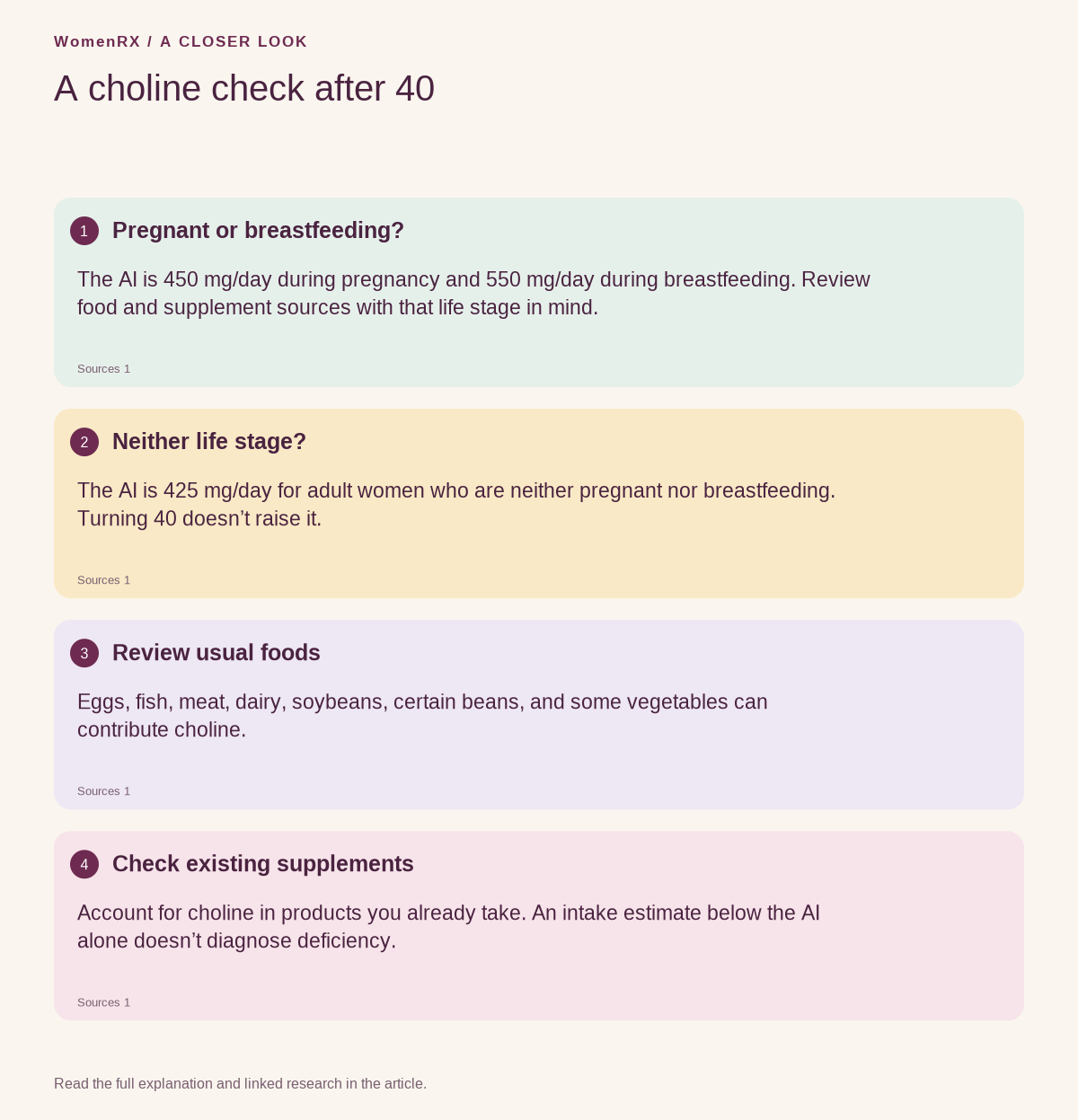
A choline check after 40
Pregnant or breastfeeding?: The AI is 450 mg/day during pregnancy and 550 mg/day during breastfeeding. Review food and supplement sources with that life stage in mind.1
Neither life stage?: The AI is 425 mg/day for adult women who are neither pregnant nor breastfeeding. Turning 40 doesn’t raise it.1
Review usual foods: Eggs, fish, meat, dairy, soybeans, certain beans, and some vegetables can contribute choline.1
Check existing supplements: Account for choline in products you already take. An intake estimate below the AI alone doesn’t diagnose deficiency.1
Read the figure as text
Start with life stage, then consider regular food sources and any supplements you already take.- Pregnant or breastfeeding?: The AI is 450 mg/day during pregnancy and 550 mg/day during breastfeeding. Review food and supplement sources with that life stage in mind.1
- Neither life stage?: The AI is 425 mg/day for adult women who are neither pregnant nor breastfeeding. Turning 40 doesn’t raise it.1
- Review usual foods: Eggs, fish, meat, dairy, soybeans, certain beans, and some vegetables can contribute choline.1
- Check existing supplements: Account for choline in products you already take. An intake estimate below the AI alone doesn’t diagnose deficiency.1
More questions, answered
Does eating less than 425 mg a day mean I’m deficient?
No. For an adult woman who is neither pregnant nor breastfeeding, 425 mg is the Adequate Intake, not a diagnostic cutoff. An estimate below it alone doesn’t establish deficiency; frank choline deficiency is very rare in healthy, nonpregnant women. 1
Sources you can check
- Choline - Health Professional Fact SheetAccessed 2026-09-25Return to first citation
- [Association between dietary choline intake trajectories and cognitive function in middle-aged and older population].Liu YB, Du WW, Cao QY, Wang HJ, Su C, He YN, Ji JG, Li J, Jia XF. · Zhonghua liu xing bing xue za zhi = Zhonghua liuxingbingxue zazhi · 2025Return to first citation