Crawling Skin During Menopause: What Deserves a Closer Look
A crawling sensation can occur during the menopause transition, but its pattern and accompanying symptoms matter more than its timing.
Menopause studies have assessed formication, the name for a crawling sensation, but its timing doesn’t establish that hormones are the cause.45 If it keeps happening, a routine visit can help identify what might relieve it. Seek assessment if you also notice tingling or numbness in your hands or feet, weakness, balance trouble, or a foot wound that isn’t healing.12
Start with what you notice
“Crawling” is a useful description to bring to an appointment. It tells someone more than “my skin feels strange.” If it feels like something is moving on your skin, say that. An urge to scratch is a separate observation, as is a patch that feels less sensitive. Note whether you can see a change on the skin, too. You don’t have to decide which medical term fits or work out the cause on your own.
The location matters, too. Is the feeling in one small patch, or does it affect both feet or hands? Does it come and go, or stay? These details can help you describe the symptom clearly. Peripheral neuropathy can cause tingling or numbness in the feet or hands; depending on the nerves affected, it can also involve problems with balance or movement.12
Menopause timing is a clue, not an answer
Formication appears on menopausal symptom questionnaires. In a 2025 survey of women from communities in China, formication was among the symptoms reported at the highest severity in the menopause-transition stage labeled -2, affecting 0.25% of women in that stage. That finding describes a symptom reported alongside menopausal stages; it doesn’t show that hormone changes caused it or establish how to treat it.4 A separate study of women visiting Beijing Obstetrics & Gynecology hospital included formication among the symptoms assessed; the reported findings did not single it out.5
So if the feeling began around the time your periods changed, keep that timing in the picture without stopping there. Reduced feeling or trouble walking can also occur with neuropathy; mention those changes when seeking an assessment rather than assuming they’re simply part of menopause.12
Which accompanying signs change the next step?
Crawling without other changes: Note where it happens, how long it lasts, and whether anything has changed on your skin. If it keeps happening, you can discuss it at a routine visit. Your notes can help you explain the pattern if you decide to seek a review.
Tingling or numbness in the feet or hands: Arrange a review. These can be early symptoms of peripheral neuropathy. A clinician may ask about the pattern and arrange tests to look for an underlying cause.1
Balance trouble, weakness, or difficulty lifting the front of a foot when walking: Arrange an assessment for these changes rather than assuming they’re due to menopause. They can occur with forms of neuropathy that affect sensation or movement.2
A cut or sore on a foot that isn’t healing: Get it checked, particularly if feeling in that foot has changed. A nonhealing foot wound is specifically listed as a reason to seek care when neuropathy may be involved.1
These signs don’t mean you have neuropathy. They do mean the assessment should look beyond menopause symptoms.
What a review can look for
Peripheral neuropathy has several possible causes. Diabetes is one; certain medicines and heavy alcohol use can also contribute. Vitamin B12 deficiency is another potentially treatable cause.13 Those possibilities call for different responses, which is why choosing a menopause remedy or a nerve-pain product before the cause is clearer may miss the useful next step.
Bring an up-to-date list of medicines and supplements, and mention if you have diabetes or have noticed changes in sensation, strength, or walking. Don’t stop a prescribed medicine on your own because you suspect it: if a medicine may be contributing, the prescriber can weigh that possibility against why you take it. Treatment for neuropathy depends on its cause, and some causes can be addressed directly.13
What might help the feeling ease?
The useful treatment depends on what’s causing the sensation, not just on when it started. If an assessment finds neuropathy related to diabetes, improving blood sugar control may help or keep it from worsening. A confirmed B12 deficiency can be treated. If a medicine is contributing, a prescriber can review it with you; medicine-related neuropathy may improve when the responsible medicine is stopped.3 These are options for identified causes, not proven fixes for crawling on its own.
If the sensation comes with nerve pain, say so. Neuropathy-related pain may call for a different treatment than an isolated crawling feeling, and common painkillers often don’t relieve nerve pain well.13 That distinction can help you avoid trying to treat the wrong symptom.
For a brief record before your visit, jot down where, when, and what else: where the crawling occurs, when it happens, and whether it comes with visible skin changes, numbness, tingling, weakness, or balance trouble. Include when your periods changed if that seems relevant. The goal isn’t to prove a hormonal link. It’s to give the person assessing you a clearer picture of the symptom you’re actually having.
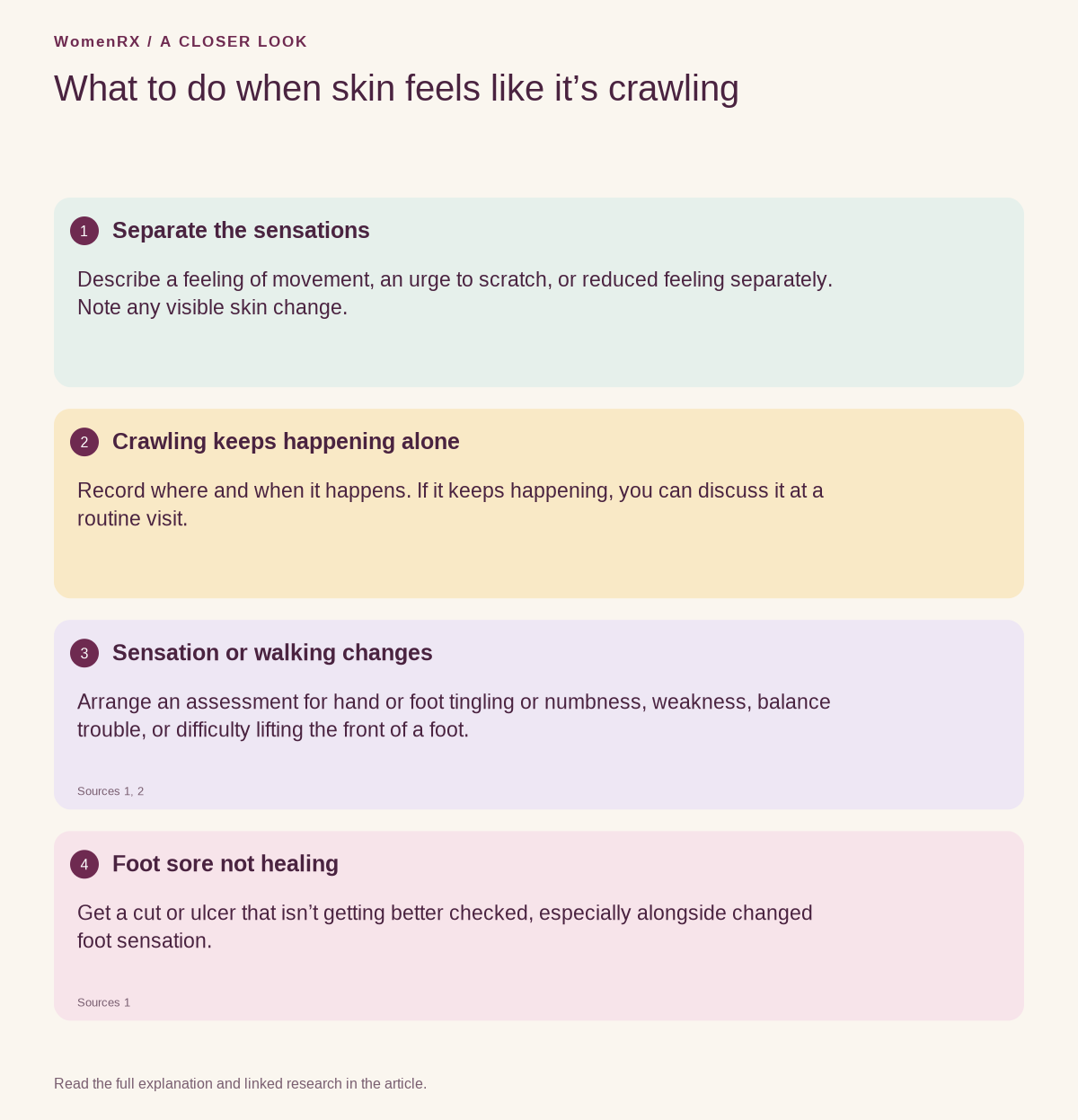
What to do when skin feels like it’s crawling
Separate the sensations: Describe a feeling of movement, an urge to scratch, or reduced feeling separately. Note any visible skin change.
Crawling keeps happening alone: Record where and when it happens. If it keeps happening, you can discuss it at a routine visit.
Sensation or walking changes: Arrange an assessment for hand or foot tingling or numbness, weakness, balance trouble, or difficulty lifting the front of a foot.12
Foot sore not healing: Get a cut or ulcer that isn’t getting better checked, especially alongside changed foot sensation.1
Read the figure as text
First describe each sensation separately. Then follow the path that fits what’s happening alongside the crawling feeling.- Separate the sensations: Describe a feeling of movement, an urge to scratch, or reduced feeling separately. Note any visible skin change.
- Crawling keeps happening alone: Record where and when it happens. If it keeps happening, you can discuss it at a routine visit.
- Sensation or walking changes: Arrange an assessment for hand or foot tingling or numbness, weakness, balance trouble, or difficulty lifting the front of a foot.12
- Foot sore not healing: Get a cut or ulcer that isn’t getting better checked, especially alongside changed foot sensation.1
Sources you can check
- Peripheral neuropathy - NHSAccessed 2026-09-25Return to first citation
- Peripheral neuropathy - Symptoms - NHSAccessed 2026-09-25Return to first citation
- Peripheral neuropathy - Treatment - NHSAccessed 2026-09-25Return to first citation
- A survey of menopausal symptoms in Chinese community women based on the STRAW+10 staging system.Wang J, Yang Y, Yang Y, Sun Z, Chen Y, Zheng R. · Menopause (New York, N.Y.) · 2025Return to first citation
- Prevalence of climacteric symptoms comparing perimenopausal and postmenopausal Chinese women.Ruan X, Cui Y, Du J, Jin F, Mueck AO. · Journal of psychosomatic obstetrics and gynaecology · 2017Return to first citation