Crawling Skin Sensations: Is Menopause the Cause?
Crawling sensations can happen around menopause, but the feeling alone can’t tell you whether hormones, nerves, or something else is involved.
Formication is a crawling, stinging, or biting sensation on the skin, often described as feeling like insects are moving there. A study of women attending a menopause clinic included broader limb pain and unusual sensations, but its abstract gives no formication-specific result. It doesn’t show that menopause causes the crawling feeling. Nerve conditions and some medications are other possibilities worth considering. 672
First, put a name to the feeling
Formication describes a sensation of crawling, stinging, or biting on the skin without evidence of infestation. It’s a description of what you feel, not a diagnosis. One clinical review discusses it in the context of tactile hallucinations, but having a crawling sensation does not by itself mean you have a psychiatric condition or believe you’re infested. 6
The words you use can help make the sensation clearer. Crawling suggests movement across the skin. Itch tells someone you feel like scratching; it doesn’t necessarily convey that sense of movement. Tingling or pins and needles describes another kind of altered sensation. These feelings can overlap, so you don’t need to force a perfect label: saying, for example, “It feels like something is crawling on my lower legs, I want to scratch, and sometimes my feet go numb” conveys more than choosing just one term. Peripheral nerve problems can cause tingling and numbness, particularly in the feet or hands. 632
What the menopause research can and can’t tell us
If you first notice a crawling feeling during perimenopause or after menopause, it’s reasonable to wonder whether hormones play a part.
In a two-year study of 4,063 women attending a menopause clinic in China, questionnaires included a category for limb pain and paresthesia, a broad term for altered sensations. Those symptoms were reported in both perimenopausal and postmenopausal women; the study found symptoms overall were more severe in the postmenopausal group. The published abstract does not give a formication-specific result, so it cannot tell us how often these women felt crawling sensations, whether hormone changes caused them, or whether treating menopause symptoms would relieve them. Because the participants attended a specialty clinic in China, their reports also should not be treated as a prevalence estimate for all US women. 7
That leaves a useful distinction: menopause may be the period when you notice the sensation, without being its established explanation. You can take the symptom seriously without assuming it’s hormonal.
Other clues that change the picture
Nerve symptoms. Peripheral neuropathy affects nerves outside the brain and spinal cord. Depending on the nerves involved, it can bring numbness, pins and needles, altered sensation, pain, weakness, or balance trouble. Diabetes is one possible cause; heavy alcohol use and some medicines are others. Vitamin B12 deficiency is another treatable cause discussed in neuropathy guidance. None of these can be identified from a crawling feeling alone. 2314
A medication change. A review of published reports associated tactile hallucinations, often described as formication, with several medication groups, including anti-Parkinson medicines, antidepressants, prescription stimulants, and some blood-pressure or seizure medicines. The review cautioned that its conclusions were limited. These reports don’t establish that a medicine you take is the cause. 6 If the sensation began after a medicine was started or changed, note that timing when describing your symptoms.
Where it happens and what comes with it. For example, crawling sensations limited to the vulva call for a different look than numbness and tingling in both feet. A review of chronic vulvar discomfort includes formication among the sensations people may report and describes several possible contributors, including skin disease, neuropathy, referred pain, and pelvic floor problems. If the feeling is in your fingers along with pain or numbness, a compressed nerve such as the one involved in carpal tunnel syndrome is another possibility. Location helps narrow the questions; it doesn’t settle the answer. 53
When to get it checked
If the crawling sensation comes with numbness, weakness, or trouble with balance, arrange an assessment rather than writing it off as menopause. Neuropathy guidance recommends evaluation of early symptoms so an underlying cause can be identified where possible. If you have a foot cut or sore that isn’t healing, get that checked too, particularly if you have diabetes or reduced feeling in your feet. 23
You can describe the pattern plainly: where it happens, whether there’s visible skin change, whether it comes with numbness or weakness, and whether it began around a medication change. The goal isn’t to prove or disprove a hormone link in advance. It’s to give the sensation enough attention to find an explanation that fits. 236
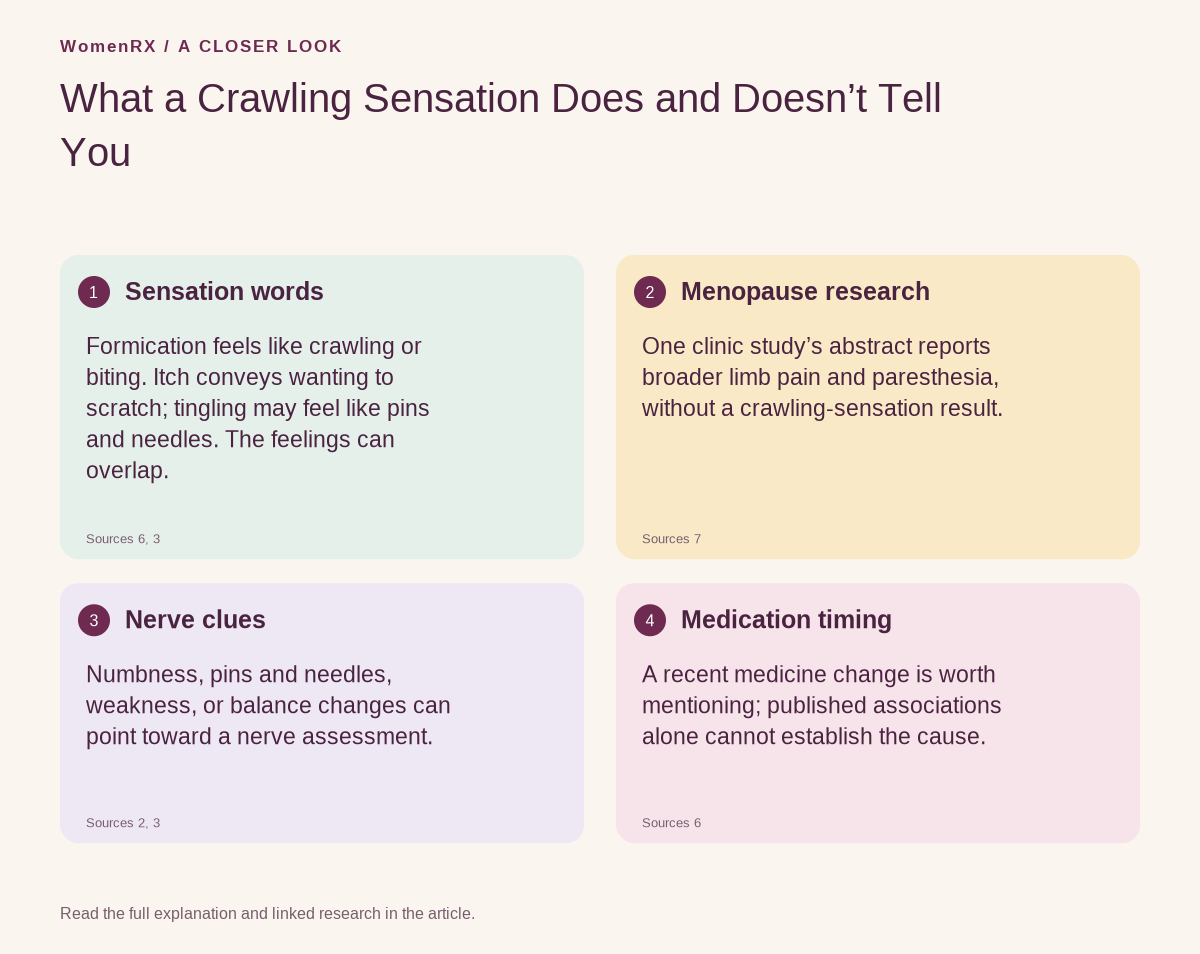
What a Crawling Sensation Does and Doesn’t Tell You
Sensation words: Formication feels like crawling or biting. Itch conveys wanting to scratch; tingling may feel like pins and needles. The feelings can overlap.63
Menopause research: One clinic study’s abstract reports broader limb pain and paresthesia, without a crawling-sensation result.7
Nerve clues: Numbness, pins and needles, weakness, or balance changes can point toward a nerve assessment.23
Medication timing: A recent medicine change is worth mentioning; published associations alone cannot establish the cause.6
Read the figure as text
The description is useful, but its location and accompanying symptoms matter more than the label alone.- Sensation words: Formication feels like crawling or biting. Itch conveys wanting to scratch; tingling may feel like pins and needles. The feelings can overlap.63
- Menopause research: One clinic study’s abstract reports broader limb pain and paresthesia, without a crawling-sensation result.7
- Nerve clues: Numbness, pins and needles, weakness, or balance changes can point toward a nerve assessment.23
- Medication timing: A recent medicine change is worth mentioning; published associations alone cannot establish the cause.6
More questions, answered
Does formication mean there are insects on my skin?
No. The term describes a crawling, stinging, or biting sensation without evidence of infestation. It names the sensation, not what’s causing it. 6
How is formication different from itch or tingling?
Formication emphasizes a crawling or biting feeling. Itch describes wanting to scratch, while tingling is often described as pins and needles. The feelings can overlap, so use whichever words fit, even if that’s more than one. 63
Sources you can check
- Peripheral neuropathy - Causes - NHSAccessed 2026-09-25Return to first citation
- Peripheral neuropathy - NHSAccessed 2026-09-25Return to first citation
- Peripheral neuropathy - Symptoms - NHSAccessed 2026-09-25Return to first citation
- Peripheral neuropathy - Treatment - NHSAccessed 2026-09-25Return to first citation
- Management of vulvar pain.Fischer G. · Dermatologic therapy · 2004Return to first citation
- Drug-Induced Tactile Hallucinations Beyond Recreational Drugs.Nakamura M, Koo J. · American journal of clinical dermatology · 2016Return to first citation
- Menopausal symptoms among Chinese peri- and postmenopausal women: a large prospective single-center cohort study.Zhang L, Ruan X, Cui Y, Gu M, Mueck AO. · Gynecological endocrinology : the official journal of the International Society of Gynecological Endocrinology · 2021Return to first citation