Crawling Skin Sensations in Perimenopause: What to Check
A crawling feeling can start during perimenopause, but its pattern and accompanying symptoms matter more than its timing.
Formication is the feeling of insects crawling on or under your skin when nothing is there. It describes a sensation, not its cause. Perimenopausal studies have measured broader tingling or altered sensation, but they don’t establish that hormones cause formication or tell us how long it lasts. New or persistent crawling sensations deserve a closer look, especially if you also have numbness or weakness.752
First, name what you’re feeling
Formication has a particular meaning: the sensation of insects crawling on or beneath your skin when nothing is touching it. The feeling can be vivid and upsetting. Having it doesn’t, by itself, tell you why it’s happening.7
Two nearby descriptions can help you explain it. Itching makes you want to scratch and may come with dry skin, a rash or hives. Paresthesia is a broader term for altered sensation, often described as tingling or pins and needles. The sensations can overlap, so you don’t need to choose the perfect medical word before describing what you feel.135
Does perimenopause explain it?
It’s possible to notice a crawling or prickling sensation during perimenopause without knowing whether the transition caused it. Some studies of women with perimenopausal symptoms recorded paresthesia, but that broader measure doesn’t identify which participants felt insect-like crawling. Those studies don’t establish a hormonal cause for formication, or a typical number of days, weeks or months it should last.56
That distinction changes the next move. Rather than waiting for the sensation to follow a presumed menopause timetable, consider what else is happening with your skin, your nerves and any medicines or substances you use.
Clues that point toward skin or nerves
If the feeling comes with visible irritation, dryness, a rash or a strong urge to scratch, start by noticing what contacts that area. Dry skin, eczema, irritating products, insect bites and allergic reactions can all cause itching. For ordinary itch, a cool compress and avoiding irritating fabrics, scratching, and high heat or humidity may help while you work out what’s setting it off.1
If there’s no visible skin change, pay attention to whether you also have tingling, numbness, burning pain or reduced ability to feel temperature. Peripheral nerve problems can produce these sensations, particularly in the hands or feet. Symptoms that begin in the feet and gradually spread upward are one pattern clinicians look for; weakness or changes in balance add a different reason to get assessed. These patterns are clues, not a way to diagnose yourself.23
The possible causes aren’t limited to skin or menopause. Diabetes, a vitamin B12 deficiency, nerve injury, shingles and certain medicines can be involved in nerve symptoms. Formication specifically has also been linked to some prescribed drugs, stimulant use, and alcohol or drug withdrawal, among other medical and neurological conditions. For example, Cleveland Clinic lists bupropion, methylphenidate and topiramate among medicines that can cause it. A link on that list doesn’t mean your medicine is the cause, and it isn’t a reason to stop a prescription on your own.247
When to get care
Arrange a medical assessment for a new, unexplained crawling sensation, particularly if it began after a medication change or keeps happening. Seek assessment for tingling or loss of feeling in your feet, worsening balance or weakness, too. If what you mainly feel is itching, severe itch, itch without an apparent cause or itch that hasn’t gone away after a few weeks also warrants a check.721
Get emergency help if a sudden change in sensation occurs with a drooping face, new weakness in one arm or difficulty speaking. Those are stroke warning signs; don’t wait to see whether the skin feeling passes.7
You can make the conversation more useful by describing the sensation in your own words: crawling, itching, prickling, burning or numbness. Note where it happens, whether you can see a skin change, whether it comes and goes or spreads, and whether weakness or balance trouble comes with it. Mention recent medication changes and any possible exposure or withdrawal. Those details help separate a skin complaint from a possible nerve problem and guide what needs checking.1237
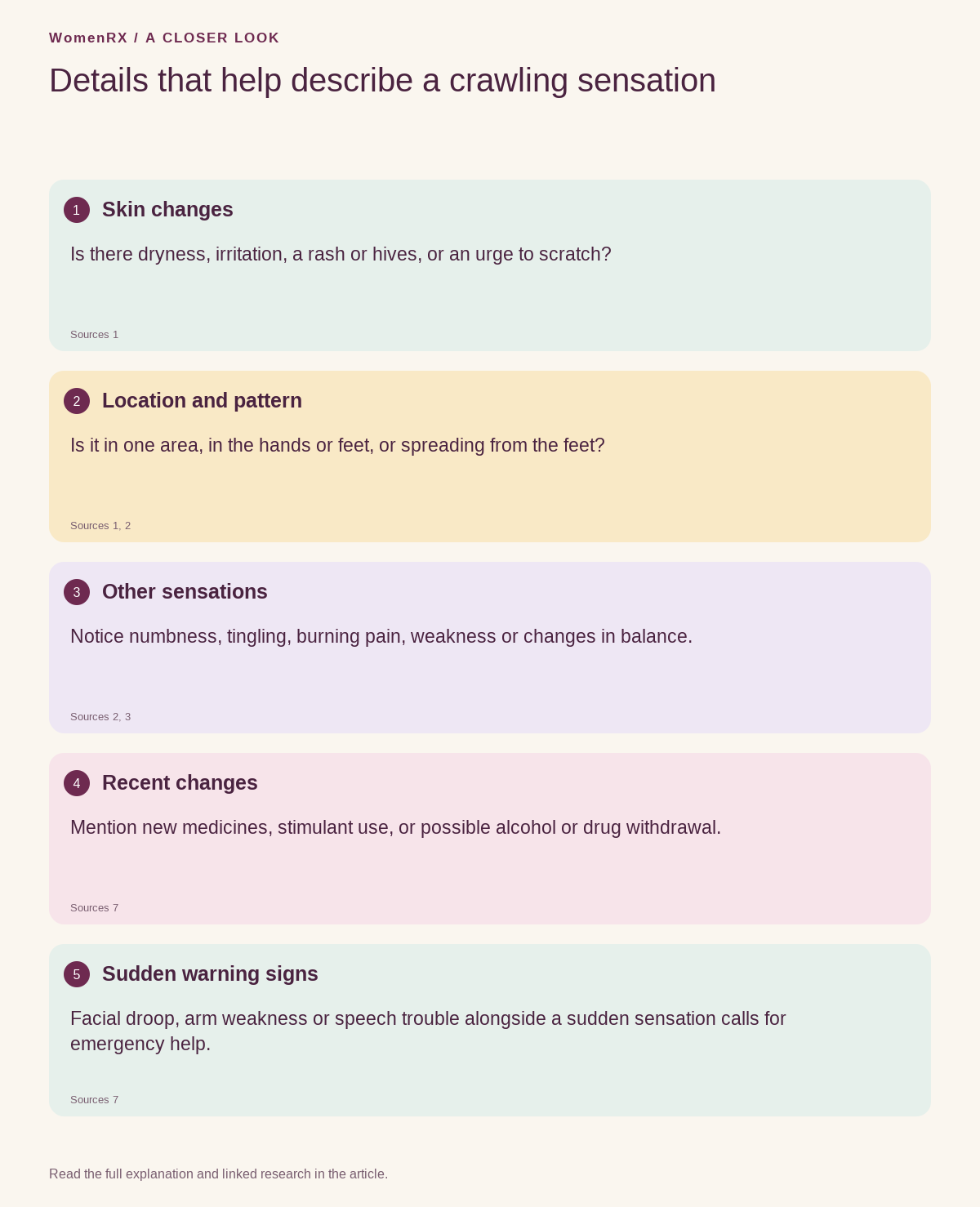
Details that help describe a crawling sensation
Skin changes: Is there dryness, irritation, a rash or hives, or an urge to scratch?1
Location and pattern: Is it in one area, in the hands or feet, or spreading from the feet?12
Other sensations: Notice numbness, tingling, burning pain, weakness or changes in balance.23
Recent changes: Mention new medicines, stimulant use, or possible alcohol or drug withdrawal.7
Sudden warning signs: Facial droop, arm weakness or speech trouble alongside a sudden sensation calls for emergency help.7
Read the figure as text
This is a description aid, not a diagnostic test. Notice which details fit before you discuss a new or persistent sensation.- Skin changes: Is there dryness, irritation, a rash or hives, or an urge to scratch?1
- Location and pattern: Is it in one area, in the hands or feet, or spreading from the feet?12
- Other sensations: Notice numbness, tingling, burning pain, weakness or changes in balance.23
- Recent changes: Mention new medicines, stimulant use, or possible alcohol or drug withdrawal.7
- Sudden warning signs: Facial droop, arm weakness or speech trouble alongside a sudden sensation calls for emergency help.7
More questions, answered
Can formication happen without a rash?
Yes. Formication describes a crawling sensation, not a visible skin finding. A rash or dryness may point toward a skin-related itch instead, while accompanying numbness, tingling or weakness raises different questions about nerve function.713
Sources you can check
- Itching | Pruritus | Itchy skin | MedlinePlusAccessed 2026-09-25Return to first citation
- Peripheral neuropathy - NHSAccessed 2026-09-25Return to first citation
- Peripheral neuropathy - Symptoms - NHSAccessed 2026-09-25Return to first citation
- Peripheral neuropathy - Treatment - NHSAccessed 2026-09-25Return to first citation
- The special extract ERr 731® from the root of rhapontic rhubarb (Rheum rhaponticum): efficacy in headache/migraine and further climacteric complaints in women in the perimenopause.Heger PW, Meinert I, Hotz D. · Frontiers in pharmacology · 2026Return to first citation
- Effect of Gua sha therapy on perimenopausal syndrome: a randomized controlled trial.Meng F, Duan PB, Zhu J, Lou QQ, Fang ZH, An HL, Liu LY, Hu Y, Hu Q. · Menopause (New York, N.Y.) · 2017Return to first citation
- Tactile Hallucinations (Formication): Causes & TreatmentAccessed 2026-09-25Return to first citation