Crawling Skin Sensations in Your 40s: Is It Perimenopause?
A crawling feeling may occur alongside perimenopausal changes, but its location and accompanying symptoms can point toward other explanations.
A crawling skin sensation in your 40s could coincide with perimenopause, especially if you’re also noticing changes in your periods, but the sensation alone can’t tell you it’s hormonal. Studies of perimenopausal women have measured related altered sensations, not established that every crawling feeling has the same cause. Nerve problems, medicines and skin conditions also deserve consideration. 4526
The feeling matters as much as the timing
Say your periods have started changing and you sometimes feel as though something is moving across your skin. It’s reasonable to wonder whether the two are connected. Research involving perimenopausal women has included paresthesia, a broad category of altered sensations, among the symptoms measured. That gives the question a basis, but it doesn’t show that a particular crawling sensation is caused by hormone changes. 45
Try describing what happens rather than relying on one label. Is it mainly an urge to scratch? A prickling, burning or crawling feeling? Do you see a rash or another skin change, or does the skin look much the same as usual? Itch, burning and other unusual sensations can occur even on normal or minimally changed skin, so appearance alone won’t settle the cause. These details give a clinician a better starting point. 6
What else could explain it?
A nerve problem is one possibility, particularly when the sensation comes with numbness, pins and needles, burning pain, reduced ability to feel temperature, weakness or balance trouble. Peripheral neuropathy often affects the feet or hands, though symptoms depend on which nerves are involved. Diabetes is one possible cause; vitamin B12 deficiency and certain medicines are other causes a clinician may investigate. These possibilities don’t mean you have neuropathy, but they’re reasons not to attribute a new sensation to perimenopause by default. 231
Skin and sensory conditions are another possibility. Some cause itch or burning on skin that looks normal or only slightly changed. Where the feeling occurs and whether a product has touched that area can help guide an evaluation; for example, a clinician may consider contact allergy when the history points to a product exposure. 6
Medicines are worth including in the picture. Some can cause peripheral neuropathy. If the sensation began after a medicine change, write down the name and when you started it, but don’t stop a prescribed medicine on the assumption that it’s the cause. A clinician can assess whether the timing and symptoms fit. 21
When to get it checked
Arrange an assessment if the sensation is new, persists or keeps returning, especially if you also notice numbness or tingling in your hands or feet. If you develop new weakness or trouble with balance, seek prompt assessment rather than waiting to see whether your periods change again. These can be neurologic symptoms that warrant evaluation. 23
An evaluation may start with questions about the feeling and an examination of sensation, strength and reflexes. Depending on what those show, a clinician may check for causes such as diabetes or vitamin B12 deficiency; more specialized nerve tests are sometimes used. That’s a more useful path than trying to decide from age alone whether the cause is hormonal. 1
Before the visit, a few concrete observations can help: where the feeling happens, whether it’s crawling, itchy, burning or prickling, when it started, whether there’s a visible skin change, and whether numbness, weakness or balance changes occur too. Include changes you’ve noticed in your periods and any recent medicine or skin-product changes. The point isn’t to prove a perimenopause connection. It’s to give the person assessing you enough detail to consider it alongside other possibilities. 136
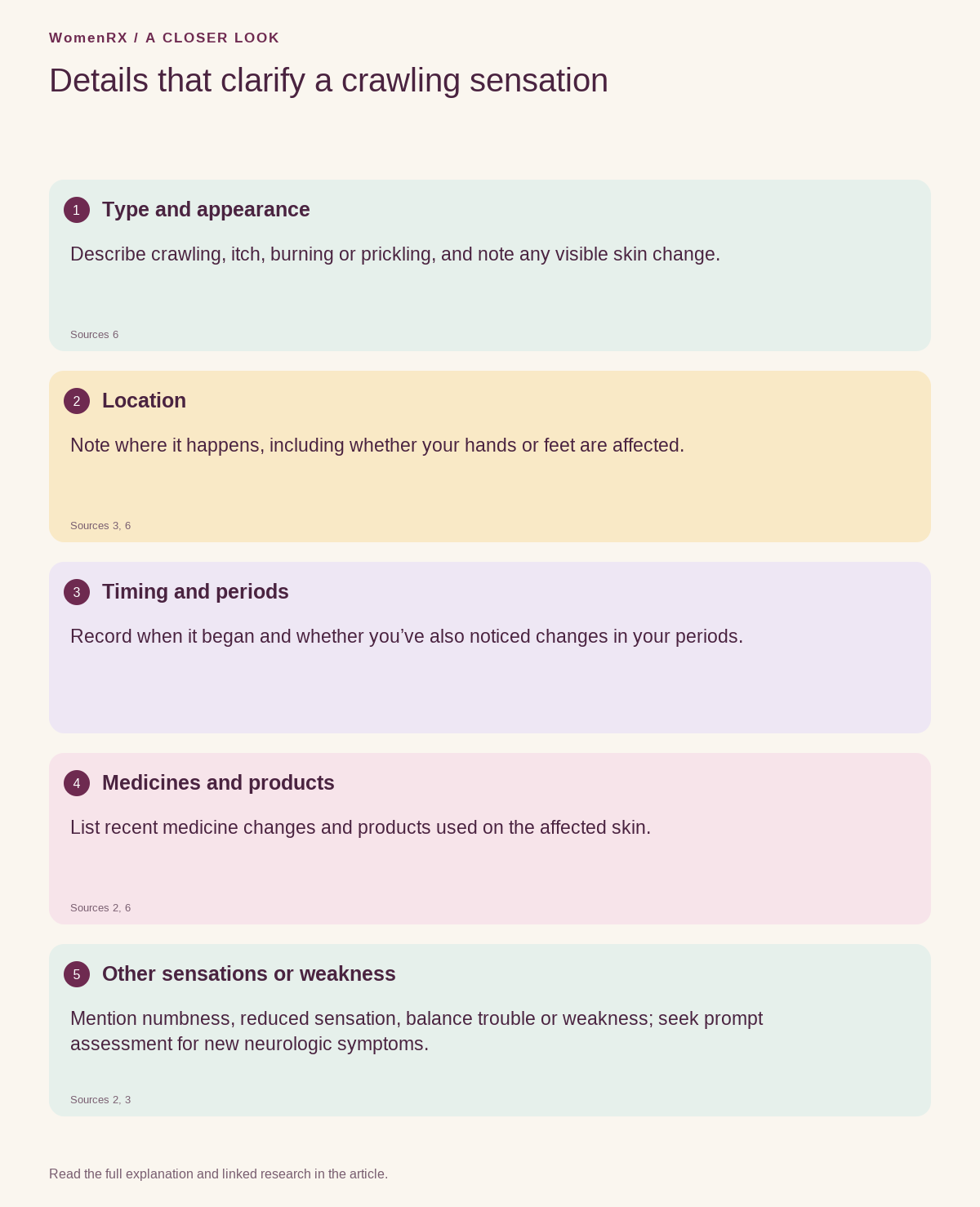
Details that clarify a crawling sensation
Type and appearance: Describe crawling, itch, burning or prickling, and note any visible skin change.6
Location: Note where it happens, including whether your hands or feet are affected.36
Timing and periods: Record when it began and whether you’ve also noticed changes in your periods.
Medicines and products: List recent medicine changes and products used on the affected skin.26
Other sensations or weakness: Mention numbness, reduced sensation, balance trouble or weakness; seek prompt assessment for new neurologic symptoms.23
Read the figure as text
These observations help describe the symptom and its context; they are not a diagnostic score.- Type and appearance: Describe crawling, itch, burning or prickling, and note any visible skin change.6
- Location: Note where it happens, including whether your hands or feet are affected.36
- Timing and periods: Record when it began and whether you’ve also noticed changes in your periods.
- Medicines and products: List recent medicine changes and products used on the affected skin.26
- Other sensations or weakness: Mention numbness, reduced sensation, balance trouble or weakness; seek prompt assessment for new neurologic symptoms.23
Sources you can check
- Peripheral neuropathy - Diagnosis - NHSAccessed 2026-09-25Return to first citation
- Peripheral neuropathy - NHSAccessed 2026-09-25Return to first citation
- Peripheral neuropathy - Symptoms - NHSAccessed 2026-09-25Return to first citation
- Impact of Exercise on Perimenopausal Syndrome: A Systematic Review of Randomized Controlled Trials.Philip AE, Singh H, Nanjundiah SY, Samudrala PC, Theunissen W, Robinson J, Banerjee I. · Cureus · 2025Return to first citation
- The special extract ERr 731® from the root of rhapontic rhubarb (Rheum rhaponticum): efficacy in headache/migraine and further climacteric complaints in women in the perimenopause.Heger PW, Meinert I, Hotz D. · Frontiers in pharmacology · 2026Return to first citation
- Understanding cutaneous sensory syndromes: diagnostic challenges and treatment implications.Patel JD, Jafferany M. · Clinical and experimental dermatology · 2026Return to first citation