Glucomannan for Weight or Blood Sugar: What to Know
Glucomannan’s weight-loss results are modest at best; glucose findings are more encouraging, but they don’t predict what a particular supplement will do for you.
Glucomannan is a water-absorbing fiber from konjac root. Weight-loss studies show little or modest average benefit, while earlier research suggests possible benefits for glucose levels. Two recent blood-sugar trials used konjac-fiber foods, so they can’t establish what a stand-alone supplement does. Tablet forms have been linked to esophageal blockage. Check the product’s fluid directions, and review any medicines you take with a pharmacist or prescriber. 1 2 3 4
The weight-loss evidence is modest
Glucomannan is a soluble fiber from konjac root. It absorbs water, which may increase fullness, but a plausible mechanism isn’t proof of lasting weight loss. 1
The study summaries don’t line up perfectly. A 2015 review of six randomized trials, with 293 participants, found no significant weight difference versus placebo after up to 12 weeks. An older review of 14 studies found about 0.79 kg more weight loss than placebo over roughly five weeks. 1
A later systematic review and meta-analysis estimated 1.27 kg greater weight loss than placebo (95% confidence interval 0.09 to 2.45 kg), but that did not reach the review’s threshold for clinical significance of 2.5 kg. Put plainly, one analysis found a small average difference; the broader takeaway is not to expect substantial weight loss from glucomannan. 4
Women were included in some studies, including a small trial of 20 women that reported weight loss. But that study alone can’t establish a reliable effect, and the broader reviews don’t show that women respond differently from men. 1
Blood-sugar results are promising, but hard to separate
Earlier research summarized by the NIH Office of Dietary Supplements suggests glucomannan may benefit glucose levels. That’s a different question from whether a particular stand-alone supplement will improve your blood sugar. Two recent trials offer more clues, but tested glucomannan in foods rather than on its own. 1 2 3
In a three-month randomized trial of adults with obesity and prediabetes, both groups followed personalized diet and exercise plans. One group also ate konjac-fiber biscuits that replaced some carbohydrates. Among the participants who completed the trial, the study reported a better fasting-glucose control rate in the biscuit group. But it found no significant between-group difference in two-hour post-meal glucose. Because the intervention involved a particular food that replaced some carbohydrates, it can’t show that a glucomannan supplement by itself improves blood sugar. The reported results also come from participants who completed the trial, not everyone originally enrolled. 2
In another randomized trial, 80 adults with type 2 diabetes ate either yogurt containing glucomannan and inulin or plain yogurt for eight weeks. The combination improved some insulin-sensitivity measures, but the trial can’t tell whether glucomannan, inulin, or the combination accounted for the findings. It doesn’t establish glucomannan alone as a way to manage diabetes. 3
Neither report gives a separate result for women, so these findings don’t demonstrate a women-specific effect. 2 3
Safety: form and medicines matter
Glucomannan can cause digestive symptoms such as bloating, gas, diarrhea, constipation, or abdominal discomfort. Tablet forms have been associated with cases of esophageal obstruction. A review reported no such cases with powdered and capsule forms, but that absence doesn’t prove those forms are risk-free. 1
Glucomannan absorbs water, so don’t assume every product form can be used the same way. Read the directions for the specific product, including any instructions about fluid when swallowing it. Take the tablet-obstruction concern seriously when deciding whether a product is suitable for you. This evidence does not establish a specific glucomannan-medicine interaction or a universal interval for separating it from medicines. If you take prescription medication, ask a pharmacist or prescriber to review the particular product alongside your treatment before adding it. 1
Pregnancy and breastfeeding suitability also isn’t established by these trials: the prediabetes study excluded pregnant and breastfeeding participants. That means its results can’t answer whether glucomannan is appropriate during those life stages. 2
A practical way to weigh the choice
If your main goal is weight loss, the best-supported expectation is a small or no noticeable benefit, not a dependable change in weight. If your goal is blood-sugar control, earlier research suggests a possible benefit for glucose levels, but the two recent food-based trials don’t establish what a stand-alone supplement will do or support replacing prescribed care. The most useful checks are the product’s form, its directions, any medicines you take, and whether the evidence actually matches your goal. 1 2 3 4
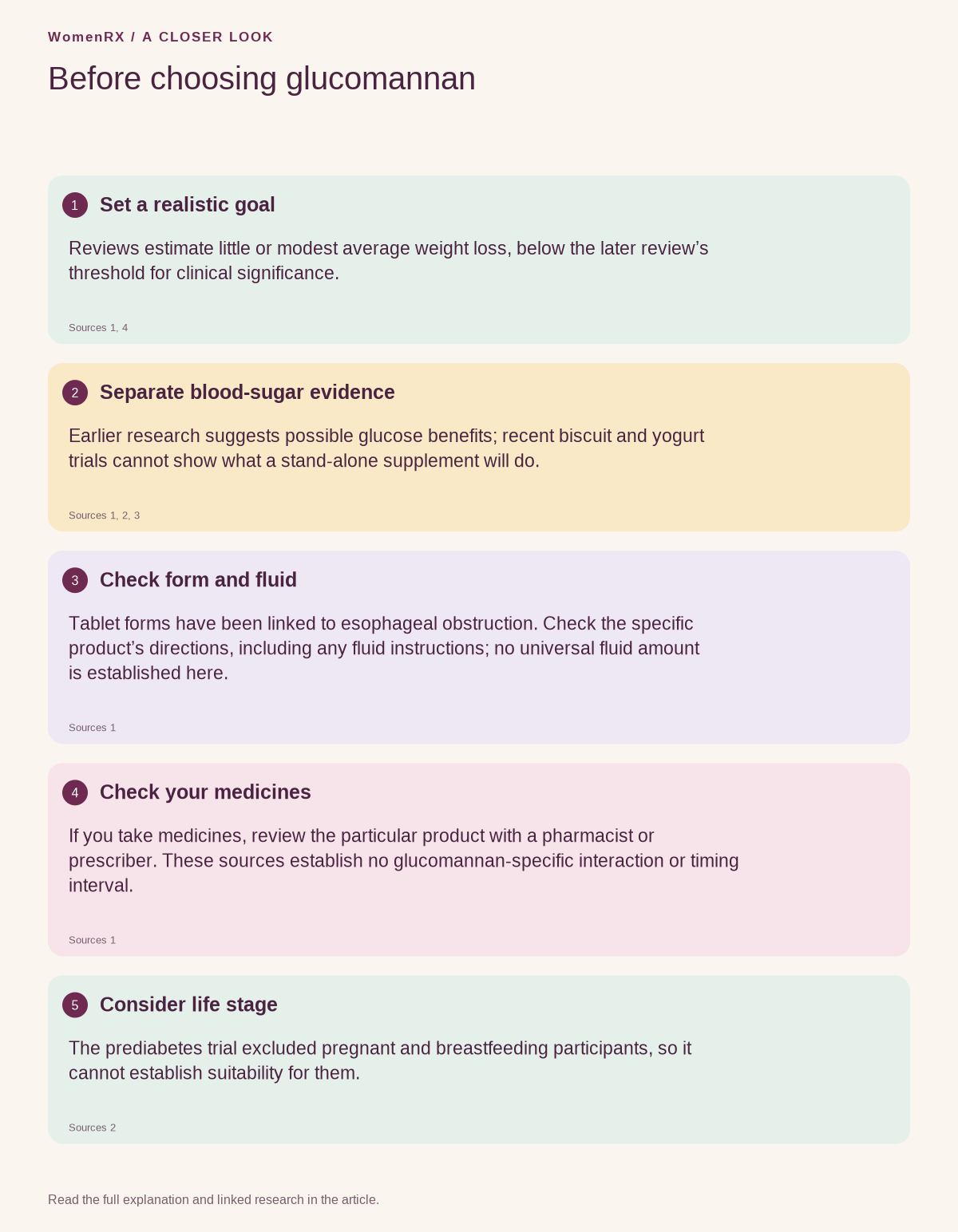
Before choosing glucomannan
Set a realistic goal: Reviews estimate little or modest average weight loss, below the later review’s threshold for clinical significance.14
Separate blood-sugar evidence: Earlier research suggests possible glucose benefits; recent biscuit and yogurt trials cannot show what a stand-alone supplement will do.123
Check form and fluid: Tablet forms have been linked to esophageal obstruction. Check the specific product’s directions, including any fluid instructions; no universal fluid amount is established here.1
Check your medicines: If you take medicines, review the particular product with a pharmacist or prescriber. These sources establish no glucomannan-specific interaction or timing interval.1
Consider life stage: The prediabetes trial excluded pregnant and breastfeeding participants, so it cannot establish suitability for them.2
Read the figure as text
Use these checks to keep the modest weight evidence separate from the blood-sugar findings and to spot the product and medicine questions that need attention.- Set a realistic goal: Reviews estimate little or modest average weight loss, below the later review’s threshold for clinical significance.14
- Separate blood-sugar evidence: Earlier research suggests possible glucose benefits; recent biscuit and yogurt trials cannot show what a stand-alone supplement will do.123
- Check form and fluid: Tablet forms have been linked to esophageal obstruction. Check the specific product’s directions, including any fluid instructions; no universal fluid amount is established here.1
- Check your medicines: If you take medicines, review the particular product with a pharmacist or prescriber. These sources establish no glucomannan-specific interaction or timing interval.1
- Consider life stage: The prediabetes trial excluded pregnant and breastfeeding participants, so it cannot establish suitability for them.2
More questions, answered
Do glucomannan studies show it is suitable during pregnancy or breastfeeding?
They don’t establish that. A trial in adults with prediabetes excluded pregnant and breastfeeding participants, so its findings can’t answer suitability for those life stages. 2
Sources you can check
- Dietary Supplements for Weight Loss - Health Professional Fact SheetAccessed 2026-09-25Return to first citation
- [The Effect of Konjac Glucomannan on Blood Glucose and Insulin Levels in Obese Patients With Prediabetes].Wu R, Tang L, Yang X, Ou Q, Gu Y, Yuan L, Tong N. · Sichuan da xue xue bao. Yi xue ban = Journal of Sichuan University. Medical science edition · 2026Return to first citation
- Effects of Yogurt Enriched with Konjac Glucomannan and Inulin on Insulin Sensitivity, Glycemic Control, Lipid Profiles, Anthropometric Measures and Oxidative Stress in Type 2 Diabetes Mellitus: A Randomized Controlled Trial.Dehzad MJ, Raja A, Moghdani Z, Sohrabi Z, Fararooei M, Famouri M, Askarpour M, Babajafari S. · Preventive nutrition and food science · 2025Return to first citation
- Efficacy of dietary supplements containing isolated organic compounds for weight loss: a systematic review and meta-analysis of randomised placebo-controlled trials.Bessell E, Maunder A, Lauche R, Adams J, Sainsbury A, Fuller NR. · International journal of obesity (2005) · 2021Return to first citation