Does Glucomannan Help With Weight Loss?
A placebo-controlled trial found no extra weight loss after eight weeks, and larger-looking results come from formulas that included other fibers.
Glucomannan can absorb water and may increase fullness, but that idea hasn’t translated into a clear weight-loss benefit in a small placebo-controlled trial. After eight weeks, adults taking it lost no more weight than adults taking a placebo. A later trial found weight loss with a three-fiber blend, but it can’t show that glucomannan alone caused the change. 1 2 3
The clearest standalone trial found no added weight loss
Glucomannan is a soluble fiber made from konjac. It absorbs water and expands, which is why it’s proposed to increase fullness and slow stomach emptying. That mechanism is plausible, but feeling fuller in theory isn’t the same as losing more weight in a trial. 1 3
In a randomized, double-blind, placebo-controlled trial, 53 adults with overweight or moderate obesity took glucomannan or placebo for eight weeks while eating their usual diets and keeping their usual activity patterns. The glucomannan group took 1.33 grams with water before each of three meals, for a total of 3.99 grams a day. At the end, weight loss did not differ significantly between groups. The trial also found no significant difference in hunger or fullness, body composition, or the other measured outcomes. 3
The study was small and lasted only eight weeks, so it can’t settle every question about longer use or different people. But for the practical question, “Did glucomannan add weight loss beyond placebo under these study conditions?” the result was no. Participants’ supplement adherence was similar in the two groups, making poor adherence an unlikely explanation for the null result in this trial. 3
A positive blend result doesn’t prove glucomannan works alone
A 2024 randomized trial followed 112 adults with obesity and certain genetic variants for 180 days. The supplement group had a reported 4.9% greater change in body weight than the placebo group. But the supplement combined glucomannan with inulin and psyllium, and the participants were selected for particular genetic variants. The result can’t tell us whether glucomannan itself produced the difference, whether it would apply to people without those variants, or whether the same effect would occur with a glucomannan-only product. 2
That distinction matters when you’re comparing a trial with a product label. A favorable result for a multi-ingredient formula isn’t evidence that each ingredient works independently. The NIH Office of Dietary Supplements also describes glucomannan’s weight-loss findings overall as showing little to no effect, noting that studies vary in quality. 1
Appetite claims and weight outcomes aren’t interchangeable
Fiber that swells in the digestive tract may affect fullness, but the eight-week placebo-controlled trial did not find a significant difference in hunger or fullness. The available findings therefore don’t establish that glucomannan reliably curbs appetite in a way that leads to meaningful weight change. 1 3
If you’re considering it mainly for weight management, the most useful expectation is modest: a fullness mechanism is proposed, but the standalone trial didn’t show extra weight loss. A longer or different study could produce a different result, but the current evidence doesn’t establish a reliable, lasting benefit. 1 3
What the studies say about tolerability
In the eight-week trial, glucomannan was generally tolerated, though belching, bloating, and stomach fullness occurred more often than with placebo. Those symptoms were reported as transient in the study. The NIH fact sheet also lists loose stools, gas, diarrhea, constipation, and abdominal discomfort, and flags a particular concern with tablet forms: they may cause an obstruction in the esophagus. 1 3
A separate, longer trial of a glucomannan-inulin-psyllium blend reported gastrointestinal events in 74.6% of the active-treatment group and none in the placebo group. Because it tested a blend in a selected group, that figure shouldn’t be treated as the expected side-effect rate for glucomannan alone. 2
These studies don’t establish different weight-loss effects for women and men, or for particular life stages such as perimenopause or after menopause. They also don’t show that a result from a selected genetic subgroup applies to women generally. 2 3
The practical takeaway
For a supplement you’re considering specifically to lose weight, glucomannan has a plausible fullness mechanism but no clear standalone benefit in the placebo-controlled trial described here. The positive longer-term result came from a combination product, so it doesn’t resolve whether glucomannan by itself would help. Check whether a product contains other active ingredients before treating its claims as evidence for glucomannan alone. 1 2 3
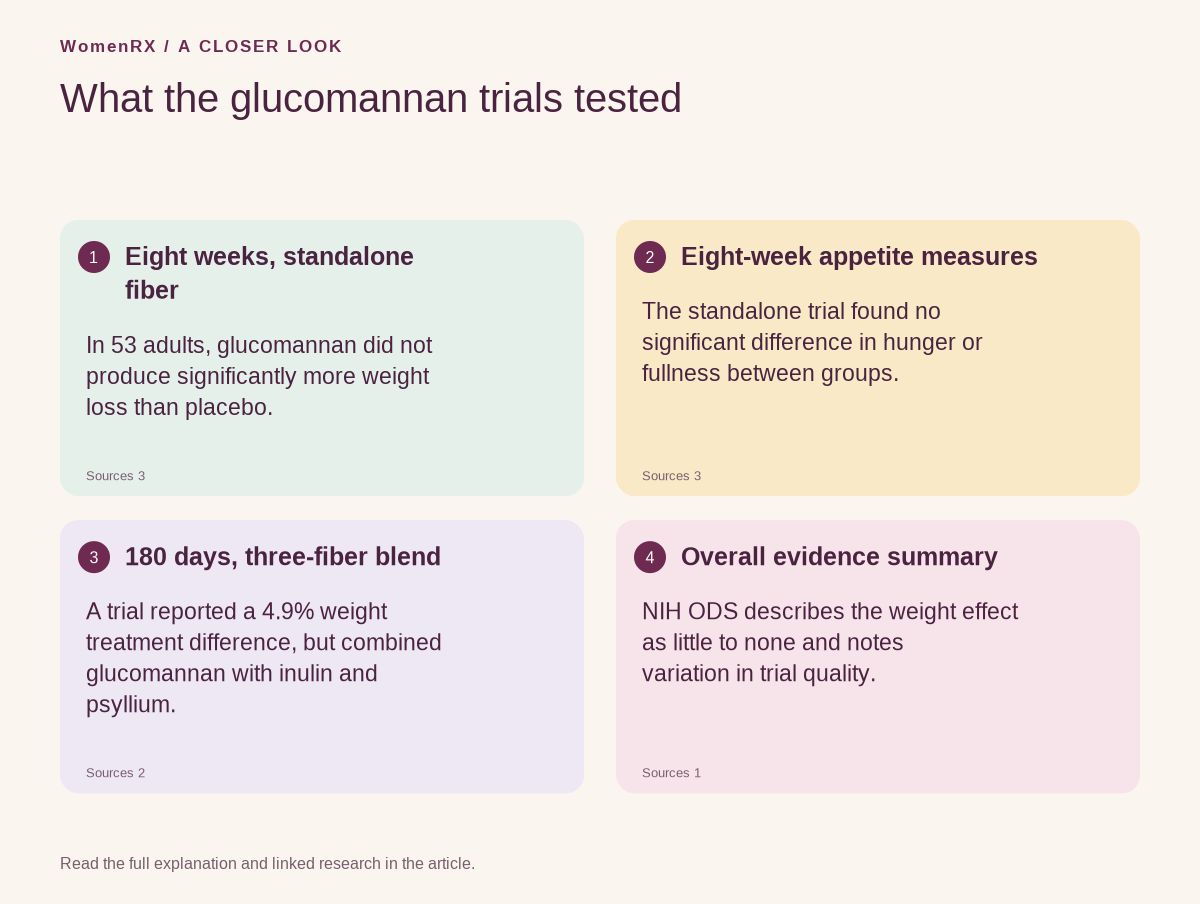
What the glucomannan trials tested
Eight weeks, standalone fiber: In 53 adults, glucomannan did not produce significantly more weight loss than placebo.3
Eight-week appetite measures: The standalone trial found no significant difference in hunger or fullness between groups.3
180 days, three-fiber blend: A trial reported a 4.9% weight treatment difference, but combined glucomannan with inulin and psyllium.2
Overall evidence summary: NIH ODS describes the weight effect as little to none and notes variation in trial quality.1
Read the figure as text
These findings differ in duration and, especially, whether glucomannan was tested by itself or as part of a blend.- Eight weeks, standalone fiber: In 53 adults, glucomannan did not produce significantly more weight loss than placebo.3
- Eight-week appetite measures: The standalone trial found no significant difference in hunger or fullness between groups.3
- 180 days, three-fiber blend: A trial reported a 4.9% weight treatment difference, but combined glucomannan with inulin and psyllium.2
- Overall evidence summary: NIH ODS describes the weight effect as little to none and notes variation in trial quality.1
More questions, answered
Does glucomannan reduce appetite?
It’s proposed to increase fullness because it absorbs water, but a placebo-controlled trial found no significant difference in reported hunger or fullness after eight weeks. A proposed mechanism isn’t proof of a dependable appetite effect. 1 3
Are the weight-loss findings specific to women?
These studies don’t report results that establish a different effect in women or by life stage. They don’t support a women-specific weight-loss claim. 2 3
Sources you can check
- Dietary Supplements for Weight Loss - Health Professional Fact SheetAccessed 2026-09-25Return to first citation
- The Impact of Glucomannan, Inulin, and Psyllium Supplementation (SolowaysTM) on Weight Loss in Adults with FTO, LEP, LEPR, and MC4R Polymorphisms: A Randomized, Double-Blind, Placebo-Controlled Trial.Pokushalov E, Ponomarenko A, Garcia C, Pak I, Shrainer E, Seryakova M, Johnson M, Miller R. · Nutrients · 2024Return to first citation
- Safety and efficacy of glucomannan for weight loss in overweight and moderately obese adults.Keithley JK, Swanson B, Mikolaitis SL, DeMeo M, Zeller JM, Fogg L, Adamji J. · Journal of obesity · 2013Return to first citation