Psyllium for Constipation: What to Check Before You Start
Psyllium can make stool easier to pass, but the fluid, medicine timing, and reason for your constipation matter.
Psyllium is a bulk-forming fiber that absorbs liquid and helps form stool that’s easier to pass. Check your product’s directions, take it with the required fluid, and review medicine timing before you start. If constipation keeps returning, changes suddenly, or comes with concerning symptoms, don’t rely on psyllium alone.62
What psyllium can, and can’t, do
Psyllium absorbs liquid in the intestines, swells, and forms a bulkier stool that may be easier to pass.6 That makes it a reasonable option to consider when hard stools or straining are the problem. You don’t need to have a bowel movement every day to be regular; a change from your usual pattern is worth paying attention to.1
There’s evidence behind psyllium, though it isn’t a promise that one serving will fix constipation. A systematic review of 16 randomized trials in adults with chronic constipation found that fiber supplements improved treatment response compared with controls, and psyllium was among the fiber types with significant effects. Gas was more common with fiber. The studies included adults of any sex, but the review didn’t establish a separate result for women.3
Match the directions to the form you bought
Psyllium is sold as powder, granules, capsules, liquid, and wafers. Those aren’t interchangeable when it comes to preparation: MedlinePlus says to mix powder or granules with 8 ounces of liquid immediately before taking them, chew wafers thoroughly, and drink at least 8 ounces of liquid when taking psyllium. Read the directions for your exact product rather than using a scoop or preparation method remembered from another one.6
The liquid isn’t an optional extra. Psyllium’s ability to absorb water is part of how it works, and inadequate water intake has been associated with gastrointestinal obstruction.64 If you have difficulty swallowing or a history of intestinal blockage, check with a clinician before taking it. Those are not situations to solve by simply adding more fiber.6
If fiber is new to your routine, ease into it rather than making a large change at once. Increasing dietary fiber too quickly can bring on gas, bloating, and cramps.5 Psyllium itself may also cause bloating, so notice whether your stools become easier to pass and whether you feel comfortable enough to keep using it.4
Check medicine timing, not just the fiber label
Psyllium can affect how some medicines are taken. MedlinePlus specifically says not to take digoxin, aspirin or other salicylates, or nitrofurantoin within three hours of psyllium. If one of those is part of your routine, ask a pharmacist how to fit psyllium around it rather than guessing or changing your prescription schedule. Tell the pharmacist about other medicines and supplements you take, too; the guidance doesn’t give one universal spacing rule for every product.6
Medicines may also be part of the reason you’re constipated. Opioid pain medicines are one example. Don’t stop a prescribed medicine on your own; ask about the constipation and whether its treatment needs to change.2
Know when fiber isn’t the whole answer
Diet and routine can matter alongside a supplement. Too little fiber or fluid, less movement, and repeatedly putting off the urge to go are common contributors to constipation. Gradually adding fiber-rich foods, drinking fluids, moving when you can, and allowing time to use the bathroom are practical places to start.2 If those changes and psyllium aren’t helping, reassess rather than continuing indefinitely: MedlinePlus advises against taking psyllium for longer than one week unless a clinician tells you to.6
Seek medical assessment if constipation keeps coming back or isn’t improving, or if you have blood in your stool, unintentional weight loss, persistent bloating, abdominal pain, or a sudden change in bowel habits.2 If you develop difficulty breathing or swallowing, a rash, vomiting, or stomach pain after taking psyllium, seek prompt medical advice.6
Constipation is common during pregnancy and after giving birth, but that doesn’t tell you which treatment fits your situation.2 If you’re pregnant or breastfeeding, tell your clinician or pharmacist before taking psyllium, especially if you’re also taking medicines or the constipation is persistent. The adult fiber trials reviewed for chronic constipation generally excluded studies made up entirely of pregnant participants, so their results shouldn’t be treated as pregnancy-specific guidance.63
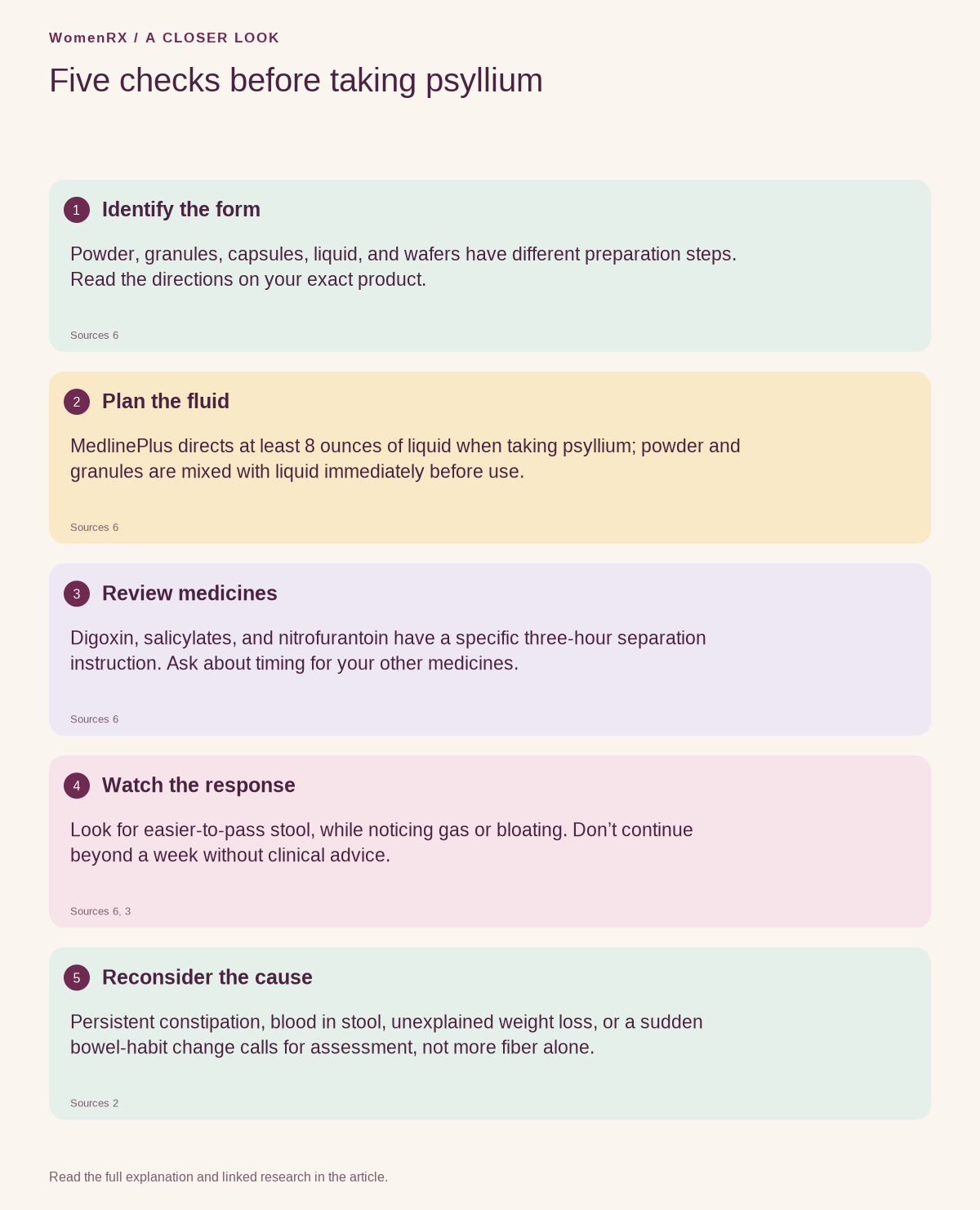
Five checks before taking psyllium
Identify the form: Powder, granules, capsules, liquid, and wafers have different preparation steps. Read the directions on your exact product.6
Plan the fluid: MedlinePlus directs at least 8 ounces of liquid when taking psyllium; powder and granules are mixed with liquid immediately before use.6
Review medicines: Digoxin, salicylates, and nitrofurantoin have a specific three-hour separation instruction. Ask about timing for your other medicines.6
Watch the response: Look for easier-to-pass stool, while noticing gas or bloating. Don’t continue beyond a week without clinical advice.63
Reconsider the cause: Persistent constipation, blood in stool, unexplained weight loss, or a sudden bowel-habit change calls for assessment, not more fiber alone.2
Read the figure as text
A quick way to connect the product in your hand with the safety questions that matter.- Identify the form: Powder, granules, capsules, liquid, and wafers have different preparation steps. Read the directions on your exact product.6
- Plan the fluid: MedlinePlus directs at least 8 ounces of liquid when taking psyllium; powder and granules are mixed with liquid immediately before use.6
- Review medicines: Digoxin, salicylates, and nitrofurantoin have a specific three-hour separation instruction. Ask about timing for your other medicines.6
- Watch the response: Look for easier-to-pass stool, while noticing gas or bloating. Don’t continue beyond a week without clinical advice.63
- Reconsider the cause: Persistent constipation, blood in stool, unexplained weight loss, or a sudden bowel-habit change calls for assessment, not more fiber alone.2
More questions, answered
Should I expect psyllium to work right away?
Don’t judge it by a promised same-day result. The adult trials in a fiber review measured outcomes over periods of at least two weeks, and results varied across studies. Follow your product’s directions, but seek advice if constipation isn’t improving rather than extending use beyond a week on your own.36
Sources you can check
- Constipation | MedlinePlusAccessed 2026-09-25Return to first citation
- Constipation - NHSAccessed 2026-09-25Return to first citation
- The Effect of Fiber Supplementation on Chronic Constipation in Adults: An Updated Systematic Review and Meta-Analysis of Randomized Controlled Trials.van der Schoot A, Drysdale C, Whelan K, Dimidi E. · The American journal of clinical nutrition · 2022Return to first citation
- Psyllium Husk: A Comprehensive Review of its Functional Properties, Health Benefits, Mechanisms of Action, and Potential Adverse Effects.Kumar A, Patel R, Yadav S, Prajapati B, Sharma S, Batta K, Kaushik R, Kumar S, Dudhat K, Rustagi S. · Current nutrition reports · 2026Return to first citation
- Dietary Fiber: MedlinePlusAccessed 2026-09-25Return to first citation
- Psyllium: MedlinePlus Drug InformationAccessed 2026-09-25Return to first citation