Psyllium Evidence Depends on the Outcome
Psyllium has been studied for blood sugar, cholesterol, and constipation, but evidence for one result doesn’t establish the others.
A meta-analysis found improved blood sugar measures mainly in people with type 2 diabetes. Cholesterol has also been discussed in research involving people with high cholesterol, though a review making that observation focused on weight rather than measuring lipid effects; detailed trial results here come from small studies in people with diabetes and constipation. Those studies don’t establish effects in women separately or address pregnancy. 2 3 4 5
Psyllium is a soluble fiber that forms a gel when hydrated. That property offers a plausible explanation for why it has been studied across different outcomes, but each outcome needs its own evidence. A change in blood sugar doesn’t prove a benefit for cholesterol, and neither one establishes that psyllium prevents a heart attack or treats diabetes on its own. 2 3
Blood sugar: the clearest signal is in type 2 diabetes
A meta-analysis assessed 35 randomized controlled studies in people without diabetes, at risk of type 2 diabetes, or living with it. In multiweek studies of people with type 2 diabetes, psyllium taken before meals was associated with lower fasting blood glucose and HbA1c, a longer-term measure of blood sugar. The reported average changes were −37 mg/dL for fasting glucose and −0.97 percentage points for HbA1c. The analysis found that effects were greater when blood sugar was less well controlled at the start; it found no significant glucose lowering in people with normal glucose levels. 2
Those results are promising, but they don’t show that psyllium can replace diabetes care. The meta-analysis itself called for more research on how to use it alongside existing treatment, including glucose-lowering medicines. 2
Cholesterol: findings span different populations
A review focused on psyllium and weight loss describes cholesterol lowering in people with high cholesterol. But that review analyzed weight outcomes, not lipid effects, so it doesn’t provide a cholesterol estimate. 3
Separate small trials measured cholesterol in people with type 2 diabetes and constipation. One 12-week trial reported lower cholesterol and triglycerides in the psyllium group than in the placebo group. Another trial found that both psyllium and flaxseed improved some lipid measures compared with placebo, with flaxseed appearing to do better overall. These trial results add detail for a specific population; they don’t establish how much psyllium lowers cholesterol in other populations or whether a change reduces heart attacks or strokes. 4 5
That distinction matters if your reason for considering psyllium is a high cholesterol result. The studies measured blood markers, not cardiovascular events, and they don’t show that psyllium can take the place of prescribed cholesterol treatment. 4 5 1
Bowel symptoms: studied in people who had constipation
Two randomized trials looked at constipation symptoms in people with type 2 diabetes and constipation; in one trial, the constipation was chronic. Both reported improvement with psyllium compared with placebo over 12 weeks. In one study, psyllium was mixed into cookies, so its results describe that trial’s specific use, not every product or routine. Another trial compared psyllium with flaxseed and found improvement in both groups, with flaxseed appearing more effective for constipation symptoms. 4 5
These findings apply most directly to people who already had constipation. They don’t show that everyone needs a fiber supplement or establish the best approach for bowel symptoms in other groups.
What the evidence says about women
The study summaries don’t report separate results for women, so they can’t tell us whether women respond differently. Nor do these findings answer whether psyllium has particular benefits or limits during pregnancy or at a specific life stage. The results are most relevant to the groups actually studied, especially people with type 2 diabetes and, in the bowel trials, constipation. 2 4 5
If you’re weighing psyllium for a specific reason, start with that outcome: the evidence differs in design and population. Blood sugar has been assessed in a meta-analysis, while the detailed cholesterol and bowel-symptom findings described here come from specific trials in people with diabetes and constipation. Keep the distinction clear, and don’t assume a result for one marker or symptom carries over to another. 2 4 5
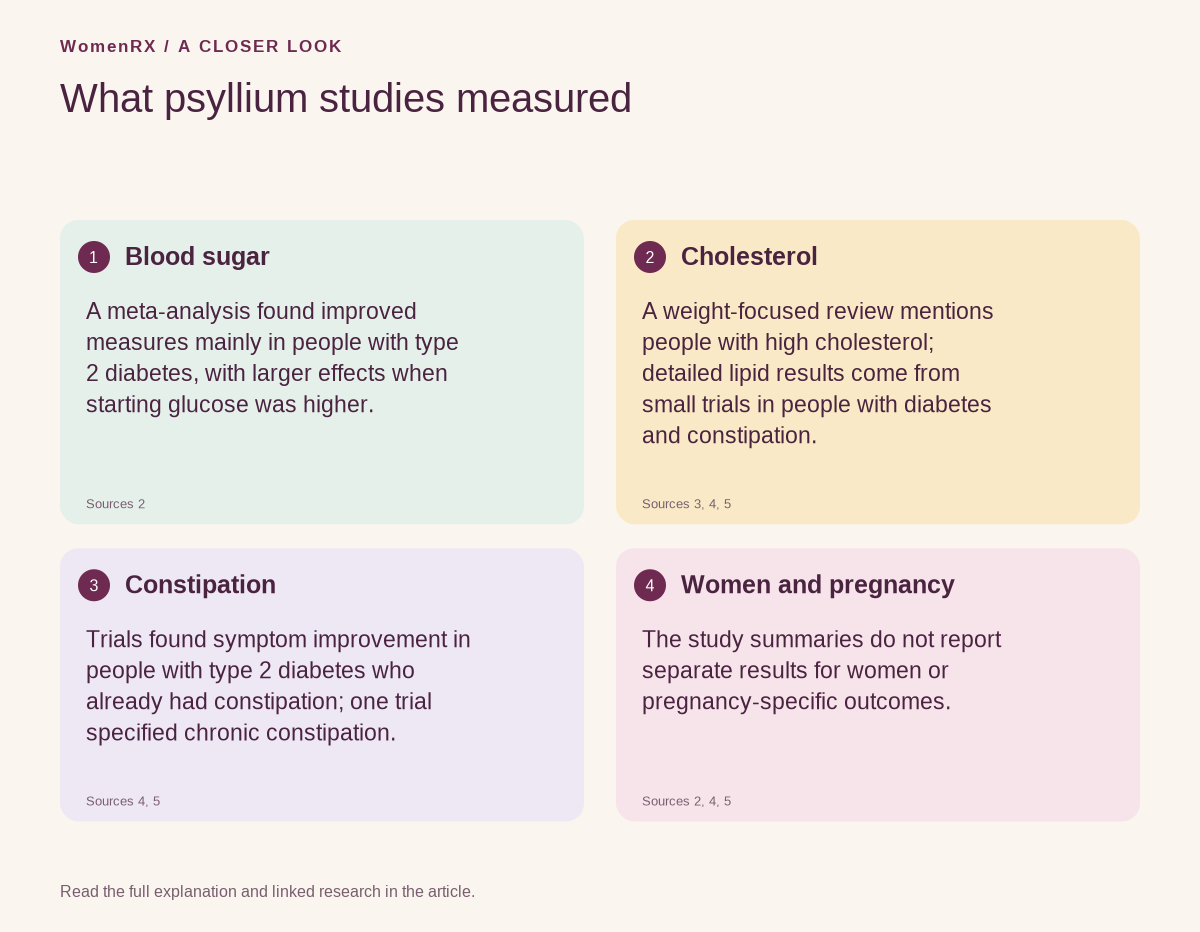
What psyllium studies measured
Blood sugar: A meta-analysis found improved measures mainly in people with type 2 diabetes, with larger effects when starting glucose was higher.2
Cholesterol: A weight-focused review mentions people with high cholesterol; detailed lipid results come from small trials in people with diabetes and constipation.345
Constipation: Trials found symptom improvement in people with type 2 diabetes who already had constipation; one trial specified chronic constipation.45
Women and pregnancy: The study summaries do not report separate results for women or pregnancy-specific outcomes.245
Read the figure as text
Findings differ by outcome and by the people studied; evidence for one use doesn’t establish another.- Blood sugar: A meta-analysis found improved measures mainly in people with type 2 diabetes, with larger effects when starting glucose was higher.2
- Cholesterol: A weight-focused review mentions people with high cholesterol; detailed lipid results come from small trials in people with diabetes and constipation.345
- Constipation: Trials found symptom improvement in people with type 2 diabetes who already had constipation; one trial specified chronic constipation.45
- Women and pregnancy: The study summaries do not report separate results for women or pregnancy-specific outcomes.245
More questions, answered
Does psyllium prevent heart disease?
These studies measured cholesterol and other blood markers, not heart attacks or strokes. They don’t establish that psyllium prevents heart disease. 4 5
Sources you can check
- Cholesterol Medicines: MedlinePlusAccessed 2026-09-25Return to first citation
- Psyllium fiber improves glycemic control proportional to loss of glycemic control: a meta-analysis of data in euglycemic subjects, patients at risk of type 2 diabetes mellitus, and patients being treated for type 2 diabetes mellitus.Gibb RD, McRorie JW, Russell DA, Hasselblad V, D'Alessio DA. · The American journal of clinical nutrition · 2015Return to first citation
- Psyllium is a natural nonfermented gel-forming fiber that is effective for weight loss: A comprehensive review and meta-analysis.Gibb RD, Sloan KJ, McRorie JW. · Journal of the American Association of Nurse Practitioners · 2023Return to first citation
- Effect of flaxseed or psyllium vs. placebo on management of constipation, weight, glycemia, and lipids: A randomized trial in constipated patients with type 2 diabetes.Soltanian N, Janghorbani M. · Clinical nutrition ESPEN · 2019Return to first citation
- Effects of psyllium vs. placebo on constipation, weight, glycemia, and lipids: A randomized trial in patients with type 2 diabetes and chronic constipation.Noureddin S, Mohsen J, Payman A. · Complementary therapies in medicine · 2018Return to first citation