Psyllium and Weight: Fullness Isn’t the Same as Weight Loss
Psyllium may make a meal feel more filling, but studies don’t consistently show that taking it leads to lasting weight loss.
Psyllium forms a gel when mixed with water, making fullness a plausible way it could affect eating. 12 But feeling fuller is not proof of sustained weight loss: a review of 22 randomized trials found no significant average change in weight, BMI, or waist size. 3 Some smaller studies found weight differences in specific groups, while a longer trial and a trial of a mixed-fiber product complicate the picture. 672
The short answer: possible fullness, uncertain weight change
Psyllium is a water-soluble fiber. It absorbs water and forms a gel, which offers a plausible reason it might make you feel fuller. But that proposed appetite mechanism is not the same as evidence that people eat less over time or lose weight. The available results on body weight are mixed, and the strongest broad summary here does not show a significant average weight reduction. 13
That distinction matters if your goal is weight change. A supplement can affect how full you feel after a meal without changing your overall intake enough, or for long enough, to shift body weight. A weight result also doesn’t establish that fullness was the reason for the change.
What the studies actually measured
A 2020 systematic review and meta-analysis combined 22 randomized trials of psyllium in adults. It found no significant average effect on body weight: the estimated difference was −0.28 kg, with a 95% confidence interval ranging from −0.78 to 0.21 kg. The review also found no significant average change in BMI or waist circumference. Differences in trial duration, psyllium use, sample size, and other study features may help explain why individual results varied. 3
A separate meta-analysis of eight studies involving 395 adults with diabetes also found no significant change in weight or BMI. That makes the overall picture less persuasive than a few positive trial results might suggest. 4
Some individual trials did report weight differences. For example, a 12-week randomized trial in 51 people with type 2 diabetes and chronic constipation found an average 2.0 kg greater reduction in weight with psyllium than placebo. A second 12-week trial in 77 people with the same conditions also reported better weight results with psyllium than placebo, though flaxseed appeared more effective. These findings apply to particular groups and study settings; they don’t show that psyllium reliably causes weight loss in the general population. 56
Duration alone doesn’t settle the question. In a 52-week trial of 159 adults with overweight or obesity, a proprietary psyllium product was associated with lower weight than rice-flour control at three and six months. The abstract reports a 1.5% difference from control at 12 months, but does not report a statistically significant weight difference for the psyllium group at that time point. It’s therefore not a clear demonstration of sustained weight loss from psyllium. 7
A 2024 trial in 112 adults with obesity who carried at least one of the specified FTO, LEP, LEPR, or MC4R genetic variants reported greater weight loss over 180 days for a supplement containing glucomannan, inulin, and psyllium than for placebo. Most participants were women, but because the product combined three fibers, the results can’t tell us how much, if any, of the effect came from psyllium itself. 2
A useful way to read a weight claim
When you see a claim that psyllium “helps with weight,” ask what the study measured and what was in the product:
- Fullness or appetite ratings: These can suggest a possible pathway, but don’t establish a lasting change in weight. The studies summarized here don’t establish that psyllium-induced fullness reliably leads to sustained weight loss.
- Food intake: A change in appetite or a single meal’s intake is not the same as a sustained reduction in eating over weeks or months.
- Body weight: This is the outcome most directly tied to a weight-loss goal, but results need a comparator and a timeframe. Small or condition-specific trials shouldn’t outweigh a larger review that finds no significant average effect.
- Combination products: If a supplement contains several fibers, a weight change can’t be assigned to psyllium alone. 236
Psyllium may still have a reason to be part of someone’s routine for another goal, such as bowel regularity. But a possible benefit for that goal doesn’t establish weight loss. If your main aim is to change your weight, current findings don’t support treating psyllium as a dependable stand-alone strategy.
What the evidence says about women
Some of the studies included women, but that isn’t the same as evidence that psyllium works differently for women. One small diabetes trial included 20 women and 20 men and balanced participants by sex, but the reported results don’t provide separate weight outcomes for women. 1
Women made up 71.6% of participants in the 2024 mixed-fiber trial, whose average participant was about 46 years old. All participants had obesity and at least one of the selected genetic variants. The results still can’t isolate psyllium’s effect, and the reported findings don’t establish effects by sex or by life stage. These studies don’t answer whether results differ across cycling years, perimenopause, or postmenopause. 2
So, there isn’t a supported basis here for a special age- or hormone-related weight effect. The most practical takeaway remains the same: psyllium’s fullness mechanism is plausible, but sustained weight loss has not been consistently demonstrated.
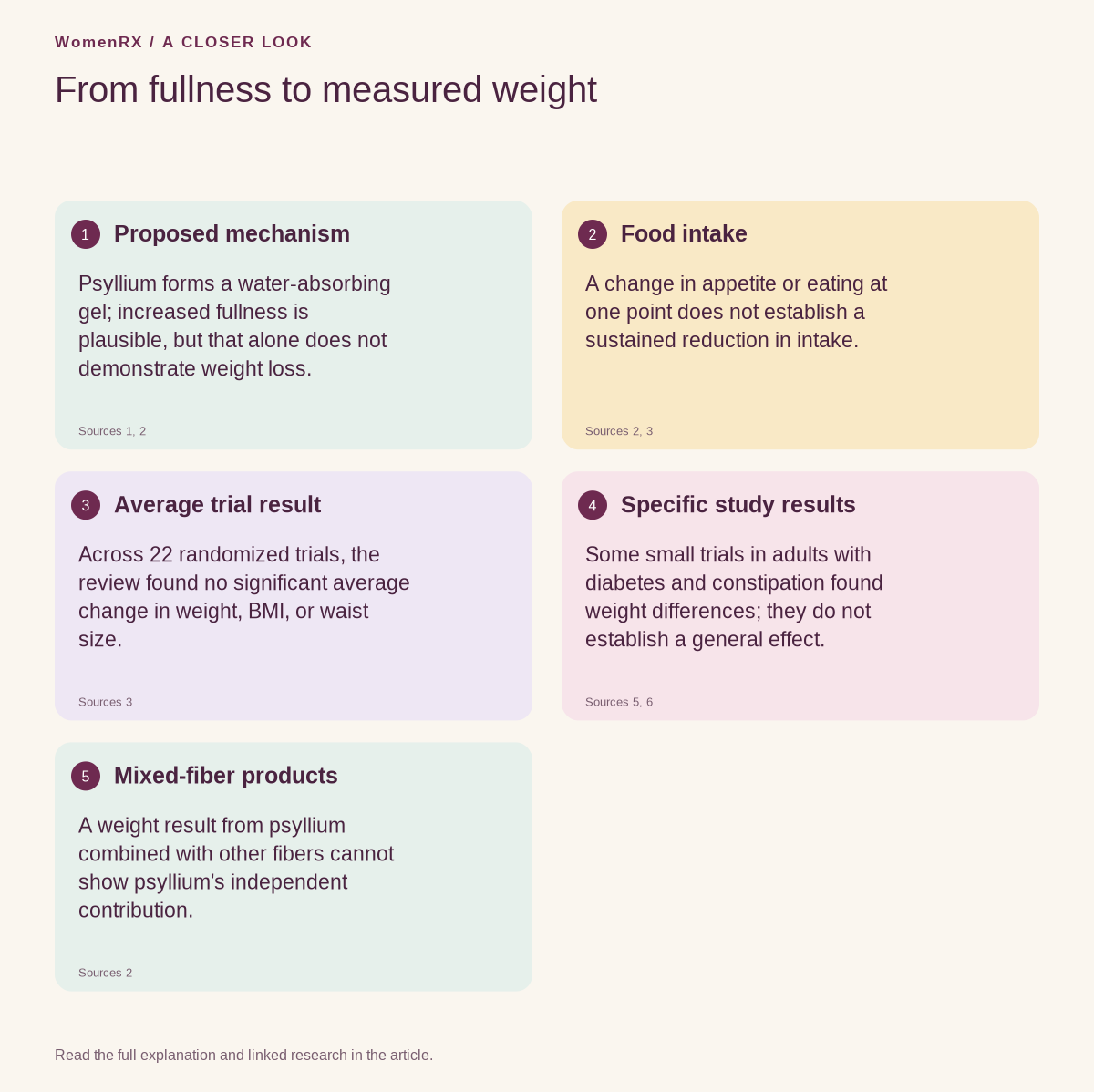
From fullness to measured weight
Proposed mechanism: Psyllium forms a water-absorbing gel; increased fullness is plausible, but that alone does not demonstrate weight loss.12
Food intake: A change in appetite or eating at one point does not establish a sustained reduction in intake.23
Average trial result: Across 22 randomized trials, the review found no significant average change in weight, BMI, or waist size.3
Specific study results: Some small trials in adults with diabetes and constipation found weight differences; they do not establish a general effect.56
Mixed-fiber products: A weight result from psyllium combined with other fibers cannot show psyllium's independent contribution.2
Read the figure as text
A proposed appetite mechanism, a measured behavior, and a weight outcome are different kinds of evidence. The distinction helps put psyllium studies in perspective.- Proposed mechanism: Psyllium forms a water-absorbing gel; increased fullness is plausible, but that alone does not demonstrate weight loss.12
- Food intake: A change in appetite or eating at one point does not establish a sustained reduction in intake.23
- Average trial result: Across 22 randomized trials, the review found no significant average change in weight, BMI, or waist size.3
- Specific study results: Some small trials in adults with diabetes and constipation found weight differences; they do not establish a general effect.56
- Mixed-fiber products: A weight result from psyllium combined with other fibers cannot show psyllium's independent contribution.2
More questions, answered
Does feeling fuller mean psyllium is reducing how much I eat?
Not necessarily. Fullness is a possible mechanism, while food intake and body weight are separate outcomes. The studies summarized here don’t establish that psyllium-related fullness reliably produces a lasting reduction in eating or weight. 13
Can a study of a fiber blend prove psyllium caused weight loss?
No. If a product combines psyllium with fibers such as glucomannan and inulin, a difference versus placebo can’t identify which ingredient caused it. 2
Sources you can check
- Soluble fibers from psyllium improve glycemic response and body weight among diabetes type 2 patients (randomized control trial).Abutair AS, Naser IA, Hamed AT. · Nutrition journal · 2016Return to first citation
- The Impact of Glucomannan, Inulin, and Psyllium Supplementation (SolowaysTM) on Weight Loss in Adults with FTO, LEP, LEPR, and MC4R Polymorphisms: A Randomized, Double-Blind, Placebo-Controlled Trial.Pokushalov E, Ponomarenko A, Garcia C, Pak I, Shrainer E, Seryakova M, Johnson M, Miller R. · Nutrients · 2024Return to first citation
- The effects of psyllium supplementation on body weight, body mass index and waist circumference in adults: A systematic review and dose-response meta-analysis of randomized controlled trials.Darooghegi Mofrad M, Mozaffari H, Mousavi SM, Sheikhi A, Milajerdi A. · Critical reviews in food science and nutrition · 2020Return to first citation
- The effect of psyllium consumption on weight, body mass index, lipid profile, and glucose metabolism in diabetic patients: A systematic review and dose-response meta-analysis of randomized controlled trials.Xiao Z, Chen H, Zhang Y, Deng H, Wang K, Bhagavathula AS, Almuhairi SJ, Ryan PM, Rahmani J, Dang M, Kontogiannis V, Vick A, Wei Y. · Phytotherapy research : PTR · 2020Return to first citation
- Effect of flaxseed or psyllium vs. placebo on management of constipation, weight, glycemia, and lipids: A randomized trial in constipated patients with type 2 diabetes.Soltanian N, Janghorbani M. · Clinical nutrition ESPEN · 2019Return to first citation
- Effects of psyllium vs. placebo on constipation, weight, glycemia, and lipids: A randomized trial in patients with type 2 diabetes and chronic constipation.Noureddin S, Mohsen J, Payman A. · Complementary therapies in medicine · 2018Return to first citation
- Effect on body weight and composition in overweight/obese Australian adults over 12 months consumption of two different types of fibre supplementation in a randomized trial.Pal S, Ho S, Gahler RJ, Wood S. · Nutrition & metabolism · 2016Return to first citation