Melatonin and Body Weight: What Human Studies Show
Human trials don’t show a consistent change in body weight from melatonin, even though some individual studies report weight or metabolic changes.
A weight change that happens after you start melatonin isn’t proof that melatonin caused it. In pooled human trials, melatonin has not consistently reduced or increased body weight. A review focused on women with overweight or obesity also found no significant weight change, although it reported a separate BMI signal. Melatonin isn’t established as a weight-loss supplement, and a clear weight-gain effect hasn’t been shown either. 3 4 5
What the weight studies actually found
The most useful question is whether people taking melatonin changed weight more than people taking a placebo or control. Across human trials, the overall answer is: not consistently. A 2024 review of 28 randomized trials in 1,543 adults found no significant effect on body weight or BMI compared with control. A separate review of 63 randomized trials likewise found no significant effect on body weight, BMI, waist circumference, or body-fat percentage. 5 4
That doesn’t prove melatonin could never affect weight in a particular person. It does mean the clinical evidence doesn’t support a dependable weight-loss or weight-gain effect.
What the women-specific research adds
A 2026 review pooled 14 trials in women with overweight or obesity. In the six trials that measured body weight, involving 172 women, melatonin did not produce a significant change compared with placebo: the estimated difference was −0.34 kg, with a confidence interval ranging from −2.34 to 1.66 kg. In plain language, the results were compatible with either some loss or some gain, and didn’t establish a reliable effect. 3
That review did report a reduction in BMI, along with changes in some blood-sugar measures. Those are different outcomes from body weight. A BMI result or a metabolic-marker change shouldn’t be presented as proof that melatonin causes meaningful weight loss. Another large review of adult trials found no significant change in BMI or several other body-composition measures. 3 4
The women-specific analysis was about women with overweight or obesity. It doesn’t tell us whether weight effects differ during pregnancy, postpartum, the cycling years, perimenopause, or after menopause. Don’t assume a women-specific effect from these results. 3
Why individual trials can look different
Some small studies have reported weight reductions. For example, one 12-week trial enrolled 38 adults with overweight or obesity, including 30 women. Everyone followed a weight-loss diet; weight fell in both the melatonin and placebo groups. The researchers reported some differences during the latter part of the study, but noted that this trial alone wasn’t enough to establish an effect. 6
A separate eight-week trial in 50 people with type 2 diabetes reported a significantly lower median change in weight in the melatonin group than in the control group. That finding is worth distinguishing from the larger pooled results: it came from a small study in a specific group, so it doesn’t show that melatonin generally changes weight. 7 When individual studies and reviews don’t line up, the pooled results across trials are usually a better guide than one positive study.
Sleep, metabolism, and the scale aren’t interchangeable
Melatonin is a hormone involved in controlling when you sleep. That gives researchers a reason to study possible connections between sleep, circadian rhythms, and metabolism. But a proposed connection, or a change in a blood-sugar marker, is not the same as showing that melatonin changes body weight in people. 2 3 4
Body weight also reflects more than body fat: it includes water, muscle, and bone, and everyday factors such as diet can affect the number. 1 So if your weight changed around the time you started melatonin, the timing is a clue to consider, not proof of cause. Look at whether other factors changed at the same time, and whether the change continues. If you’re gaining or losing weight unexpectedly, get medical advice rather than assuming melatonin is responsible. 1
Bottom line: Current human evidence doesn’t show that melatonin reliably causes weight loss or weight gain. A change on your own scale may be real, but the trials don’t make melatonin the default explanation.
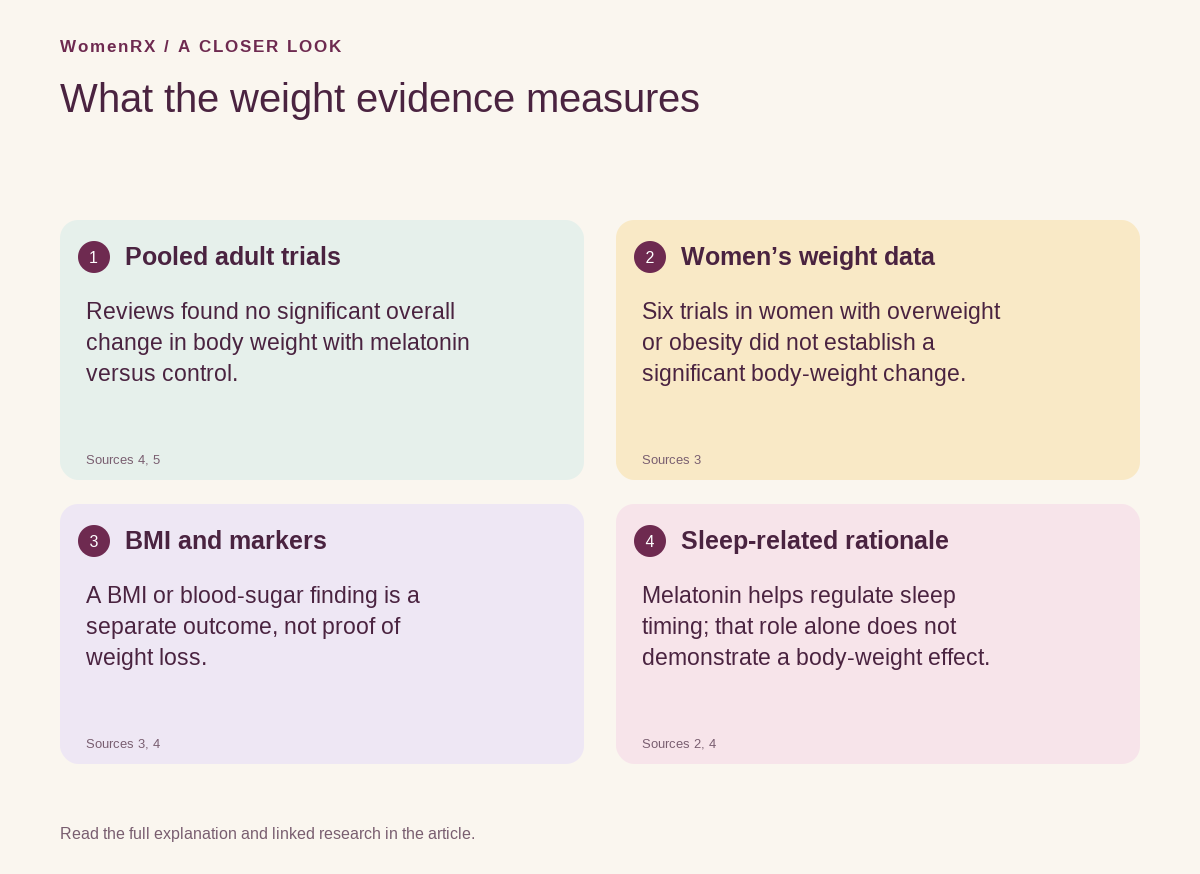
What the weight evidence measures
Pooled adult trials: Reviews found no significant overall change in body weight with melatonin versus control.45
Women’s weight data: Six trials in women with overweight or obesity did not establish a significant body-weight change.3
BMI and markers: A BMI or blood-sugar finding is a separate outcome, not proof of weight loss.34
Sleep-related rationale: Melatonin helps regulate sleep timing; that role alone does not demonstrate a body-weight effect.24
Read the figure as text
Separate direct body-weight results from related findings that don’t establish weight loss or gain.- Pooled adult trials: Reviews found no significant overall change in body weight with melatonin versus control.45
- Women’s weight data: Six trials in women with overweight or obesity did not establish a significant body-weight change.3
- BMI and markers: A BMI or blood-sugar finding is a separate outcome, not proof of weight loss.34
- Sleep-related rationale: Melatonin helps regulate sleep timing; that role alone does not demonstrate a body-weight effect.24
More questions, answered
Can I take melatonin to lose weight?
The available trial reviews don’t establish melatonin as a weight-loss treatment: pooled human studies generally found no significant change in body weight. A separate BMI finding in one review of women with overweight or obesity doesn’t establish weight loss. 3 4 5
Does the research show different weight effects after menopause?
The women-specific review concerned women with overweight or obesity, but its reported results don’t establish a separate effect after menopause. The findings shouldn’t be treated as evidence of a menopause-specific weight benefit or risk. 3
Sources you can check
- Body Weight: MedlinePlusAccessed 2026-09-25Return to first citation
- About melatonin - NHSAccessed 2026-09-25Return to first citation
- The effects of melatonin supplementation on obesity and glycemic indices in women with overweight and obesity: a systematic review and meta-analysis of randomized controlled trials.Li J, He Y, Qiu J, Safargar M, Prabahar K, Shi Q. · Diabetology & metabolic syndrome · 2026Return to first citation
- Comprehensive Effects of Melatonin Supplementation on Cardiometabolic Risk Factors: A Systematic Review and Dose-Response Meta-Analysis.Mohammadi S, Ashtary-Larky D, Erfanian-Salim M, Alaghemand N, Yousefi M, Sanjari Pirayvatlou P, Mirkarimi M, Mavi SA, Alavi I, Ettehad Y, Mehrbod M, Asbaghi O, Suzuki K, Reiter RJ. · Nutrients · 2025Return to first citation
- Effect of melatonin supplementation on body composition and blood pressure in adults: A systematic review and Dose-Response meta-analysis of randomized controlled trial.Vajdi M, Moeinolsadat S, Noshadi N, Pourteymour Fard Tabrizi F, Khajeh M, Abbasalizad-Farhangi M, Alipour B. · Heliyon · 2024Return to first citation
- Melatonin Supplementation and Anthropometric Indices: A Randomized Double-Blind Controlled Clinical Trial.Mohammadi S, Rastmanesh R, Jahangir F, Amiri Z, Djafarian K, Mohsenpour MA, Hassanipour S, Ghaffarian-Bahraman A. · BioMed research international · 2021Return to first citation
- Consumption of melatonin supplement improves cardiovascular disease risk factors and anthropometric indices in type 2 diabetes mellitus patients: a double-blind, randomized, placebo-controlled trial.Bazyar H, Zare Javid A, Bavi Behbahani H, Moradi F, Moradi Poode B, Amiri P. · Trials · 2021Return to first citation