Can Sage Change Body Weight? What Human Studies Show
A small trial in people with PCOS reported a BMI decrease, but it didn’t show how many pounds changed or clearly establish a difference from placebo.
Human evidence offers a limited signal, not proof that sage causes weight loss. In an eight-week trial involving 60 people with PCOS, researchers reported a statistically significant BMI decrease in the sage-extract group, but the abstract gives no change in pounds and does not clearly establish that BMI fell more than with placebo. Waist-to-hip ratio did not differ significantly between groups. 2
What the human trial measured
The most directly relevant human study was a randomized, placebo-controlled trial of 60 people with polycystic ovary syndrome (PCOS). Participants took sage extract or placebo for eight weeks. The researchers reported a statistically significant decrease in BMI in the sage group. But the abstract doesn’t provide the size of that decrease, report pounds lost, or clearly say that the BMI change was greater than the change with placebo. It also found no significant between-group difference in waist-to-hip ratio. 2
That makes this a possible signal worth studying, not a clear demonstration that sage reduces body weight. The trial was short and focused on people with PCOS, so it can’t establish an effect for women generally or for people in perimenopause or after menopause.
BMI and pounds are related, but not interchangeable
BMI is calculated using weight and height. Because an adult’s height usually stays the same, a lower BMI generally corresponds to lower body weight. Still, a BMI result without the actual change in weight doesn’t tell you how many pounds changed or whether the change would matter in everyday life. BMI also can’t distinguish fat from muscle or bone. 1
In this trial, the distinction matters: BMI decreased within the sage group, but the reported abstract doesn’t give the amount or establish a clear advantage over placebo. The waist-to-hip result, another body-size measure, did not differ significantly between the groups. 2
Better insulin markers don’t prove weight loss
The same trial reported lower insulin and HOMA-IR, a measure used to assess insulin resistance, and a greater increase in QUICKI, another insulin-sensitivity measure, in the sage group compared with placebo. These are metabolic findings. They don’t tell you whether participants lost weight, and they shouldn’t be treated as a substitute for a measured weight outcome. 2
That separation is useful when reading supplement claims: a change in blood sugar or insulin-related measures may be relevant to metabolic health, but it doesn’t establish a change on the scale. Here, BMI was measured and a decrease was reported; a weight change in pounds was not provided in the abstract. 2
What this means if you’re weighing the claim
The fairest summary is that one short trial in people with PCOS reported a BMI decrease during sage-extract use, alongside changes in insulin-related measures. The result doesn’t establish a reliable or meaningful weight-loss effect, and it doesn’t show that sage affects weight differently during menopause. The study tested a specific extract in a specific group, so its result shouldn’t be assumed to apply to sage used as a cooking herb or to every supplement product. 2
If a product claims that sage causes weight loss, look for evidence that directly reports body weight, the comparison group’s results, and how long the change lasted. A better insulin marker or a change in another metabolic test alone isn’t proof of weight loss.
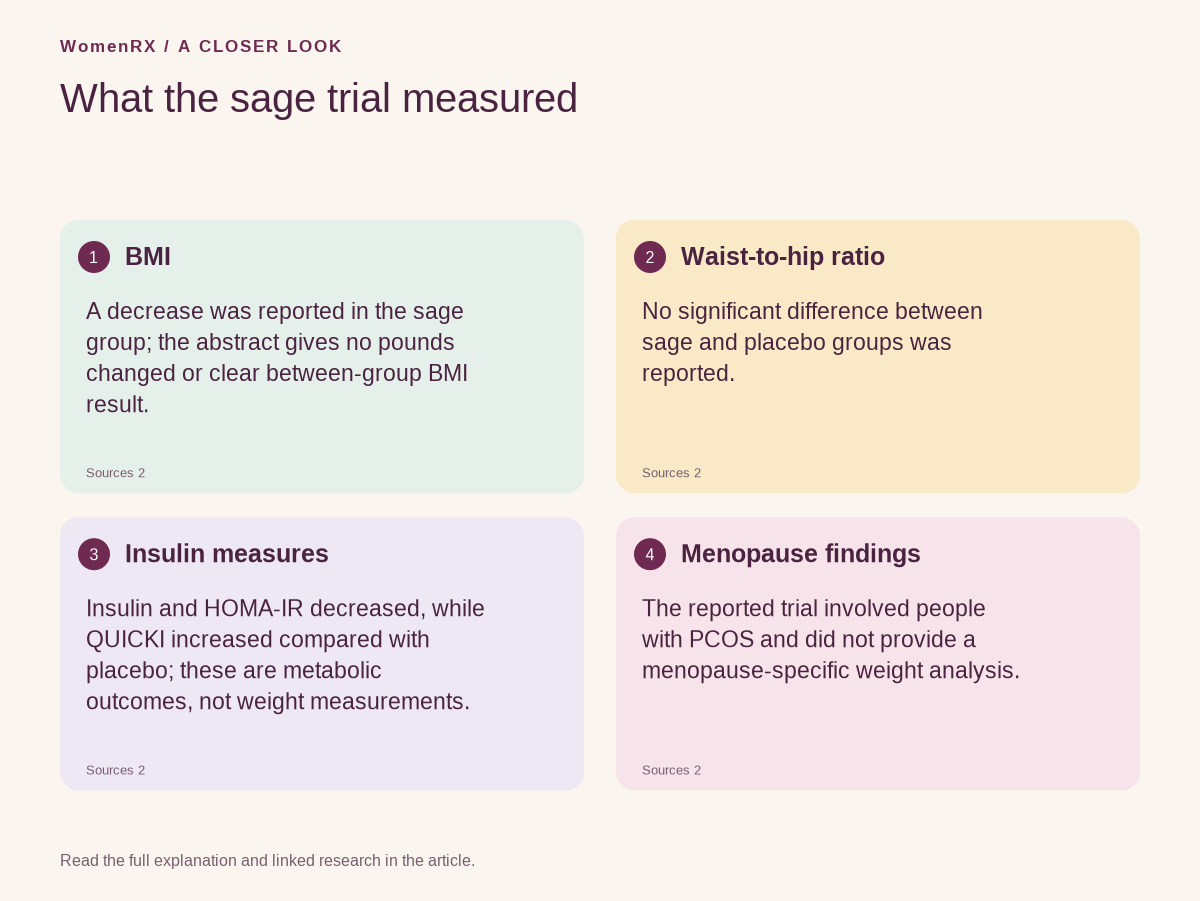
What the sage trial measured
BMI: A decrease was reported in the sage group; the abstract gives no pounds changed or clear between-group BMI result.2
Waist-to-hip ratio: No significant difference between sage and placebo groups was reported.2
Insulin measures: Insulin and HOMA-IR decreased, while QUICKI increased compared with placebo; these are metabolic outcomes, not weight measurements.2
Menopause findings: The reported trial involved people with PCOS and did not provide a menopause-specific weight analysis.2
Read the figure as text
The trial reported several outcomes, but they answer different questions. A metabolic marker is not the same as a measured change in body weight.- BMI: A decrease was reported in the sage group; the abstract gives no pounds changed or clear between-group BMI result.2
- Waist-to-hip ratio: No significant difference between sage and placebo groups was reported.2
- Insulin measures: Insulin and HOMA-IR decreased, while QUICKI increased compared with placebo; these are metabolic outcomes, not weight measurements.2
- Menopause findings: The reported trial involved people with PCOS and did not provide a menopause-specific weight analysis.2
More questions, answered
Does the PCOS trial show how many pounds participants lost?
No. The abstract reports a statistically significant BMI decrease in the sage group, but it doesn’t provide the size of the change in pounds or clearly establish that BMI fell more than with placebo. 2
Does this study tell us whether sage affects weight during menopause?
No. The participants had PCOS, and the reported results don’t provide a menopause-specific analysis. The finding shouldn’t be assumed to apply during perimenopause or after menopause. 2
Sources you can check
- Body Weight: MedlinePlusAccessed 2026-09-25Return to first citation
- Efficacy of Salvia officinalis extract on the prevention of insulin resistance in euglycemic patients with polycystic ovary syndrome: A double-blinded placebo-controlled clinical trial.Amini L, Mojab F, Jahanfar S, Sepidarkish M, Raoofi Z, Maleki-Hajiagha A. · Complementary therapies in medicine · 2020Return to first citation