DIM and Body Weight: What Human Studies Show
A small trial found a body-fat-percentage signal, but it didn’t establish that DIM causes weight loss.
DIM isn’t established as a way to lose weight or change body composition. In one small randomized trial of premenopausal women, researchers reported a greater decrease in body-fat percentage with DIM than with placebo, but the abstract doesn’t give the size of that difference or report weight loss. That result is a limited signal, not proof of a meaningful effect. 3
The key distinction: weight, body fat, and hormones
A change in a hormone-related measure isn’t the same as a change on the scale. And a change in body-fat percentage, if one is reported, doesn’t tell you how many pounds someone lost or whether the change would matter in everyday life. Weight includes fat, muscle, bone, and water, so those measures answer different questions. 1
That distinction matters with DIM, a supplement studied in part for effects on estrogen-related measures. A shift in an estrogen-metabolite ratio or another biomarker doesn’t demonstrate that DIM reduces body weight or body fat. To support a weight-loss claim, a study needs to measure those outcomes directly and report the results. 34
What the body-composition trial found
The clearest direct result comes from a randomized, double-blind trial of 60 premenopausal Mexican women whose estrogen-metabolite ratio was below a specified threshold. Participants received DIM or placebo for 30 days. The researchers reported a greater decrease in body-fat percentage in the DIM group than in the placebo group, with a p-value of 0.04. They did not report the size of that difference in the abstract, and it doesn’t establish that participants lost a meaningful amount of weight. 3
This is worth distinguishing from a definitive weight-loss result. A p-value indicates a statistical comparison, not how large or noticeable a change was. The study was small and short, and it examined premenopausal women selected for a particular biomarker. It doesn’t tell us whether the finding applies to women with different starting measurements, to perimenopausal or postmenopausal women, or over a longer period. The reported result also doesn’t provide a comparison by menstrual or menopause status. 3
Hormone findings aren’t weight outcomes
Other studies in women have focused on different questions. In a placebo-controlled trial involving women taking tamoxifen, the main outcome was a urinary estrogen-metabolite ratio; the researchers also measured hormone-related markers and breast density. Those results don’t establish an effect on body weight. 4
A separate, small study followed healthy women with BRCA mutations, most of whom were postmenopausal, and examined breast density and hormone measures. It was not a randomized weight-loss trial, and its reported findings don’t show that DIM changes body weight. Menopause status in a study is useful context, but it can’t fill in a weight result the study did not report. 5
How to judge a DIM weight claim
When you see a claim that DIM helps with weight, check what was actually measured. Was it scale weight, body-fat percentage, waist size, or a hormone marker? Were participants assigned to DIM or a comparison group, and was the difference reported between those groups? How long did the study last, and were the participants similar to the women the claim is aimed at?
Also check whether the result is about DIM alone or a multi-ingredient product. For combination supplements, a result can’t necessarily be attributed to one ingredient, and formulas may differ. 2
Bottom line: the limited human evidence includes one short trial reporting a body-fat-percentage signal in premenopausal women. It does not establish DIM as a weight-loss supplement, and the available findings don’t show whether weight or body-composition effects differ after menopause. Treat a hormone-marker result as a hormone-marker result, not as proof of fat loss.
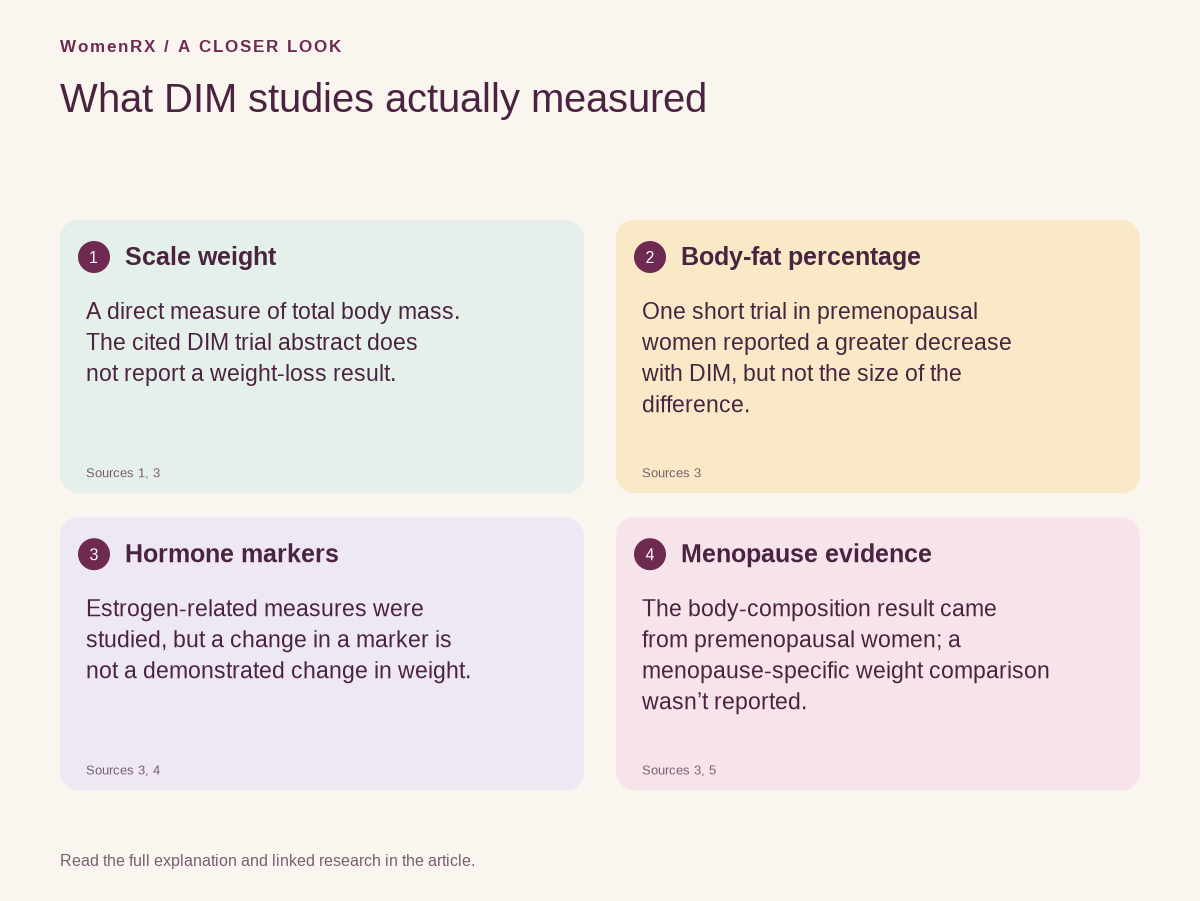
What DIM studies actually measured
Scale weight: A direct measure of total body mass. The cited DIM trial abstract does not report a weight-loss result.13
Body-fat percentage: One short trial in premenopausal women reported a greater decrease with DIM, but not the size of the difference.3
Hormone markers: Estrogen-related measures were studied, but a change in a marker is not a demonstrated change in weight.34
Menopause evidence: The body-composition result came from premenopausal women; a menopause-specific weight comparison wasn’t reported.35
Read the figure as text
These categories separate direct body-composition findings from hormone markers and show why they support different conclusions.- Scale weight: A direct measure of total body mass. The cited DIM trial abstract does not report a weight-loss result.13
- Body-fat percentage: One short trial in premenopausal women reported a greater decrease with DIM, but not the size of the difference.3
- Hormone markers: Estrogen-related measures were studied, but a change in a marker is not a demonstrated change in weight.34
- Menopause evidence: The body-composition result came from premenopausal women; a menopause-specific weight comparison wasn’t reported.35
Sources you can check
- Body Weight: MedlinePlusAccessed 2026-09-25Return to first citation
- Dietary Supplements for Weight Loss - Health Professional Fact SheetAccessed 2026-09-25Return to first citation
- Effectiveness of 3,3'-Diindolylmethane Supplements on Favoring the Benign Estrogen Metabolism Pathway and Decreasing Body Fat in Premenopausal Women.Godínez-Martínez E, Santillán R, Sámano R, Chico-Barba G, Tolentino MC, Hernández-Pineda J. · Nutrition and cancer · 2023Return to first citation
- A randomized, placebo-controlled trial of diindolylmethane for breast cancer biomarker modulation in patients taking tamoxifen.Thomson CA, Chow HHS, Wertheim BC, Roe DJ, Stopeck A, Maskarinec G, Altbach M, Chalasani P, Huang C, Strom MB, Galons JP, Thompson PA. · Breast cancer research and treatment · 2017Return to first citation
- 3,3-Diindolylmethane (DIM): a nutritional intervention and its impact on breast density in healthy BRCA carriers. A prospective clinical trial.Yerushalmi R, Bargil S, Ber Y, Ozlavo R, Sivan T, Rapson Y, Pomerantz A, Tsoref D, Sharon E, Caspi O, Grubsrein A, Margel D. · Carcinogenesis · 2020Return to first citation