DIM and Hormones: What Human Studies Show
DIM has been studied for hormone-related biomarkers and breast imaging, but those changes don’t establish relief from symptoms or prevention of disease.
Human studies of DIM have mainly measured estrogen-metabolite ratios, blood hormone levels, or breast tissue on imaging. Results are mixed, and the studies don’t show that DIM eases menstrual symptoms, menopause symptoms, or prevents or treats a hormone-sensitive condition. If you’re considering it, discuss your reason for taking it, your medicines and supplements, and any hormone-sensitive diagnosis or care plan with your clinician or pharmacist.
DIM, short for diindolylmethane, is a compound formed from substances in cruciferous vegetables. The idea behind taking it for “hormone balance” is that it may affect how the body processes estrogen. But a change in a laboratory measure is not the same as a change in how you feel, or proof that a condition is prevented or treated.
What researchers have measured
A small randomized trial studied 60 premenopausal Mexican women whose estrogen-metabolite ratio was below a specified threshold. After 30 days, the women assigned to DIM showed no significant increase in that ratio. The study therefore did not show that DIM changed this particular biomarker over that period. It did not test whether DIM improved menstrual symptoms or prevented disease. 2
A separate prospective study followed 23 healthy women with a BRCA mutation, most of whom were postmenopausal. After a year of DIM, average fibroglandular tissue on breast MRI decreased slightly, while another MRI measure did not change significantly. The study also reported lower average estradiol and testosterone levels. Because the study was small and did not randomly assign participants to DIM or placebo, these findings can’t establish that DIM reduces breast cancer risk or improves health. Breast imaging and hormone levels are outcomes researchers can measure; they are not proof of a meaningful benefit to an individual. 1
In a pilot study of patients with thyroid proliferative disease, researchers reported a change in the ratio of two estrogen metabolites after 14 days of DIM. That study measured DIM and metabolites in tissue, blood, and urine. It did not establish that DIM treats thyroid disease or reduces the chance of developing it. 3
Biomarkers aren’t symptom relief
These studies don’t establish that DIM helps with painful or irregular periods, premenstrual symptoms, hot flashes, or other menopause symptoms. The populations and outcomes matter: a study in premenopausal women measuring a urine ratio doesn’t answer a menopause question, and a study in mostly postmenopausal BRCA carriers measuring breast tissue doesn’t answer a menstrual-symptom question.
DIM can affect estrogen- and aryl hydrocarbon receptor activity in breast cancer cells in laboratory experiments. That offers a possible biological explanation for why researchers study it, but cells in a lab aren’t a person taking a supplement. A mechanism by itself cannot tell you whether a supplement will help, harm, or make no difference in a particular person. 4
So far, the human findings are not a consistent signal of a patient-relevant benefit: the randomized premenopausal trial did not find a significant improvement in its estrogen-metabolite measure, while the small BRCA study found a change in one imaging measure but could not show that DIM prevented cancer. 1 2
What to check before trying DIM
If you’re considering DIM, make the conversation specific rather than asking only whether it “balances hormones.” You might ask:
- What outcome am I hoping to change: a symptom, a lab result, or a diagnosed condition?
- Is there human evidence for that outcome in people with my life stage or diagnosis?
- Could taking it affect my existing care plan, including hormone-sensitive care?
- Can you check DIM against my full list of prescription medicines, over-the-counter products, and supplements?
- What would count as a reason to stop or reassess it?
These studies don’t establish specific medicine interactions, so it wouldn’t be accurate to name a particular interaction from this evidence. That also doesn’t prove that combining DIM with any medicine is safe. Share the exact product and ingredient list with your clinician or pharmacist, especially if you’re receiving care for a hormone-sensitive condition or using hormone-related treatment. You might also ask how DIM would fit alongside prescribed treatment or recommended screening, if either is part of your care.
The studies also don’t establish long-term safety. In the small BRCA study, reported side effects were mild, but a small study cannot settle uncommon or longer-term risks. 1 A short pilot study or a biomarker change can’t fill that gap.
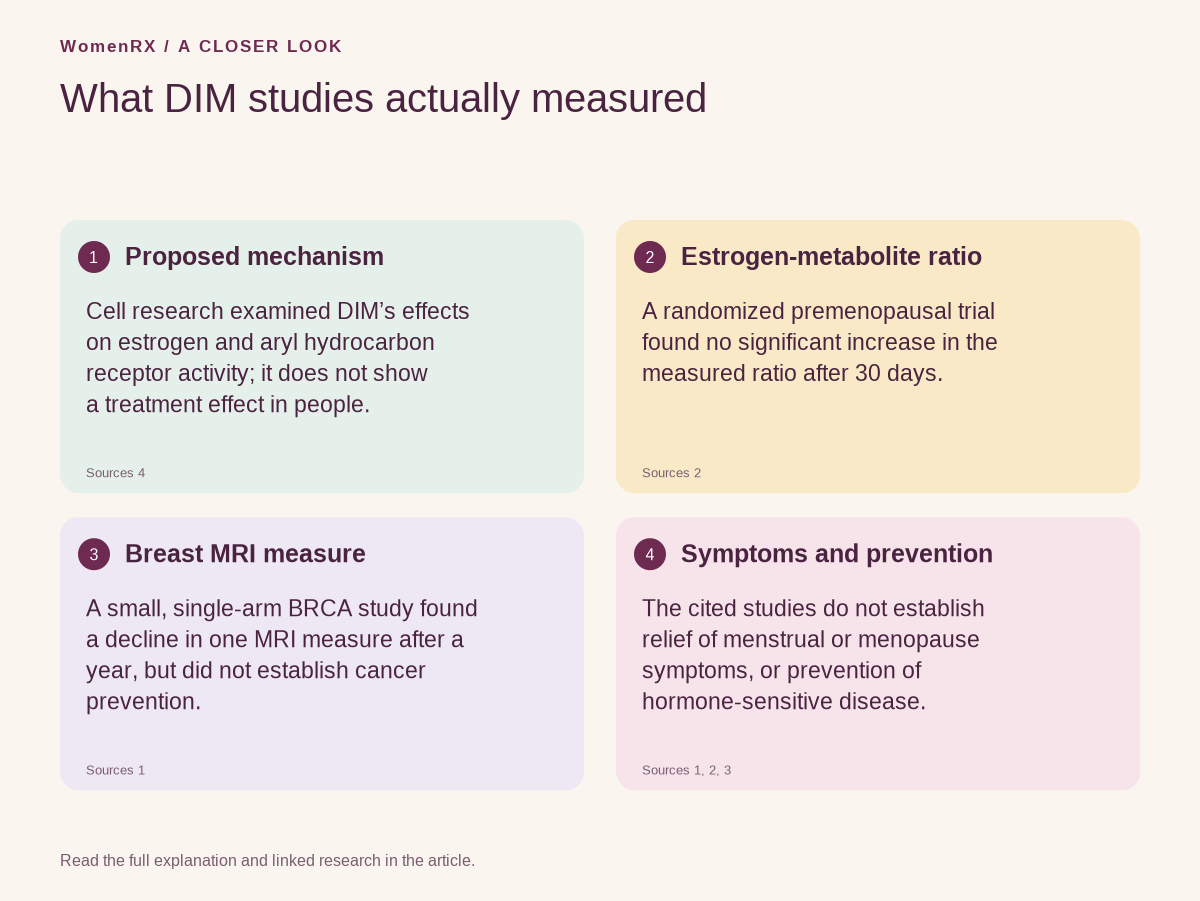
What DIM studies actually measured
Proposed mechanism: Cell research examined DIM’s effects on estrogen and aryl hydrocarbon receptor activity; it does not show a treatment effect in people.4
Estrogen-metabolite ratio: A randomized premenopausal trial found no significant increase in the measured ratio after 30 days.2
Breast MRI measure: A small, single-arm BRCA study found a decline in one MRI measure after a year, but did not establish cancer prevention.1
Symptoms and prevention: The cited studies do not establish relief of menstrual or menopause symptoms, or prevention of hormone-sensitive disease.123
Read the figure as text
Separate proposed biological activity from measured biomarkers and from benefits that would matter to daily life.- Proposed mechanism: Cell research examined DIM’s effects on estrogen and aryl hydrocarbon receptor activity; it does not show a treatment effect in people.4
- Estrogen-metabolite ratio: A randomized premenopausal trial found no significant increase in the measured ratio after 30 days.2
- Breast MRI measure: A small, single-arm BRCA study found a decline in one MRI measure after a year, but did not establish cancer prevention.1
- Symptoms and prevention: The cited studies do not establish relief of menstrual or menopause symptoms, or prevention of hormone-sensitive disease.123
More questions, answered
Does DIM help with menopause symptoms?
The human studies described here measured biomarkers, hormone levels, or breast imaging, not relief from hot flashes or other menopause symptoms. Those findings don’t show that DIM treats menopause symptoms. 1 2
Is DIM proven to prevent breast cancer?
No. A small, nonrandomized study in women with BRCA mutations found a change in one MRI measure after a year, but it did not establish that DIM prevents breast cancer. 1
Sources you can check
- 3,3-Diindolylmethane (DIM): a nutritional intervention and its impact on breast density in healthy BRCA carriers. A prospective clinical trial.Yerushalmi R, Bargil S, Ber Y, Ozlavo R, Sivan T, Rapson Y, Pomerantz A, Tsoref D, Sharon E, Caspi O, Grubsrein A, Margel D. · Carcinogenesis · 2020Return to first citation
- Effectiveness of 3,3'-Diindolylmethane Supplements on Favoring the Benign Estrogen Metabolism Pathway and Decreasing Body Fat in Premenopausal Women.Godínez-Martínez E, Santillán R, Sámano R, Chico-Barba G, Tolentino MC, Hernández-Pineda J. · Nutrition and cancer · 2023Return to first citation
- 3,3'-diindolylmethane modulates estrogen metabolism in patients with thyroid proliferative disease: a pilot study.Rajoria S, Suriano R, Parmar PS, Wilson YL, Megwalu U, Moscatello A, Bradlow HL, Sepkovic DW, Geliebter J, Schantz SP, Tiwari RK. · Thyroid : official journal of the American Thyroid Association · 2011Return to first citation
- Resveratrol and 3,3'-Diindolylmethane Differentially Regulate Aryl Hydrocarbon Receptor and Estrogen Receptor Alpha Activity through Multiple Transcriptomic Targets in MCF-7 Human Breast Cancer Cells.Das S, Somisetty VS, Ulven SM, Matthews J. · International journal of molecular sciences · 2023Return to first citation