DIM Benefits: What Human Studies Have Actually Tested
DIM has been studied for a few specific outcomes, but changing a hormone marker is not the same as improving health or preventing disease.
Human studies have tested DIM for breast-related biomarkers, cervical cell changes, estrogen-metabolism measures, and body composition. Results vary by outcome and formulation: one small trial found cervical lesion regression with a vaginal product, while oral DIM studies have mostly measured biomarkers rather than disease outcomes. No tested biomarker alone proves cancer prevention, and DIM lowered tamoxifen metabolites in one trial. 1234
DIM, or diindolylmethane, is a compound formed from indole-3-carbinol, which occurs in cruciferous vegetables. The human research doesn’t support treating DIM as a general-purpose hormone-balancing supplement. Instead, studies have tested distinct products in distinct groups of women, and often measured a lab value or imaging feature rather than a symptom, diagnosis, or long-term health outcome.
That distinction matters: a biomarker can change without showing that someone feels better or is less likely to develop a disease.
Breast research: biomarkers changed, but cancer prevention wasn’t tested
In a randomized, placebo-controlled trial, 130 women taking tamoxifen for breast cancer were assigned to oral DIM or placebo for 12 months; 98 completed the intervention. DIM changed the urinary ratio of two estrogen metabolites and increased sex hormone-binding globulin compared with placebo. But breast density did not change. The trial did not establish that DIM prevents breast cancer or improves cancer outcomes. 1
There’s also a treatment concern in that same study: tamoxifen metabolites, including endoxifen, were lower in the DIM group than in the placebo group. The researchers said further work was needed to learn whether that could reduce tamoxifen’s clinical benefit. If you take tamoxifen, this is a concrete reason to discuss DIM with your oncology team before using it. 1
A separate study followed 23 healthy women with BRCA mutations who took oral DIM for a year. MRI-measured fibroglandular tissue decreased on average, but another MRI measure, background parenchymal enhancement, did not significantly change. The study was single-arm, so it can’t establish that DIM caused the change; it also did not test whether participants developed fewer cancers. Breast imaging changes are not the same as demonstrated cancer prevention. 2
Cervical findings apply to a specific vaginal product
One randomized, placebo-controlled trial enrolled 78 women of reproductive age with cervical intraepithelial neoplasia (CIN) I-II. It tested DIM in vaginal suppositories, not an oral dietary supplement. The study reported complete regression on biopsy in 100% of the higher-dose group, 90.5% of the lower-dose group, and 61.1% of the placebo group over 90-180 days. These results are from a small trial of a particular formulation and clinical condition; they don’t show that oral DIM supplements prevent cervical cancer or can replace appropriate care for an abnormal cervical finding. 3
Estrogen metabolism and body composition: limited, mixed results
In a randomized trial of 60 premenopausal Mexican women with a low baseline estrogen-metabolite ratio, 30 days of oral DIM did not significantly increase the ratio during supplementation. A positive trend appeared a month after supplementation ended, but it was not statistically significant. The DIM group had a greater decrease in body-fat percentage than the placebo group, with a reported p-value of 0.04; the abstract gives no size for that difference. A short-term body-composition finding doesn’t establish meaningful or lasting weight loss. 4
A small phase I study in patients with thyroid proliferative disease found that 14 days of DIM was associated with a change in urinary estrogen-metabolite ratios. That is a biomarker result, not evidence that DIM treats thyroid disease or prevents thyroid cancer. 5
How to read the claims
The most useful question isn’t simply whether DIM “works.” It’s whether a study tested the outcome you care about, in people like you, using the same kind of product. For example, a result from vaginal suppositories for biopsy-confirmed cervical changes doesn’t establish a benefit from an oral supplement. A shift in estrogen metabolites doesn’t by itself establish cancer prevention, symptom relief, or hormone balance.
Across these studies, researchers tested particular outcomes in particular groups, including premenopausal women, women with BRCA mutations, and women taking tamoxifen. Those findings don’t establish benefits for menopause symptoms, fertility, or other commonly promoted uses that weren’t measured here. The clearest practical distinction is between a measured change, such as a lab marker or MRI feature, and a demonstrated improvement in health.
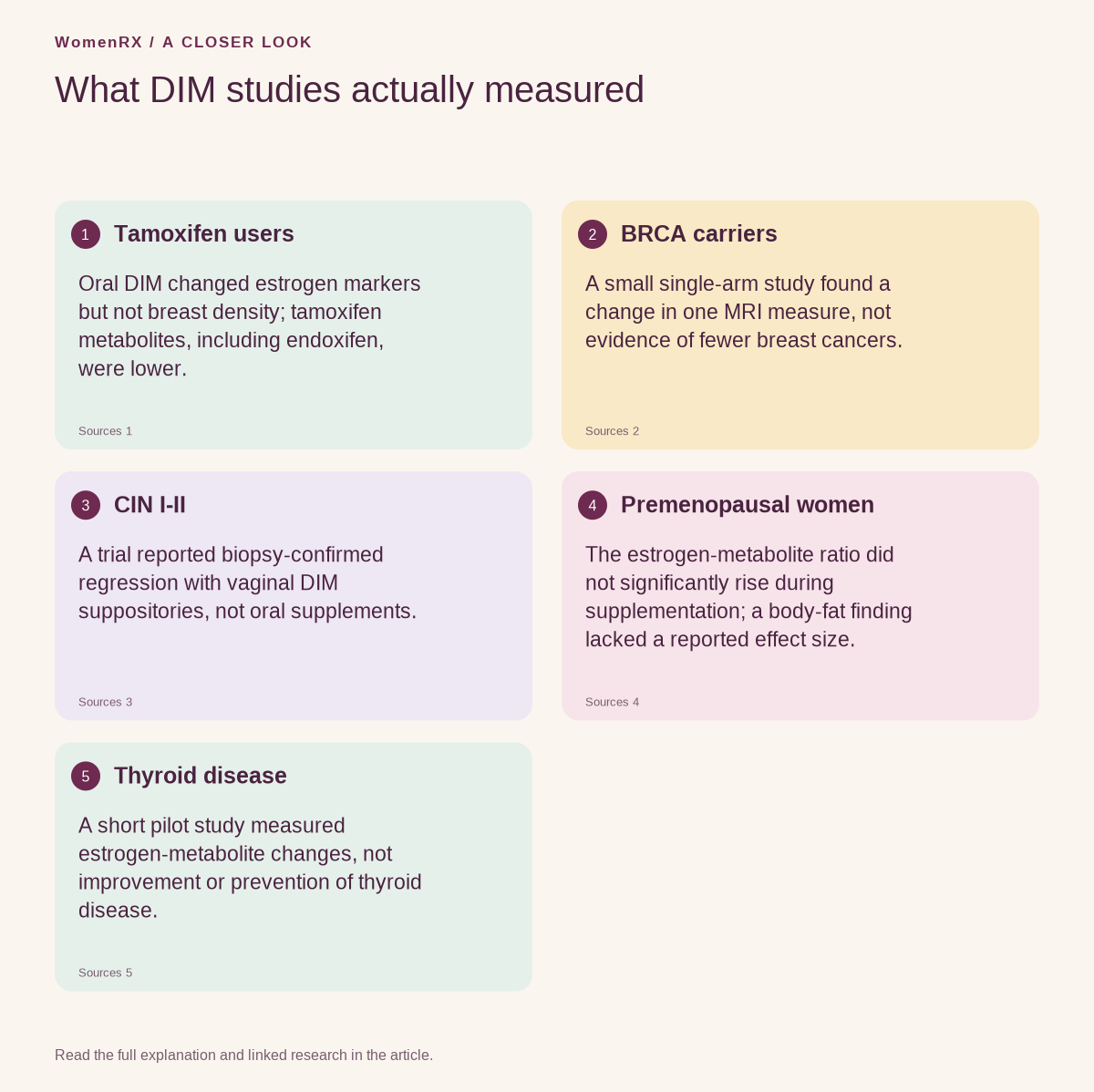
What DIM studies actually measured
Tamoxifen users: Oral DIM changed estrogen markers but not breast density; tamoxifen metabolites, including endoxifen, were lower.1
BRCA carriers: A small single-arm study found a change in one MRI measure, not evidence of fewer breast cancers.2
CIN I-II: A trial reported biopsy-confirmed regression with vaginal DIM suppositories, not oral supplements.3
Premenopausal women: The estrogen-metabolite ratio did not significantly rise during supplementation; a body-fat finding lacked a reported effect size.4
Thyroid disease: A short pilot study measured estrogen-metabolite changes, not improvement or prevention of thyroid disease.5
Read the figure as text
The population, product, and endpoint determine what each result can tell you.- Tamoxifen users: Oral DIM changed estrogen markers but not breast density; tamoxifen metabolites, including endoxifen, were lower.1
- BRCA carriers: A small single-arm study found a change in one MRI measure, not evidence of fewer breast cancers.2
- CIN I-II: A trial reported biopsy-confirmed regression with vaginal DIM suppositories, not oral supplements.3
- Premenopausal women: The estrogen-metabolite ratio did not significantly rise during supplementation; a body-fat finding lacked a reported effect size.4
- Thyroid disease: A short pilot study measured estrogen-metabolite changes, not improvement or prevention of thyroid disease.5
More questions, answered
Does DIM prevent breast cancer?
These studies do not show that DIM prevents breast cancer. One small study in women with BRCA mutations measured MRI features rather than cancer incidence, and a trial in women taking tamoxifen found no change in breast density. 12
Is the cervical study evidence for oral DIM supplements?
No. It tested a specific vaginal suppository in women with CIN I-II. Its results can’t be assumed to apply to oral supplements. 3
Sources you can check
- A randomized, placebo-controlled trial of diindolylmethane for breast cancer biomarker modulation in patients taking tamoxifen.Thomson CA, Chow HHS, Wertheim BC, Roe DJ, Stopeck A, Maskarinec G, Altbach M, Chalasani P, Huang C, Strom MB, Galons JP, Thompson PA. · Breast cancer research and treatment · 2017Return to first citation
- 3,3-Diindolylmethane (DIM): a nutritional intervention and its impact on breast density in healthy BRCA carriers. A prospective clinical trial.Yerushalmi R, Bargil S, Ber Y, Ozlavo R, Sivan T, Rapson Y, Pomerantz A, Tsoref D, Sharon E, Caspi O, Grubsrein A, Margel D. · Carcinogenesis · 2020Return to first citation
- Double-blind randomized placebo-controlled multicenter clinical trial (phase IIa) on diindolylmethane's efficacy and safety in the treatment of CIN: implications for cervical cancer prevention.Ashrafian L, Sukhikh G, Kiselev V, Paltsev M, Paltsev M, Drukh V, Kuznetsov I, Muyzhnek E, Apolikhina I, Andrianova E. · The EPMA journal · 2015Return to first citation
- Effectiveness of 3,3'-Diindolylmethane Supplements on Favoring the Benign Estrogen Metabolism Pathway and Decreasing Body Fat in Premenopausal Women.Godínez-Martínez E, Santillán R, Sámano R, Chico-Barba G, Tolentino MC, Hernández-Pineda J. · Nutrition and cancer · 2023Return to first citation
- 3,3'-diindolylmethane modulates estrogen metabolism in patients with thyroid proliferative disease: a pilot study.Rajoria S, Suriano R, Parmar PS, Wilson YL, Megwalu U, Moscatello A, Bradlow HL, Sepkovic DW, Geliebter J, Schantz SP, Tiwari RK. · Thyroid : official journal of the American Thyroid Association · 2011Return to first citation