DIM Supplements: What Human Studies Actually Show
DIM may affect hormone markers, but that finding doesn’t tell you whether it will help an estrogen-related concern.
A clinical review describes limited evidence that DIM may shift hormone markers, but it does not report a clear clinical advantage over indole-3-carbinol. A small study tested single doses of absorption-enhanced DIM in healthy men and women to assess tolerability and absorption, not symptom relief. Those amounts are study doses, not a recommended dose for women. 4 1
DIM, short for 3,3′-diindolylmethane, is a compound associated with cruciferous vegetables. Supplements are often considered for concerns described as “estrogen-related,” but that phrase can cover very different questions. Are you hoping to change a laboratory result, ease a symptom, or lower a disease risk? The evidence for one doesn’t automatically answer the others. 2
What a hormone-marker change can tell you
A clinical review of crucifer-derived compounds describes limited evidence that DIM may shift hormone markers in a way similar to indole-3-carbinol, or I3C. The review says more clinical trials were available for I3C than for DIM, and the data it assessed did not suggest that DIM offered enhanced clinical benefits over I3C. 4
A marker is a measurement, not an outcome you necessarily experience. Even if DIM changes a measure of estrogen metabolism, that result alone cannot tell you whether it will ease a symptom or improve health. The review abstract does not report findings on menstrual symptoms, fertility, or particular disease outcomes. That does not mean those outcomes have never been studied. 4
That distinction is useful when reading a product claim. “Changes estrogen metabolism” and “helps with my symptoms” are two separate claims. Evidence for the first should not be presented as proof of the second.
What the human dose study was designed to answer
In a small study, healthy, drug-free, nonsmoking men and women received a single dose of an absorption-enhanced formulation called BR-DIM. The tested amounts were 50, 100, 150, 200, and 300 mg; researchers tested 300 mg in an additional group. They measured how much DIM appeared in blood and assessed short-term tolerability. They did not use these doses to find a treatment amount for an estrogen-related symptom. The mixed-sex results did not provide a separately reported result for women. 1
No BR-DIM-related adverse effects were reported at single doses up to 200 mg. At 300 mg, one of six participants reported mild nausea and headache; vomiting was also reported and was judged probably related to BR-DIM. That describes what happened in a small, single-dose study, not what to expect from taking DIM regularly. It also does not establish that the same amounts behave alike across DIM formulations. 1
The safety question that remains open
The clinical review calls for more human research on DIM safety. The single-dose study cannot answer questions about ongoing use. 4 1
Drug interactions are another area where the type of evidence matters. In cultured human liver cells, DIM affected the expression or activity of enzymes involved in processing substances, including CYP3A4. That laboratory finding raises a question for further research, but it does not establish that DIM changes the level or effect of a particular medicine in people. 3
If you’re weighing DIM for a specific concern, ask what the claim rests on: a proposed mechanism, a hormone measurement, or a study of the outcome you care about. The human findings described here support a cautious answer about markers and short-term tolerability. They do not turn the tested doses into personal dosing advice. 4 1
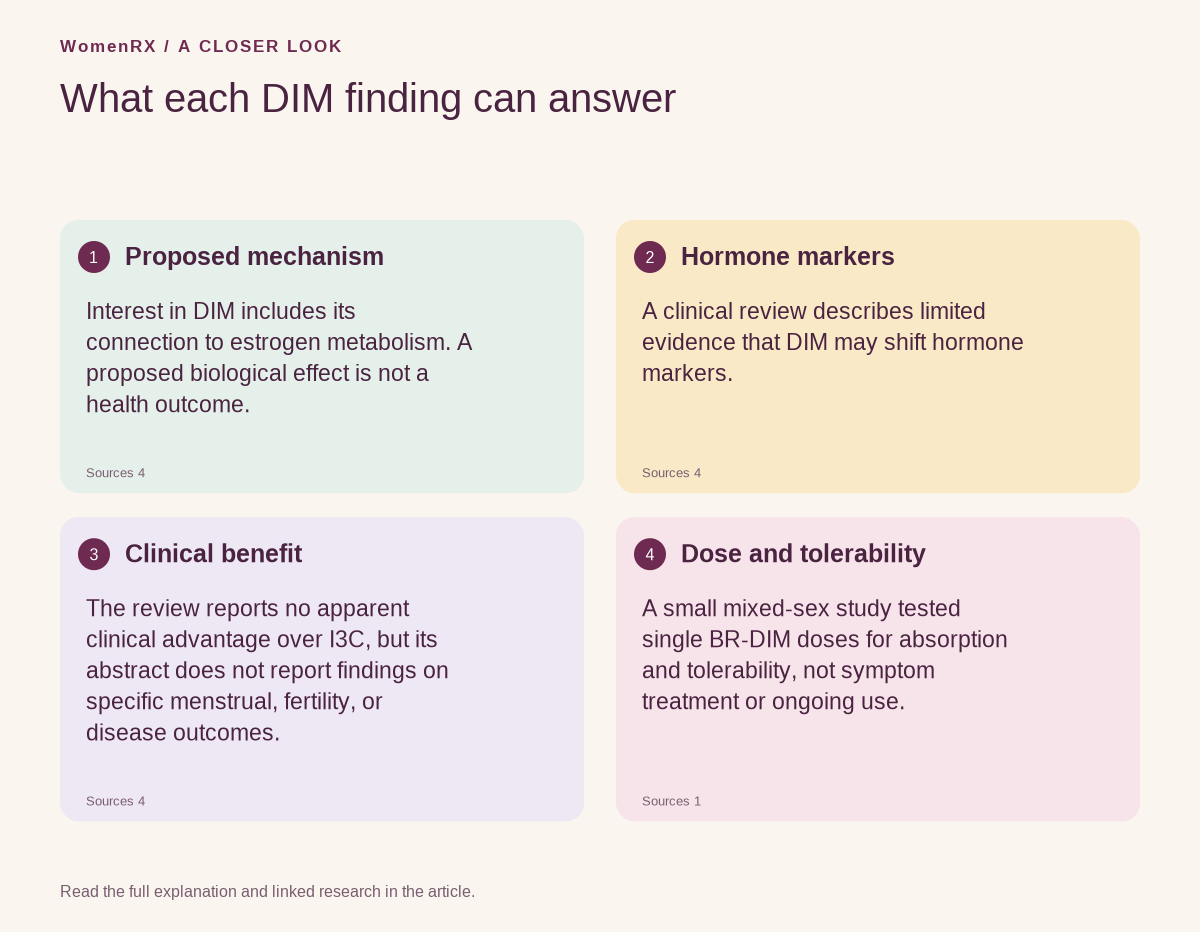
What each DIM finding can answer
Proposed mechanism: Interest in DIM includes its connection to estrogen metabolism. A proposed biological effect is not a health outcome.4
Hormone markers: A clinical review describes limited evidence that DIM may shift hormone markers.4
Clinical benefit: The review reports no apparent clinical advantage over I3C, but its abstract does not report findings on specific menstrual, fertility, or disease outcomes.4
Dose and tolerability: A small mixed-sex study tested single BR-DIM doses for absorption and tolerability, not symptom treatment or ongoing use.1
Read the figure as text
These findings address different questions and should not be treated as interchangeable evidence of benefit.- Proposed mechanism: Interest in DIM includes its connection to estrogen metabolism. A proposed biological effect is not a health outcome.4
- Hormone markers: A clinical review describes limited evidence that DIM may shift hormone markers.4
- Clinical benefit: The review reports no apparent clinical advantage over I3C, but its abstract does not report findings on specific menstrual, fertility, or disease outcomes.4
- Dose and tolerability: A small mixed-sex study tested single BR-DIM doses for absorption and tolerability, not symptom treatment or ongoing use.1
Sources you can check
- Single-dose pharmacokinetics and tolerability of absorption-enhanced 3,3'-diindolylmethane in healthy subjects.Reed GA, Sunega JM, Sullivan DK, Gray JC, Mayo MS, Crowell JA, Hurwitz A. · Cancer epidemiology, biomarkers & prevention : a publication of the American Association for Cancer Research, cosponsored by the American Society of Preventive Oncology · 2008Return to first citation
- Cellular and Molecular Mechanisms of 3,3'-Diindolylmethane in Gastrointestinal Cancer.Kim SM. · International journal of molecular sciences · 2016Return to first citation
- Modulation of aflatoxin B1-mediated genotoxicity in primary cultures of human hepatocytes by diindolylmethane, curcumin, and xanthohumols.Gross-Steinmeyer K, Stapleton PL, Tracy JH, Bammler TK, Strom SC, Buhler DR, Eaton DL. · Toxicological sciences : an official journal of the Society of Toxicology · 2009Return to first citation
- A review of the clinical efficacy and safety of cruciferous vegetable phytochemicals.Minich DM, Bland JS. · Nutrition reviews · 2007Return to first citation