DIM Supplements: What the Estrogen Research Really Shows
DIM may change how estrogen metabolites appear in urine, but that’s a different question from whether it improves symptoms or protects your health.
Diindolylmethane (DIM) is a compound formed from a substance in cruciferous vegetables. Studies in women have tested whether DIM changes a ratio of estrogen metabolites measured in urine, with different results in different groups. Those results don’t establish relief of menstrual or menopause symptoms or prevention of disease. If you take tamoxifen, one trial raises a specific concern about its metabolites. 124
What does DIM do to estrogen?
DIM forms from indole-3-carbinol, a substance found in cruciferous vegetables such as broccoli and cabbage. Supplement research has focused in part on whether DIM changes the types of estrogen metabolites found in urine. That’s more specific than saying DIM “balances hormones,” and it doesn’t mean that eating vegetables has the same effects as taking a DIM supplement. 24
The measurement at the center of several studies is a ratio: 2-hydroxyestrogens compared with 16α-hydroxyestrone. A higher ratio means more of the measured metabolites appear on the 2-hydroxyestrogen side relative to the 16α-hydroxyestrone side. It does not, by itself, tell you that your total estrogen is too high, that it has been “detoxified,” or that you’ll feel better. 12
Why the findings differ between studies
In a randomized trial of 60 premenopausal Mexican women selected for a low starting urine ratio, DIM did not significantly increase the ratio after 30 days compared with placebo. A possible increase measured 30 days after supplementation ended was also not statistically significant. This study does not support a reliable increase in that marker during the period tested. 1
A different randomized trial enrolled 130 women prescribed tamoxifen and compared DIM with placebo for 12 months; 98 completed the intervention. In this group, DIM increased the urine ratio compared with placebo. Breast density, measured by mammography and MRI, did not change. The trial did not establish whether DIM changes breast cancer outcomes. 2
These results aren’t a simple vote for or against DIM. The trials studied different groups over different periods. The stronger signal in the tamoxifen trial is a finding about a urine marker in women taking tamoxifen, not evidence that DIM improves health for women generally. A small phase I study in patients with thyroid proliferative disease also reported a change in the urine ratio after DIM use, but it did not demonstrate prevention or treatment of thyroid disease. 123
A useful way to check a DIM claim
Ask what the claim promises, then look for the outcome that would actually show it:
- “Supports estrogen metabolism” may refer to a change in the urine ratio. Even that result was not consistent across the studies above. 12
- “Helps PMS or menopause symptoms” calls for studies measuring those symptoms. The trials discussed here do not establish relief of PMS, cycle-related symptoms, or menopause symptoms. 12
- “Protects against cancer” calls for evidence about cancer outcomes, not just a metabolite ratio. The tamoxifen trial measured biomarkers and breast density; it did not establish cancer prevention or improved treatment outcomes. 2
If you’re having periods, in perimenopause, or postmenopausal, those distinctions still matter. The premenopausal trial was limited to women with a particular starting urine measurement. Its findings cannot simply be applied to every woman with cycle symptoms, and the tamoxifen trial cannot be treated as a menopause-symptom study. 12
The safety question changes if you take tamoxifen
In the tamoxifen trial, women assigned to DIM had lower blood levels of several tamoxifen metabolites, including endoxifen, than women assigned to placebo. The researchers could not determine whether that change reduced tamoxifen’s clinical benefit. If tamoxifen is part of your treatment, talk with the clinician managing it before considering DIM. A shift in the urine ratio isn’t a reason to overlook a possible change to a treatment you rely on. 2
The trial reported few adverse events and no difference between groups, but that finding does not settle the safety of regular DIM use over longer periods or in other populations. A review has also identified reports of delayed hypersensitivity reactions associated with DIM. Because that evidence comes largely from case reports and safety reporting, it cannot tell us how often such reactions happen. 25
The most useful question, then, isn’t whether DIM can affect a lab result in anyone. It’s whether the particular benefit you want has been demonstrated in people like you, and whether a treatment you already use could be affected.
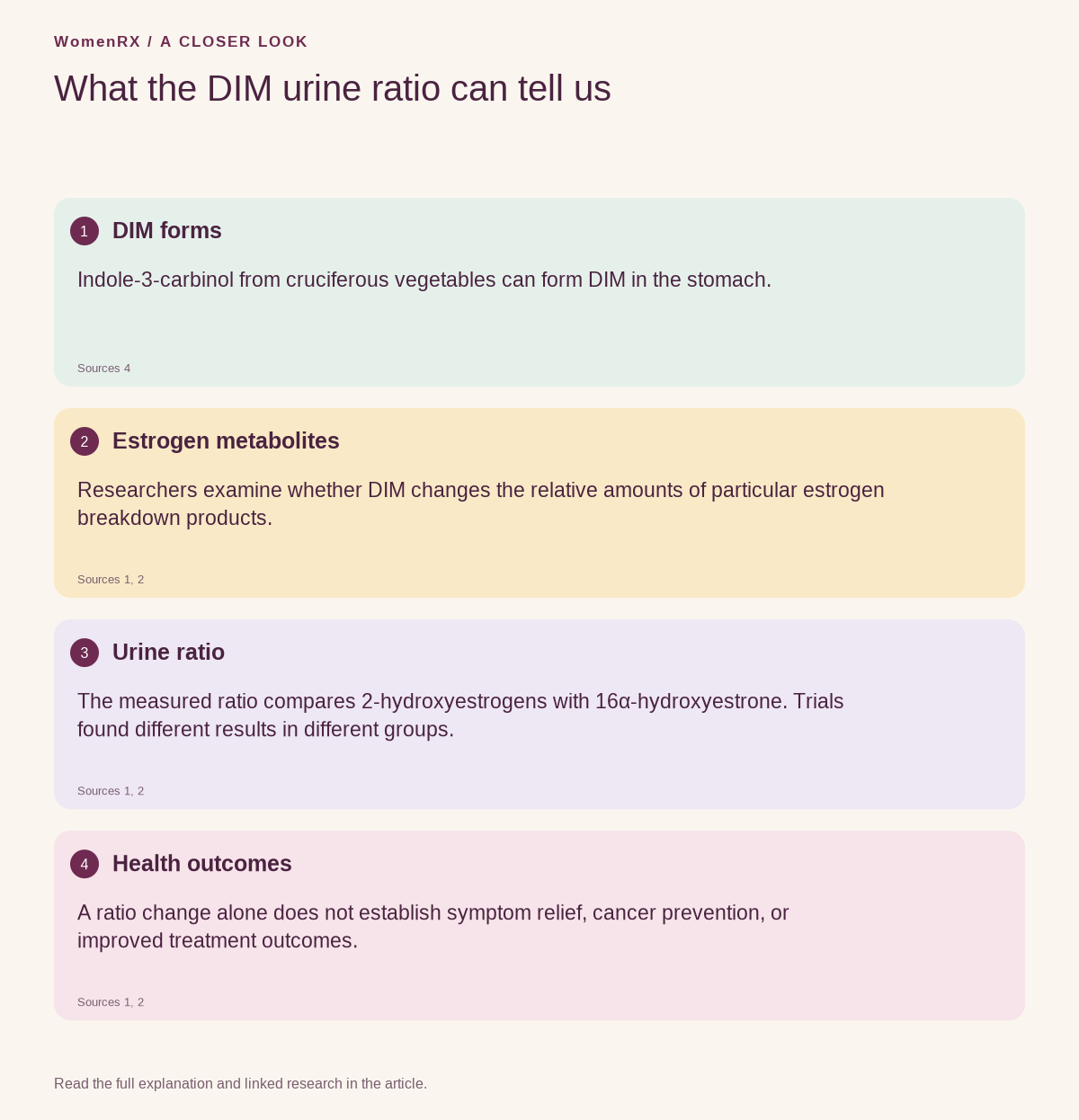
What the DIM urine ratio can tell us
DIM forms: Indole-3-carbinol from cruciferous vegetables can form DIM in the stomach.4
Estrogen metabolites: Researchers examine whether DIM changes the relative amounts of particular estrogen breakdown products.12
Urine ratio: The measured ratio compares 2-hydroxyestrogens with 16α-hydroxyestrone. Trials found different results in different groups.12
Health outcomes: A ratio change alone does not establish symptom relief, cancer prevention, or improved treatment outcomes.12
Read the figure as text
This pathway separates the proposed effect on estrogen metabolites from the health outcomes a supplement claim would need to demonstrate.- DIM forms: Indole-3-carbinol from cruciferous vegetables can form DIM in the stomach.4
- Estrogen metabolites: Researchers examine whether DIM changes the relative amounts of particular estrogen breakdown products.12
- Urine ratio: The measured ratio compares 2-hydroxyestrogens with 16α-hydroxyestrone. Trials found different results in different groups.12
- Health outcomes: A ratio change alone does not establish symptom relief, cancer prevention, or improved treatment outcomes.12
More questions, answered
Does a higher estrogen-metabolite ratio mean less estrogen?
No. The studied ratio compares particular estrogen metabolites in urine. A change in their relative amounts does not, on its own, establish a reduction in total estrogen or an improvement in symptoms. 12
Does DIM prevent breast cancer?
The tamoxifen trial found a change in an estrogen-metabolite ratio, but it did not establish that DIM prevents breast cancer or improves cancer outcomes. Breast density did not change in that trial. 2
Sources you can check
- Effectiveness of 3,3'-Diindolylmethane Supplements on Favoring the Benign Estrogen Metabolism Pathway and Decreasing Body Fat in Premenopausal Women.Godínez-Martínez E, Santillán R, Sámano R, Chico-Barba G, Tolentino MC, Hernández-Pineda J. · Nutrition and cancer · 2023Return to first citation
- A randomized, placebo-controlled trial of diindolylmethane for breast cancer biomarker modulation in patients taking tamoxifen.Thomson CA, Chow HHS, Wertheim BC, Roe DJ, Stopeck A, Maskarinec G, Altbach M, Chalasani P, Huang C, Strom MB, Galons JP, Thompson PA. · Breast cancer research and treatment · 2017Return to first citation
- 3,3'-diindolylmethane modulates estrogen metabolism in patients with thyroid proliferative disease: a pilot study.Rajoria S, Suriano R, Parmar PS, Wilson YL, Megwalu U, Moscatello A, Bradlow HL, Sepkovic DW, Geliebter J, Schantz SP, Tiwari RK. · Thyroid : official journal of the American Thyroid Association · 2011Return to first citation
- Cellular and Molecular Mechanisms of 3,3'-Diindolylmethane in Gastrointestinal Cancer.Kim SM. · International journal of molecular sciences · 2016Return to first citation
- Hypersensitivity reactions associated with nutraceuticals and dietary supplements: A narrative review.Srisuwatchari W, Norchai P. · Asian Pacific journal of allergy and immunology · 2026Return to first citation