DIM After 40: Does It Help With Perimenopause?
Studies in women have measured estrogen markers and other outcomes, but they don’t establish that DIM improves perimenopause symptoms or changing periods.
These studies don’t establish that DIM eases perimenopause symptoms or makes changing periods more regular. A randomized trial in premenopausal women measured a urine estrogen marker, not symptoms or cycle changes, and did not find a significant increase in that marker during supplementation. Other studies involved different populations or measured lab and imaging outcomes instead. 4 5 7
What a hormone-marker change can tell you
DIM is often discussed in relation to estrogen metabolism. But a change in a urine measurement isn’t the same as fewer hot flashes, better sleep, improved mood, or more predictable periods. To know whether DIM helps with those concerns, studies would need to measure the symptoms or cycle outcomes themselves.
One randomized, double-blind trial enrolled 60 premenopausal Mexican women whose urine estrogen-metabolite ratio was below a specified threshold. After 30 days, the researchers did not find a significant increase in that ratio in the DIM group. The trial measured a lab marker, not perimenopause symptoms or menstrual regularity. Its abstract identifies participants as premenopausal but does not establish that they were over 40 or in the menopausal transition. 4
A retrospective study found differences in urine estrogen profiles between women who reported taking DIM and those who reported not taking it. A smaller group with results from before and after starting DIM also showed changes in some measurements. These findings describe lab results; they don’t establish that DIM improved symptoms or cycles, and the larger comparison can’t show that DIM caused the differences. 7
Why age alone doesn’t make a study perimenopause evidence
A study of 23 healthy women with BRCA mutations may sound relevant because their median age was 47. But 78% were postmenopausal, and the study examined breast-tissue measurements on MRI rather than perimenopause symptoms or periods. It was a prospective, single-arm study, so it doesn’t establish that DIM helps during the menopausal transition. 5
A different small study included eight women with endometriosis who were randomly given dienogest alone or dienogest with DIM for three months. It explored DIM as an addition to an endometriosis treatment, not as a treatment for perimenopause or ordinary cycle changes. 3
Taken together, these studies don’t answer the central question for someone considering DIM for perimenopause: whether it improves the symptoms or bleeding-pattern changes that matter to her. The North American Menopause Society’s 2023 statement does not recommend supplements and herbal remedies for menopause-related hot flashes and night sweats. That recommendation covers the category, not DIM specifically. 2
If you use an estradiol patch
There is a specific reason to mention DIM if you use a transdermal estradiol patch. In a retrospective study of postmenopausal women using a patch, women who also reported DIM use had different urine estrogen profiles from women using the patch alone. The study did not establish whether those differences affected symptom relief or bone health, and it doesn’t tell us what happens during perimenopause. Share your supplement use with the clinician managing your hormone treatment rather than assuming the combination has no effect. 6
This finding isn’t proof that DIM reduces the patch’s benefits. It shows a difference in lab measurements, while the clinical meaning remains uncertain. 6
Questions that keep the decision focused
If you’re weighing DIM, start with the outcome you want to change. You might ask:
- Is my main concern irregular bleeding, hot flashes, sleep disruption, or something else? The DIM studies described here don’t establish relief for those perimenopause concerns.
- Am I taking an estradiol patch or other hormone treatment? The patch study found altered urine profiles among postmenopausal women reporting DIM use, though it did not establish a clinical effect. 6
- What would count as a meaningful improvement for me? A shift in a urine marker isn’t the same as feeling better or having more predictable periods.
- If hot flashes are the concern, what options have evidence for that symptom? The menopause position statements describe hormone therapy as the most effective treatment for vasomotor symptoms and identify several evidence-supported nonhormonal options. 1 2
For now, this evidence supports a limited conclusion: DIM may be associated with changes in some estrogen measurements, but it hasn’t been shown in these studies to improve perimenopause symptoms or changing cycles.
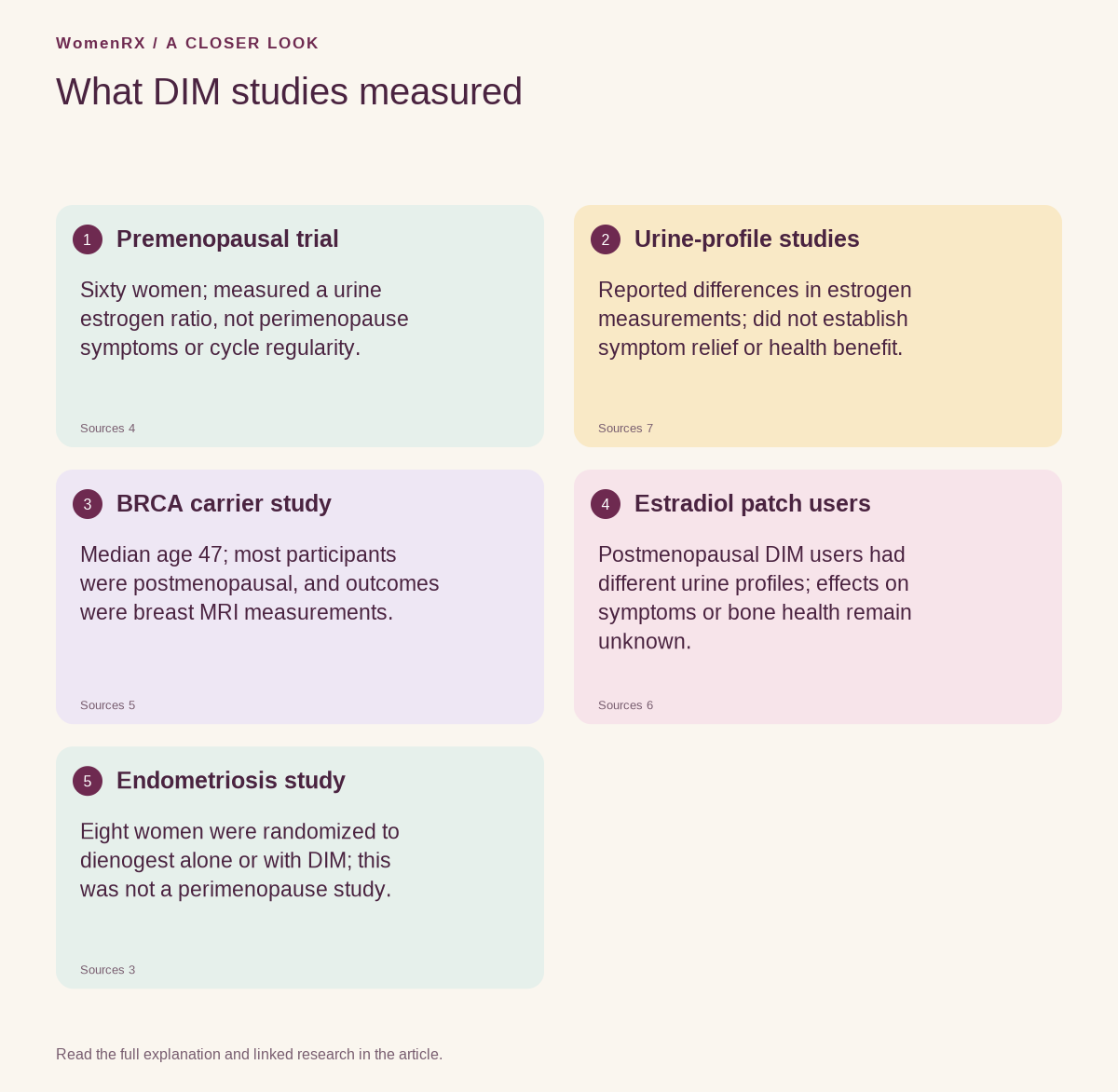
What DIM studies measured
Premenopausal trial: Sixty women; measured a urine estrogen ratio, not perimenopause symptoms or cycle regularity.4
Urine-profile studies: Reported differences in estrogen measurements; did not establish symptom relief or health benefit.7
BRCA carrier study: Median age 47; most participants were postmenopausal, and outcomes were breast MRI measurements.5
Estradiol patch users: Postmenopausal DIM users had different urine profiles; effects on symptoms or bone health remain unknown.6
Endometriosis study: Eight women were randomized to dienogest alone or with DIM; this was not a perimenopause study.3
Read the figure as text
Compare each study’s population and outcome with the question of whether DIM helps with perimenopause symptoms or changing cycles.- Premenopausal trial: Sixty women; measured a urine estrogen ratio, not perimenopause symptoms or cycle regularity.4
- Urine-profile studies: Reported differences in estrogen measurements; did not establish symptom relief or health benefit.7
- BRCA carrier study: Median age 47; most participants were postmenopausal, and outcomes were breast MRI measurements.5
- Estradiol patch users: Postmenopausal DIM users had different urine profiles; effects on symptoms or bone health remain unknown.6
- Endometriosis study: Eight women were randomized to dienogest alone or with DIM; this was not a perimenopause study.3
More questions, answered
Does a change in estrogen metabolites mean DIM is helping?
Not by itself. A lab measurement can change without showing that symptoms improved, periods became more regular, or another meaningful health outcome changed. The DIM studies described here do not establish those benefits for perimenopause. 4 7
Sources you can check
- The 2022 hormone therapy position statement of The North American Menopause Society.“The 2022 Hormone Therapy Position Statement of The North American Menopause Society” Advisory Panel. · Menopause (New York, N.Y.) · 2022Return to first citation
- The 2023 nonhormone therapy position statement of The North American Menopause Society.Menopause (New York, N.Y.) · 2023Return to first citation
- Comparison of dienogest effects upon 3,3'-diindolylmethane supplementation in models of endometriosis and clinical cases.Morales-Prieto DM, Herrmann J, Osterwald H, Kochhar PS, Schleussner E, Markert UR, Oettel M. · Reproductive biology · 2018Return to first citation
- Effectiveness of 3,3'-Diindolylmethane Supplements on Favoring the Benign Estrogen Metabolism Pathway and Decreasing Body Fat in Premenopausal Women.Godínez-Martínez E, Santillán R, Sámano R, Chico-Barba G, Tolentino MC, Hernández-Pineda J. · Nutrition and cancer · 2023Return to first citation
- 3,3-Diindolylmethane (DIM): a nutritional intervention and its impact on breast density in healthy BRCA carriers. A prospective clinical trial.Yerushalmi R, Bargil S, Ber Y, Ozlavo R, Sivan T, Rapson Y, Pomerantz A, Tsoref D, Sharon E, Caspi O, Grubsrein A, Margel D. · Carcinogenesis · 2020Return to first citation
- The impact of 3,3'-diindolylmethane on estradiol and estrogen metabolism in postmenopausal women using a transdermal estradiol patch.Newman MS, Smeaton J. · Menopause (New York, N.Y.) · 2025Return to first citation
- Exploring the impact of 3,3'-diindolylmethane on the urinary estrogen profile of premenopausal women.Newman M, Smeaton J. · BMC complementary medicine and therapies · 2024Return to first citation