When Should You Take DIM? What Timing Research Shows
A blood-level study in women measured DIM after they took a different compound, so it can’t establish a morning, nighttime, or mealtime rule for DIM supplements.
There’s no supported reason to favor morning over night for a DIM supplement based on these studies. The human research measured DIM formed after women took indole-3-carbinol (I3C), not a DIM supplement; an oral DIM study compared formulations in mice. Neither establishes whether a DIM product works better with food or in divided servings. Check your product’s directions rather than changing a prescription schedule to accommodate it. 12
Why a blood-level peak isn’t a dosing recommendation
It’s tempting to choose a time of day based on when DIM shows up in the bloodstream. But a peak tells you when researchers measured the highest concentration under particular study conditions. It doesn’t tell you whether taking DIM at breakfast rather than bedtime changes a health outcome.
In a phase I study, women took indole-3-carbinol (I3C), and researchers measured DIM formed from it. After a single I3C dose, DIM in blood generally peaked about two hours later. Some participants also took I3C twice daily for eight weeks. That schedule was part of a study of I3C, not a test showing that a DIM supplement should be split into two servings. 2
Researchers have also given DIM itself by mouth to mice. In that study, blood levels peaked roughly half an hour to an hour after administration, and an absorption-enhanced formulation produced greater DIM exposure than a crystalline formulation. The comparison was between formulations in mice, not between morning and evening, meals and fasting, or single and divided servings in people. Faster absorption or greater blood exposure alone isn’t proof of a better result for someone taking a supplement. 1
The practical distinction is this: administration affects what researchers can measure, but these findings don’t identify an ideal daily routine for DIM. They also don’t prove that timing can never matter.
Let the specific product answer the product questions
If you’ve decided to use DIM, read the directions on the container you actually have. Look for whether it specifies a meal, a number of servings, or other administration details. For example, a label that says to take that product with food gives you a direction for that product. It doesn’t establish that every DIM formulation needs food.
Don’t borrow a twice-daily routine from the I3C study or assume that an absorption-enhanced formulation’s results apply to another capsule. If your label is unclear, bring a photo of its directions and ingredient list to a pharmacist. That’s more useful than trying to calculate a schedule from blood-level peaks. 12
If contraception or hormone-related medicine is on your schedule
Neither the women’s I3C study nor the mouse DIM study tested DIM alongside hormonal contraception or hormone-related medicines. They therefore can’t establish whether taking a DIM supplement at the same time as those medicines matters, or whether separating them by a few hours would address a potential interaction. 12
Keep taking a prescribed medicine as directed rather than moving, skipping, or spacing its doses based on a DIM timing tip. Before adding DIM, show a pharmacist or prescriber the exact supplement label and your current medication schedule. The question to ask is whether that product belongs in your routine at all, not just which hour to take it.
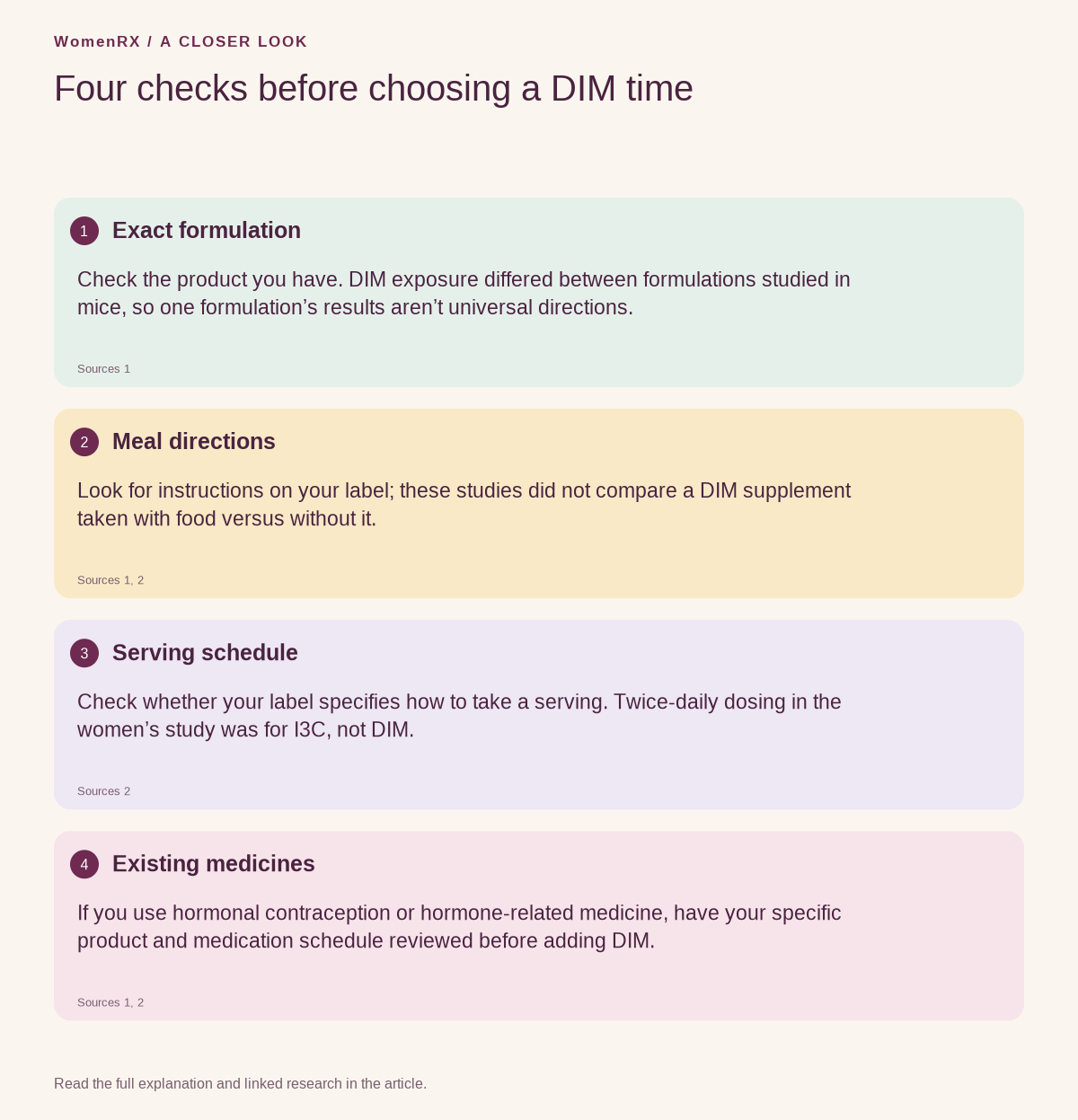
Four checks before choosing a DIM time
Exact formulation: Check the product you have. DIM exposure differed between formulations studied in mice, so one formulation’s results aren’t universal directions.1
Meal directions: Look for instructions on your label; these studies did not compare a DIM supplement taken with food versus without it.12
Serving schedule: Check whether your label specifies how to take a serving. Twice-daily dosing in the women’s study was for I3C, not DIM.2
Existing medicines: If you use hormonal contraception or hormone-related medicine, have your specific product and medication schedule reviewed before adding DIM.12
Read the figure as text
Use product-specific directions without mistaking blood-level research for a proven daily schedule.- Exact formulation: Check the product you have. DIM exposure differed between formulations studied in mice, so one formulation’s results aren’t universal directions.1
- Meal directions: Look for instructions on your label; these studies did not compare a DIM supplement taken with food versus without it.12
- Serving schedule: Check whether your label specifies how to take a serving. Twice-daily dosing in the women’s study was for I3C, not DIM.2
- Existing medicines: If you use hormonal contraception or hormone-related medicine, have your specific product and medication schedule reviewed before adding DIM.12
More questions, answered
Does taking DIM with food improve absorption?
That hasn’t been established by the cited human study, which gave women I3C rather than a DIM supplement, or by the oral DIM study in mice, which compared formulations rather than meals. Follow any meal direction on your specific product instead of treating it as a rule for all DIM supplements. 12
Should I divide my DIM serving?
The twice-daily schedule reported in the women’s study was for I3C. It doesn’t show that dividing a DIM supplement serving improves absorption or results. Check your product’s directions rather than adapting the I3C study schedule. 2
Sources you can check
- Physiological modeling of formulated and crystalline 3,3'-diindolylmethane pharmacokinetics following oral administration in mice.Anderton MJ, Manson MM, Verschoyle R, Gescher A, Steward WP, Williams ML, Mager DE. · Drug metabolism and disposition: the biological fate of chemicals · 2004Return to first citation
- Single-dose and multiple-dose administration of indole-3-carbinol to women: pharmacokinetics based on 3,3'-diindolylmethane.Reed GA, Arneson DW, Putnam WC, Smith HJ, Gray JC, Sullivan DK, Mayo MS, Crowell JA, Hurwitz A. · Cancer epidemiology, biomarkers & prevention : a publication of the American Association for Cancer Research, cosponsored by the American Society of Preventive Oncology · 2006Return to first citation