DIM Supplements: What We Know About Timing and Hormone Claims
DIM has changed hormone-related lab markers in some small studies, but that hasn’t shown it eases menstrual or menopause symptoms, and one trial found a potential concern with tamoxifen.
DIM has altered estrogen-metabolism markers in some human studies, but those changes don’t establish a benefit for menstrual symptoms, contraception, or menopause. No best time of day has been demonstrated: trials reported daily use over set study periods, not a comparison of morning versus evening. One trial in women taking tamoxifen found lower levels of tamoxifen metabolites with DIM, so combining them deserves a prescriber’s review. 1 2
A lab change isn’t the same as feeling better
DIM, or diindolylmethane, is a compound formed from substances in cruciferous vegetables. Its proposed effects on estrogen metabolism have led to claims that it can “balance” hormones. Human studies have measured changes in estrogen-related markers, but a marker is not the same as a meaningful outcome such as less painful periods, more reliable contraception, or relief from hot flashes.
In a randomized trial, 60 premenopausal Mexican women with a low baseline estrogen-metabolite ratio received placebo or DIM for 30 days. The ratio did not significantly increase during treatment. Researchers noted a non-significant trend at a later measurement, but that doesn’t establish a lasting effect or a health benefit. The study did not test whether DIM improved menstrual symptoms. 1
A small phase I study in patients with thyroid proliferative disease reported a change in the urinary ratio of two estrogen metabolites after 14 days. It measured laboratory markers in people being treated surgically; it did not show that DIM prevented or treated a thyroid condition or improved symptoms. Together, these studies show why a proposed mechanism or biomarker shift shouldn’t be taken as proof of “hormone balancing.” 3
What’s known about timing?
The trials reported DIM taken daily over a study period. They did not compare taking it in the morning with taking it at night, or establish a best relationship to meals, menstrual-cycle days, or hormone-treatment schedules. So there’s no evidence-based “best time” to take DIM in this research.
Study schedules are not personal instructions. The trials used different formulations and amounts for different research questions, and their results don’t establish a general supplement dose or a schedule that works for hormone-related concerns. 1 2 3
The interaction that matters most: tamoxifen
A year-long randomized trial studied DIM alongside tamoxifen in women prescribed the drug for breast cancer. Compared with placebo, DIM changed estrogen-metabolism markers, but it also lowered measured tamoxifen metabolites, including endoxifen. The study did not determine whether that change affected tamoxifen’s effectiveness. That unresolved possibility is a concrete reason not to add DIM to tamoxifen without discussing it with the clinician managing treatment. 2
This finding is specific to tamoxifen. It doesn’t tell us what happens when DIM is combined with birth-control pills or menopausal hormone therapy. Nor does evidence about a lab marker establish that those combinations are safe. If you use hormonal medication, have your prescriber or pharmacist check the specific product and your treatment before you start DIM; don’t change prescribed treatment based on supplement claims.
What the evidence can and can’t answer
The human studies here focus on biomarkers or a specific treatment interaction, not symptom relief. They don’t establish that DIM helps PMS, changes contraception effectiveness, or improves perimenopause or menopause symptoms. If one of those is your reason for considering DIM, the useful question is whether the supplement has been tested for that outcome, not whether it affects an estrogen-related pathway.
The clearest practical takeaway is narrow: human evidence shows some changes in measured markers, not a proven hormone-related benefit, and there is a specific potential interaction concern with tamoxifen. Timing has not been tested as a way to improve results.
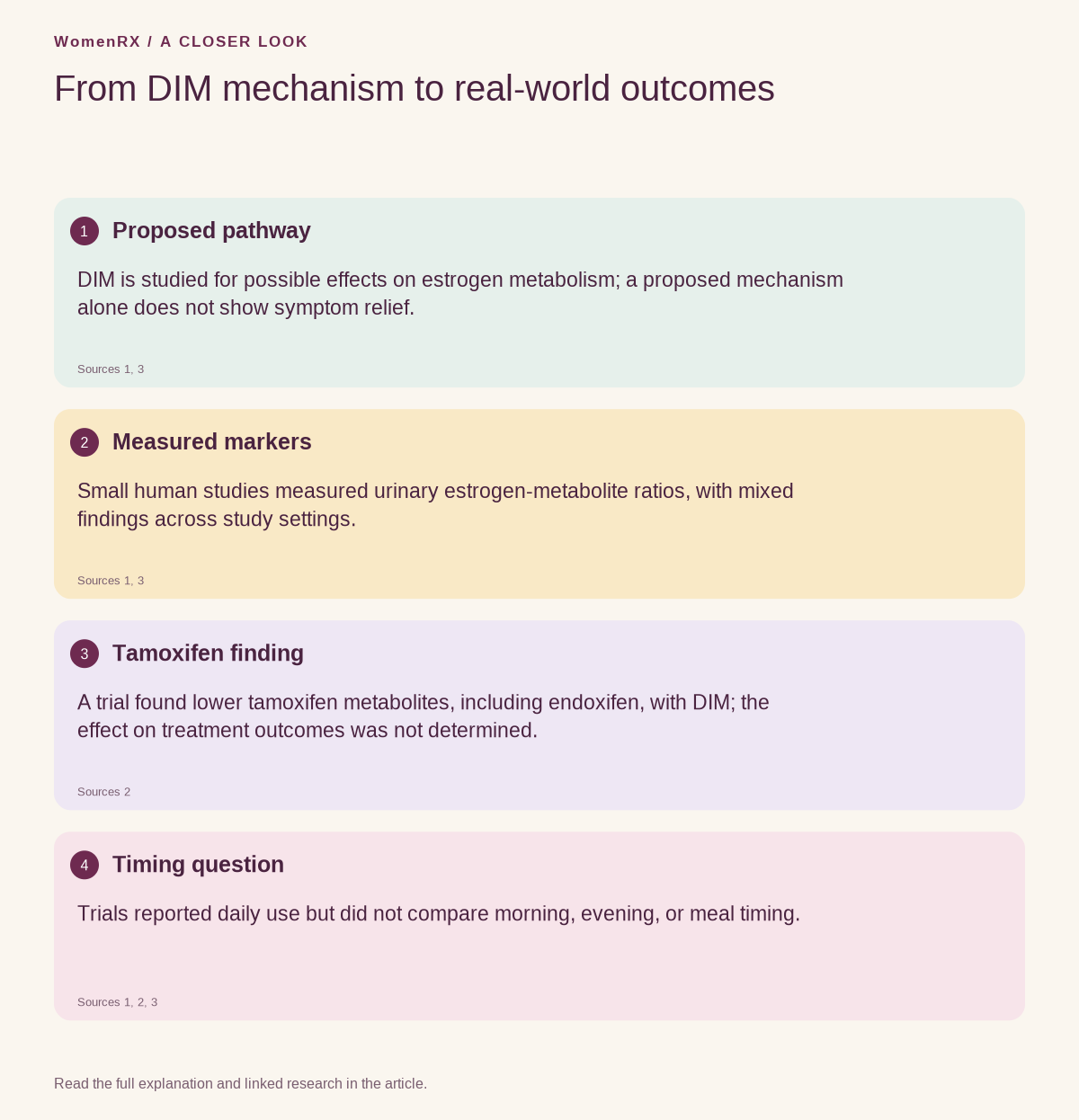
From DIM mechanism to real-world outcomes
Proposed pathway: DIM is studied for possible effects on estrogen metabolism; a proposed mechanism alone does not show symptom relief.13
Measured markers: Small human studies measured urinary estrogen-metabolite ratios, with mixed findings across study settings.13
Tamoxifen finding: A trial found lower tamoxifen metabolites, including endoxifen, with DIM; the effect on treatment outcomes was not determined.2
Timing question: Trials reported daily use but did not compare morning, evening, or meal timing.123
Read the figure as text
The distinction is between a proposed pathway, changes measured in people, and benefits or risks that matter in daily life.- Proposed pathway: DIM is studied for possible effects on estrogen metabolism; a proposed mechanism alone does not show symptom relief.13
- Measured markers: Small human studies measured urinary estrogen-metabolite ratios, with mixed findings across study settings.13
- Tamoxifen finding: A trial found lower tamoxifen metabolites, including endoxifen, with DIM; the effect on treatment outcomes was not determined.2
- Timing question: Trials reported daily use but did not compare morning, evening, or meal timing.123
More questions, answered
Does DIM help with PMS or menopause symptoms?
The trials described here measured estrogen-related markers, not PMS, hot flashes, or other menopause symptoms. They don’t establish DIM as a treatment for those concerns. 1 3
Can I take DIM with birth control or menopausal hormone therapy?
These studies don’t establish the effects or safety of combining DIM with birth control or menopausal hormone therapy. Don’t assume that an estrogen-related mechanism means the combination is safe; have the specific products checked before adding DIM.
Sources you can check
- Effectiveness of 3,3'-Diindolylmethane Supplements on Favoring the Benign Estrogen Metabolism Pathway and Decreasing Body Fat in Premenopausal Women.Godínez-Martínez E, Santillán R, Sámano R, Chico-Barba G, Tolentino MC, Hernández-Pineda J. · Nutrition and cancer · 2023Return to first citation
- A randomized, placebo-controlled trial of diindolylmethane for breast cancer biomarker modulation in patients taking tamoxifen.Thomson CA, Chow HHS, Wertheim BC, Roe DJ, Stopeck A, Maskarinec G, Altbach M, Chalasani P, Huang C, Strom MB, Galons JP, Thompson PA. · Breast cancer research and treatment · 2017Return to first citation
- 3,3'-diindolylmethane modulates estrogen metabolism in patients with thyroid proliferative disease: a pilot study.Rajoria S, Suriano R, Parmar PS, Wilson YL, Megwalu U, Moscatello A, Bradlow HL, Sepkovic DW, Geliebter J, Schantz SP, Tiwari RK. · Thyroid : official journal of the American Thyroid Association · 2011Return to first citation