DIM Supplements: What Dose Evidence Actually Shows
DIM has changed hormone-related lab measures in some small studies, but those changes don’t establish a daily dose that improves acne, menopause symptoms, or other health outcomes.
There’s no established daily DIM dose for women seeking “estrogen balance,” clearer skin, or menopause relief. Small human studies used different products and amounts, and mostly measured hormone-related lab markers rather than symptom or disease outcomes. One important exception to check before taking DIM is tamoxifen: a trial found lower levels of tamoxifen metabolites with DIM, though it did not determine whether treatment benefit changed. 5 6
A lab result isn’t the same as a health benefit
DIM, or diindolylmethane, is a compound formed from indole-3-carbinol, which occurs in cruciferous vegetables. It’s marketed for “estrogen balance,” but a change in how estrogen-related compounds appear in urine doesn’t by itself show that a supplement improves symptoms or prevents disease.
The distinction matters: the human studies discussed here measured hormone-related biomarkers, not a proven benefit for acne, menopause symptoms, or cancer prevention. A review of cruciferous-vegetable compounds also concluded that more human research was needed on DIM’s effects and safety. 5 6 7 8
The studied amounts aren’t a recommended dose
In a randomized trial of 60 premenopausal Mexican women whose urinary estrogen-metabolite ratio was below 0.9, the DIM group received 75 mg daily for 30 days, while the comparison group received placebo. That amount did not significantly increase the urinary estrogen-metabolite ratio being studied at the end of supplementation. The trial does not establish a dose that works for symptoms or for women generally. 5
A separate randomized trial enrolled women taking tamoxifen for breast cancer. The DIM group received a particular product, BR-DIM, at 150 mg twice daily for 12 months; the comparison group received placebo. The trial found changes in certain biomarkers, but it did not establish that this amount is appropriate for someone taking DIM for another reason or using a different product. 6
A small phase I study in patients with thyroid proliferative disease used 300 mg daily for 14 days and reported a change in urinary estrogen metabolites. That study’s population, short duration, and biomarker focus don’t show that this amount treats thyroid disease or is a general-purpose dose. 7
These amounts come from studies with different products, participants, and goals. They are research descriptions, not dosing instructions. There isn’t a single daily amount that can be recommended from these results.
If you take tamoxifen, check before adding DIM
The clearest treatment interaction signal in these studies involves tamoxifen. In the 12-month trial, DIM increased the urinary estrogen-metabolite ratio, but levels of several tamoxifen metabolites, including endoxifen, were lower than with placebo. The researchers said further study was needed to determine whether that change affects tamoxifen’s clinical benefit. 6
That uncertainty is a reason not to add DIM on your own while taking tamoxifen. Tell the clinician managing your treatment what supplement you’re considering. The study does not prove that DIM makes tamoxifen ineffective, but it does show a change in drug-related measurements that deserves review.
For hormonal birth control, fertility treatment, and other hormone-related medicines, these studies don’t establish whether DIM changes treatment effects. That’s not proof that a specific interaction happens, or that none can happen. If you’re using one of these treatments, ask the prescriber or pharmacist to review the exact product before you start DIM.
Menopause hormone therapy is a separate co-use question. The DIM studies described here don’t establish the effects or safety of adding DIM to that therapy. If you use menopause hormone therapy, review the proposed supplement with its prescriber rather than assuming a DIM study dose applies to your treatment. 3 5 6 7
Acne and menopause need outcome evidence
Hormonal changes can contribute to acne, and established acne treatments can include hormonal therapy. But that doesn’t show that DIM treats acne: the DIM trials described above measured other outcomes, not acne improvement. 1 2 5 6
For menopause-related hot flashes and night sweats, the North American Menopause Society’s 2023 position statement does not recommend supplements and herbal remedies as a category. That guidance isn’t a DIM-specific trial result, but it does not support choosing DIM as an evidence-based treatment for these symptoms. The Society’s 2022 statement describes hormone therapy as the most effective treatment for vasomotor symptoms and says treatment decisions should be individualized and periodically reviewed. 3 4
Pregnancy, breastfeeding, and fertility treatment are separate questions
The human DIM studies described here involved premenopausal Mexican women with a low baseline urinary estrogen-metabolite ratio, women taking tamoxifen, and patients with thyroid proliferative disease. They don’t establish safety or a useful dose during pregnancy or breastfeeding. They also don’t answer whether DIM affects fertility treatment. If any of these apply to you, check with the clinician managing that care before taking DIM rather than relying on a dose from a study in a different group.
A practical way to assess a label
Before buying or starting a DIM product, ask what outcome you expect it to improve and whether that outcome was actually measured in a human study. Then compare the study population and product with your situation. A change in a urine marker is not the same as relief from acne or hot flashes, and a dose used in one trial isn’t automatically right for a different product or treatment. If you take tamoxifen, have a hormonal treatment underway, or are pregnant or breastfeeding, make that review part of the decision.
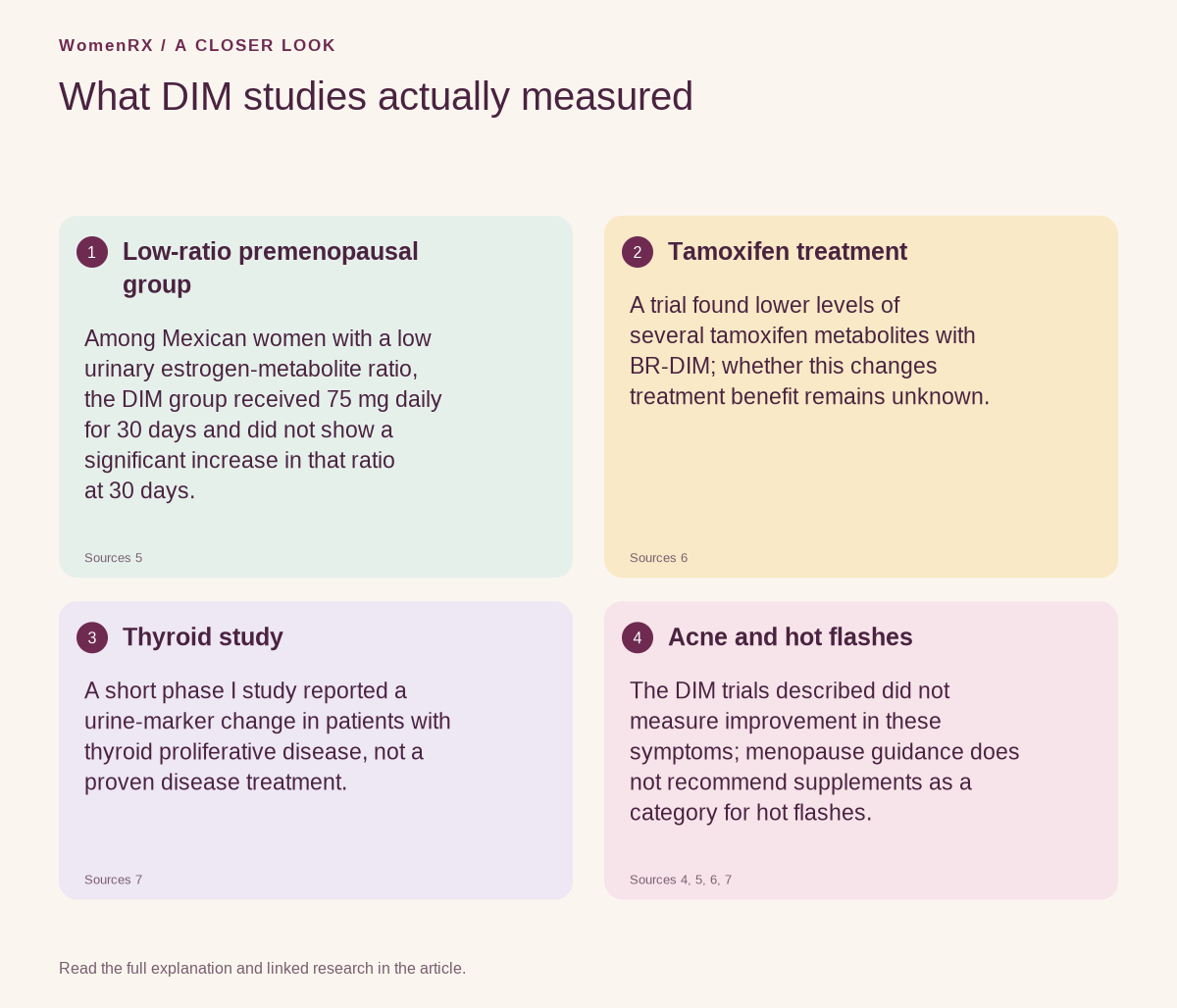
What DIM studies actually measured
Low-ratio premenopausal group: Among Mexican women with a low urinary estrogen-metabolite ratio, the DIM group received 75 mg daily for 30 days and did not show a significant increase in that ratio at 30 days.5
Tamoxifen treatment: A trial found lower levels of several tamoxifen metabolites with BR-DIM; whether this changes treatment benefit remains unknown.6
Thyroid study: A short phase I study reported a urine-marker change in patients with thyroid proliferative disease, not a proven disease treatment.7
Acne and hot flashes: The DIM trials described did not measure improvement in these symptoms; menopause guidance does not recommend supplements as a category for hot flashes.4567
Read the figure as text
The trial outcomes help separate biomarker changes from demonstrated benefits and highlight the medication finding that merits review.- Low-ratio premenopausal group: Among Mexican women with a low urinary estrogen-metabolite ratio, the DIM group received 75 mg daily for 30 days and did not show a significant increase in that ratio at 30 days.5
- Tamoxifen treatment: A trial found lower levels of several tamoxifen metabolites with BR-DIM; whether this changes treatment benefit remains unknown.6
- Thyroid study: A short phase I study reported a urine-marker change in patients with thyroid proliferative disease, not a proven disease treatment.7
- Acne and hot flashes: The DIM trials described did not measure improvement in these symptoms; menopause guidance does not recommend supplements as a category for hot flashes.4567
More questions, answered
Does DIM “detox” estrogen?
Some human studies report changes in estrogen-related urinary markers, but those measurements don’t establish that DIM removes harmful estrogen or improves a health outcome. 5 6 7
Can I take DIM with hormonal birth control?
These studies don’t establish whether DIM changes the effects of hormonal birth control. Ask the clinician or pharmacist who knows your specific medication and supplement product to review them together.
Does DIM help with hot flashes?
The cited DIM studies don’t demonstrate relief from hot flashes. The North American Menopause Society’s 2023 position statement does not recommend supplements and herbal remedies as a category for vasomotor symptoms. 4
Sources you can check
- Acne - NHSAccessed 2026-09-25Return to first citation
- Acne - Treatment - NHSAccessed 2026-09-25Return to first citation
- The 2022 hormone therapy position statement of The North American Menopause Society.“The 2022 Hormone Therapy Position Statement of The North American Menopause Society” Advisory Panel. · Menopause (New York, N.Y.) · 2022Return to first citation
- The 2023 nonhormone therapy position statement of The North American Menopause Society.Menopause (New York, N.Y.) · 2023Return to first citation
- Effectiveness of 3,3'-Diindolylmethane Supplements on Favoring the Benign Estrogen Metabolism Pathway and Decreasing Body Fat in Premenopausal Women.Godínez-Martínez E, Santillán R, Sámano R, Chico-Barba G, Tolentino MC, Hernández-Pineda J. · Nutrition and cancer · 2023Return to first citation
- A randomized, placebo-controlled trial of diindolylmethane for breast cancer biomarker modulation in patients taking tamoxifen.Thomson CA, Chow HHS, Wertheim BC, Roe DJ, Stopeck A, Maskarinec G, Altbach M, Chalasani P, Huang C, Strom MB, Galons JP, Thompson PA. · Breast cancer research and treatment · 2017Return to first citation
- 3,3'-diindolylmethane modulates estrogen metabolism in patients with thyroid proliferative disease: a pilot study.Rajoria S, Suriano R, Parmar PS, Wilson YL, Megwalu U, Moscatello A, Bradlow HL, Sepkovic DW, Geliebter J, Schantz SP, Tiwari RK. · Thyroid : official journal of the American Thyroid Association · 2011Return to first citation
- A review of the clinical efficacy and safety of cruciferous vegetable phytochemicals.Minich DM, Bland JS. · Nutrition reviews · 2007Return to first citation