DIM Supplements: What Hormone Claims Hold Up?
DIM can change some estrogen-related measurements, but that hasn’t been shown to ease hormone-related symptoms or prevent disease.
Human studies show that DIM can affect estrogen-related measurements. That’s not the same as showing it helps with periods, fertility, or menopause symptoms, or prevents cancer. There’s a specific reason to check before taking it with tamoxifen: one randomized trial found lower levels of measured tamoxifen metabolites in women assigned DIM. 12
A changed marker isn’t a proven benefit
DIM, or 3,3′-diindolylmethane, is a compound associated with cruciferous vegetables and studied for its effects on estrogen metabolism. Researchers have measured changes in urinary estrogen metabolites among people taking DIM. But a change in a lab measurement does not, by itself, show that a supplement improves symptoms or prevents disease. 4
That distinction matters because some claims focus on shifting the balance of estrogen metabolites toward a supposedly “better” pattern. Human studies have measured those metabolites, along with other markers such as sex hormone-binding globulin and breast density. They have not established that changing the measurements improves menstrual symptoms, fertility, menopause symptoms, or cancer outcomes. 124
What the human studies found
Before menopause: A small randomized trial assigned 60 premenopausal Mexican women with a low estrogen-metabolite ratio to DIM or placebo for 30 days. The ratio did not increase significantly during supplementation. A possible increase measured 30 days after supplementation ended did not reach statistical significance. The study doesn’t show that DIM helps with periods, fertility, or other symptoms. 2
A separate retrospective study used laboratory data to compare urinary estrogen profiles among people reporting DIM use with profiles among those reporting no use. It found differences in many measurements. In a smaller group with results from before and after starting DIM, some measurements also changed. Because the study was not randomized and measured urine profiles rather than health outcomes, it can’t establish that DIM caused a benefit. Neither analysis showed that a changed profile improved health. 4
After menopause, while using an estradiol patch: In a retrospective study, postmenopausal women using a transdermal estradiol patch who also reported DIM use had different urinary estrogen profiles from women using the patch alone. The study did not establish whether those differences changed symptom relief or other treatment outcomes. It raises a possible supplement-medicine interaction question, not proof that DIM cancels the patch’s effects. 3
While taking tamoxifen: This is the clearest medication concern in the human trial evidence. In a randomized, placebo-controlled trial, women taking tamoxifen were assigned DIM or placebo for 12 months. Among the 98 women who completed the study, measured tamoxifen metabolites, including endoxifen, were lower in the DIM group. The trial did not determine whether this affected tamoxifen’s clinical benefit. 1
A practical check before considering DIM
Start with the reason you’re considering it. If your goal is relief from menstrual changes, fertility support, or help with perimenopause or postmenopause symptoms, the studies above don’t show that DIM delivers those outcomes. A change in an estrogen-metabolite result is not a substitute for evidence that you’ll feel better or have a meaningful health benefit.
Next, check whether you take tamoxifen or use a transdermal estradiol patch. The tamoxifen trial found lower measured drug metabolites with DIM, and the patch study found altered urinary estrogen profiles among women reporting both. If either applies to you, raise DIM with the clinician managing that treatment before adding it. These findings identify a reason to check, not a proven outcome of taking the combination. 13
Finally, weigh what’s known about safety against the goal. The tamoxifen trial reported minimal adverse events that did not differ between groups, but that 12-month study does not settle the long-term safety of regular DIM use. And neither a supplement nor a favorable-looking metabolite ratio should be treated as cancer prevention: the human findings discussed here do not establish that benefit. 124
DIM: Markers and human outcomes
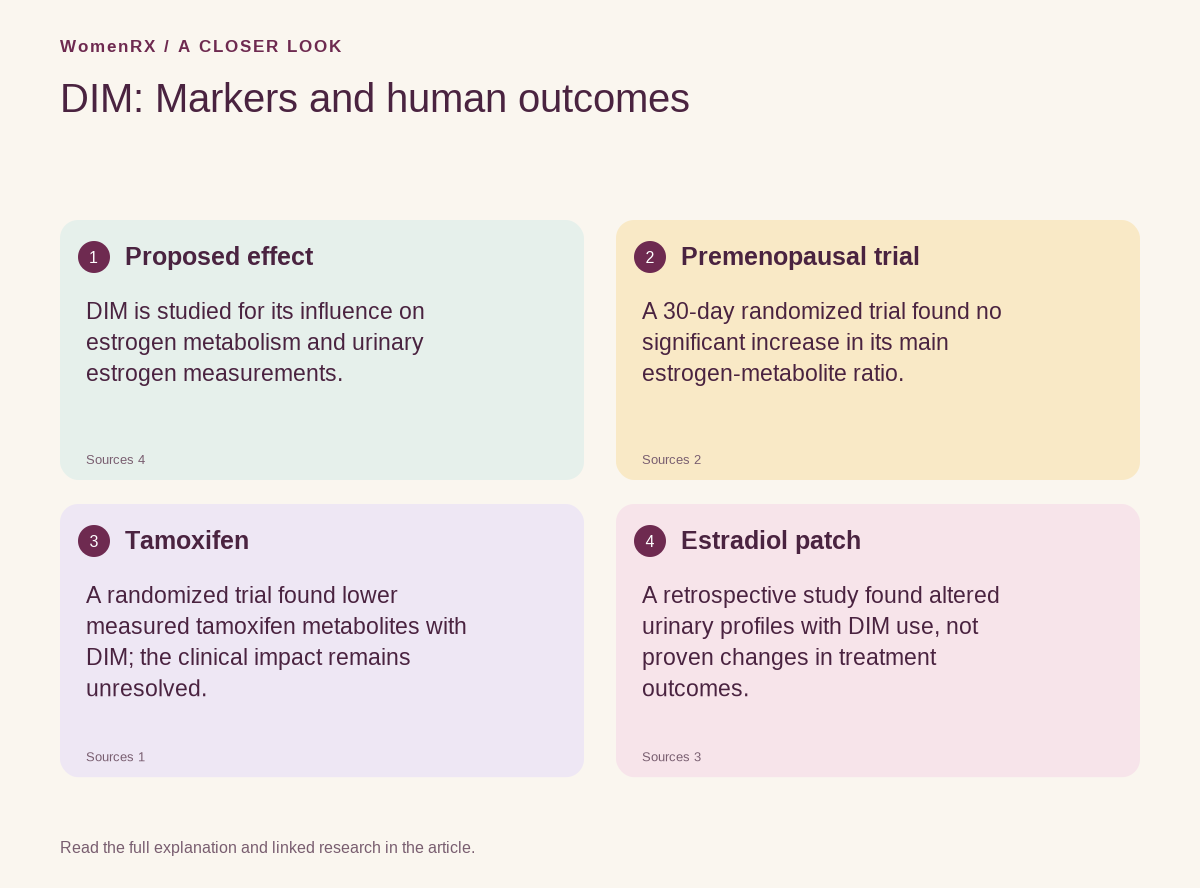
Proposed effect: DIM is studied for its influence on estrogen metabolism and urinary estrogen measurements.4
Premenopausal trial: A 30-day randomized trial found no significant increase in its main estrogen-metabolite ratio.2
Tamoxifen: A randomized trial found lower measured tamoxifen metabolites with DIM; the clinical impact remains unresolved.1
Estradiol patch: A retrospective study found altered urinary profiles with DIM use, not proven changes in treatment outcomes.3
Read the figure as text
This evidence map separates observed changes in estrogen-related measurements from health outcomes the studies did not establish.- Proposed effect: DIM is studied for its influence on estrogen metabolism and urinary estrogen measurements.4
- Premenopausal trial: A 30-day randomized trial found no significant increase in its main estrogen-metabolite ratio.2
- Tamoxifen: A randomized trial found lower measured tamoxifen metabolites with DIM; the clinical impact remains unresolved.1
- Estradiol patch: A retrospective study found altered urinary profiles with DIM use, not proven changes in treatment outcomes.3
More questions, answered
Does a higher estrogen-metabolite ratio mean DIM prevents cancer?
No. The ratio is a laboratory measurement. The human studies described here do not show that changing it prevents cancer or lowers a person’s cancer risk. 24
Sources you can check
- A randomized, placebo-controlled trial of diindolylmethane for breast cancer biomarker modulation in patients taking tamoxifen.Thomson CA, Chow HHS, Wertheim BC, Roe DJ, Stopeck A, Maskarinec G, Altbach M, Chalasani P, Huang C, Strom MB, Galons JP, Thompson PA. · Breast cancer research and treatment · 2017Return to first citation
- Effectiveness of 3,3'-Diindolylmethane Supplements on Favoring the Benign Estrogen Metabolism Pathway and Decreasing Body Fat in Premenopausal Women.Godínez-Martínez E, Santillán R, Sámano R, Chico-Barba G, Tolentino MC, Hernández-Pineda J. · Nutrition and cancer · 2023Return to first citation
- The impact of 3,3'-diindolylmethane on estradiol and estrogen metabolism in postmenopausal women using a transdermal estradiol patch.Newman MS, Smeaton J. · Menopause (New York, N.Y.) · 2025Return to first citation
- Exploring the impact of 3,3'-diindolylmethane on the urinary estrogen profile of premenopausal women.Newman M, Smeaton J. · BMC complementary medicine and therapies · 2024Return to first citation