How to Read a DIM Supplement Label and Its Claims
A change in an estrogen-metabolism marker isn’t proof that DIM eases symptoms or prevents breast cancer.
Check the DIM amount, other ingredients, and the exact outcome behind each claim. Human studies have measured biomarkers and breast-tissue imaging, but those findings don’t establish relief from menstrual or menopause symptoms or prevention of breast cancer. If you take tamoxifen, ask your oncology prescriber or pharmacist about DIM: a trial found lower levels of tamoxifen metabolites, including endoxifen. 1 2 3
DIM, short for 3,3′-diindolylmethane, is a compound derived from substances in cruciferous vegetables. A label may promise “hormone balance” or “breast health,” but those phrases can blur the difference between a proposed biological effect, a change in a lab measurement, and a benefit you can feel or a disease outcome.
Start by asking two questions: What does this product contain? And what result actually supports its claim?
Audit the claim, not just the wording
| Label claim or evidence | What research can tell you | What it doesn’t establish |
|---|---|---|
| “Supports estrogen metabolism” | A randomized trial in 60 premenopausal Mexican women measured a urine estrogen-metabolite ratio. The ratio did not increase significantly after 30 days of DIM. 1 | That DIM improves cycle-related symptoms or other health outcomes. The study measured a biomarker, not symptom relief. 1 |
| “Promotes a favorable hormone profile” | In a 12-month randomized trial of women taking tamoxifen, a specific DIM formulation changed some biomarkers, including the urine 2/16α-hydroxyestrone ratio and SHBG. 2 | That those changes improve symptoms or prevent cancer. The trial found no change in breast density and did not establish a cancer outcome. 2 |
| “Supports breast health” or “reduces breast cancer risk” | A small study in healthy BRCA carriers reported a decrease in one MRI measure of breast tissue after a year. It was a nonrandomized single-arm intervention with a parallel untreated, age- and menopause-status-matched comparison group. 3 | That DIM prevents breast cancer. A change in an imaging measure is not proof of fewer cancers, and the study’s design cannot establish prevention. 3 |
| “Clinically studied” | It means a particular formulation was tested in a particular population, for a particular period, with particular outcomes. | That other DIM products are equivalent or that the result applies to your reason for taking it. The tamoxifen trial tested BR-DIM; it did not compare different retail products. 2 |
A mechanism is a proposed explanation for how an ingredient might act. A biomarker is a measurable signal, such as a hormone level or metabolite ratio. A patient outcome is something more directly meaningful, such as symptom improvement or fewer cases of disease. Evidence at one level doesn’t automatically demonstrate the next.
Match the study to your life stage and goal
The trials described here studied different groups and asked different questions: premenopausal women and a urine marker, women taking tamoxifen and several biomarkers, and BRCA carriers and MRI measures of breast tissue. None tested DIM as a treatment for menstrual or menopause symptoms. The breast-focused studies measured markers or imaging findings, not whether DIM prevented breast cancer. 1 2 3
So if a label promises help with hot flashes, irregular periods, or breast tenderness, look for evidence that actually measured that symptom in people at a similar life stage. A hormone-related claim alone doesn’t show that a product helps during cycling years, perimenopause, or postmenopause.
Check the product details
Read the full Supplement Facts panel and note the amount of DIM listed per serving, along with any other active ingredients. If the label gives a blend weight, check whether it separately identifies the amount of DIM itself. A product with several active ingredients also makes it harder to connect a result or possible effect to DIM alone.
If the company cites a study, compare its product and formulation with the one tested. The tamoxifen trial used BR-DIM, so its findings don’t establish that another formulation has the same effects. A study’s dose describes what researchers tested; it isn’t a recommended amount for you. 2
If a company advertises testing, ask what was tested, who performed the testing, and whether the report applies to the specific batch you’d buy. Testing information is a product-quality question, not evidence that a health claim is true.
If you take tamoxifen, check before adding DIM
This is a specific interaction concern, not a reason to assume DIM interacts with every medicine. In a randomized, placebo-controlled trial of women taking tamoxifen, participants given BR-DIM had lower levels of tamoxifen metabolites, including endoxifen, than those given placebo. The researchers said further study was needed to determine whether that change affects tamoxifen’s clinical benefit. 2
If you take tamoxifen, show the exact product label to your oncology prescriber or pharmacist before using it. The trial raises a relevant medication question, but it doesn’t settle the effect on cancer outcomes.
The most useful label question isn’t whether a product sounds “hormone-focused.” It’s whether the research matches the product, your life stage, and the outcome you want.
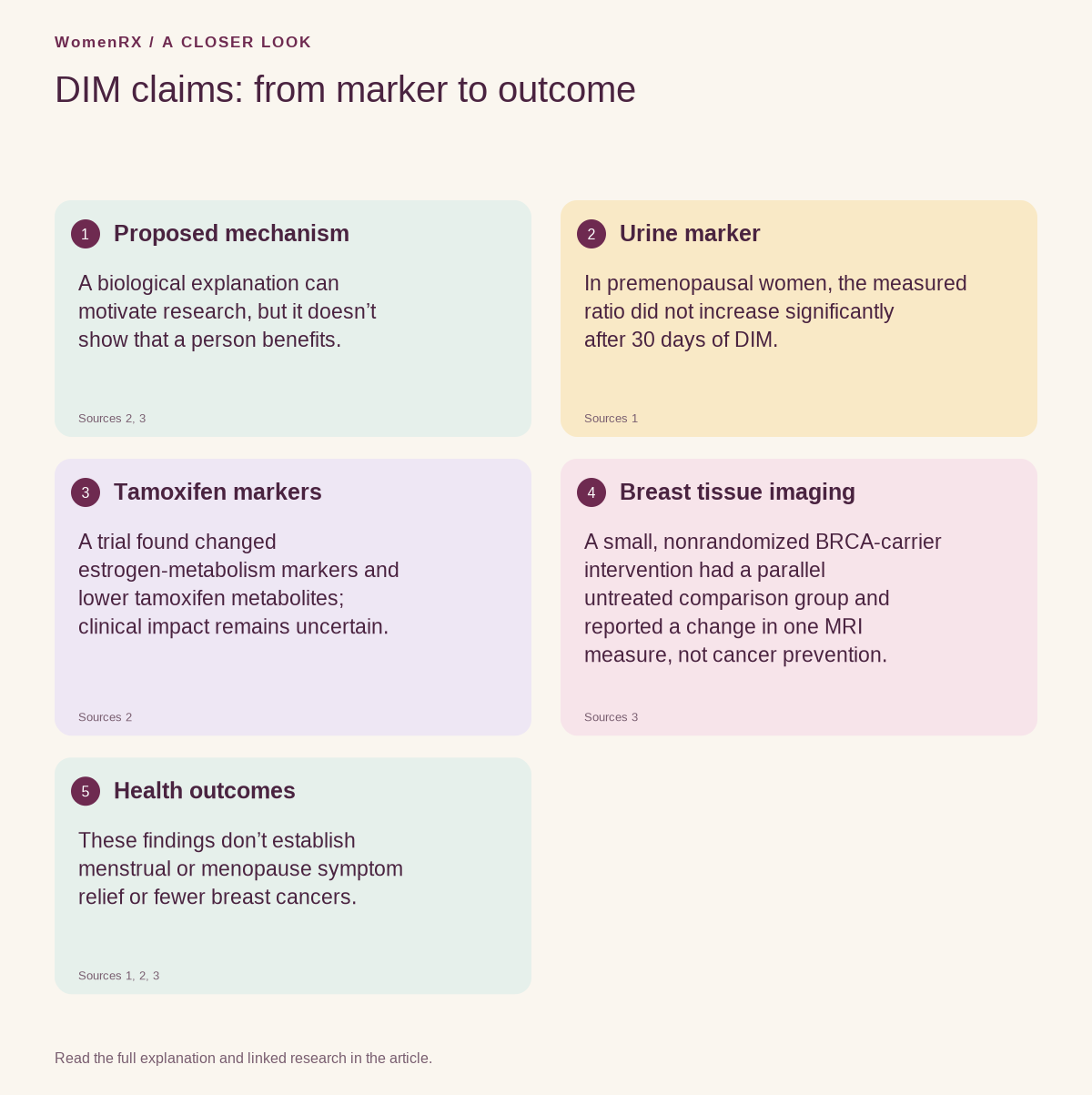
DIM claims: from marker to outcome
Proposed mechanism: A biological explanation can motivate research, but it doesn’t show that a person benefits.23
Urine marker: In premenopausal women, the measured ratio did not increase significantly after 30 days of DIM.1
Tamoxifen markers: A trial found changed estrogen-metabolism markers and lower tamoxifen metabolites; clinical impact remains uncertain.2
Breast tissue imaging: A small, nonrandomized BRCA-carrier intervention had a parallel untreated comparison group and reported a change in one MRI measure, not cancer prevention.3
Health outcomes: These findings don’t establish menstrual or menopause symptom relief or fewer breast cancers.123
Read the figure as text
A mechanism, lab result, or imaging change can be useful evidence, but each answers a different question from whether a supplement improves symptoms or prevents disease.- Proposed mechanism: A biological explanation can motivate research, but it doesn’t show that a person benefits.23
- Urine marker: In premenopausal women, the measured ratio did not increase significantly after 30 days of DIM.1
- Tamoxifen markers: A trial found changed estrogen-metabolism markers and lower tamoxifen metabolites; clinical impact remains uncertain.2
- Breast tissue imaging: A small, nonrandomized BRCA-carrier intervention had a parallel untreated comparison group and reported a change in one MRI measure, not cancer prevention.3
- Health outcomes: These findings don’t establish menstrual or menopause symptom relief or fewer breast cancers.123
More questions, answered
Does a higher estrogen-metabolite ratio mean lower breast cancer risk?
Not by itself. The ratio is a biomarker, not a cancer outcome. In the tamoxifen trial, DIM changed the ratio but didn’t change breast density, and the study didn’t establish that DIM prevents breast cancer. 2
Does a DIM supplement have the same evidence as eating cruciferous vegetables?
Not from these studies. One feeding study measured urinary DIM after people ate Brussels sprouts or cabbage; it examined a marker of vegetable exposure, not whether a DIM supplement improves symptoms or prevents disease. 4
Sources you can check
- Effectiveness of 3,3'-Diindolylmethane Supplements on Favoring the Benign Estrogen Metabolism Pathway and Decreasing Body Fat in Premenopausal Women.Godínez-Martínez E, Santillán R, Sámano R, Chico-Barba G, Tolentino MC, Hernández-Pineda J. · Nutrition and cancer · 2023Return to first citation
- A randomized, placebo-controlled trial of diindolylmethane for breast cancer biomarker modulation in patients taking tamoxifen.Thomson CA, Chow HHS, Wertheim BC, Roe DJ, Stopeck A, Maskarinec G, Altbach M, Chalasani P, Huang C, Strom MB, Galons JP, Thompson PA. · Breast cancer research and treatment · 2017Return to first citation
- 3,3-Diindolylmethane (DIM): a nutritional intervention and its impact on breast density in healthy BRCA carriers. A prospective clinical trial.Yerushalmi R, Bargil S, Ber Y, Ozlavo R, Sivan T, Rapson Y, Pomerantz A, Tsoref D, Sharon E, Caspi O, Grubsrein A, Margel D. · Carcinogenesis · 2020Return to first citation
- Harnessing the Power of Cruciferous Vegetables: Developing a Biomarker for Brassica Vegetable Consumption Using Urinary 3,3'-Diindolylmethane.Fujioka N, Ransom BW, Carmella SG, Upadhyaya P, Lindgren BR, Roper-Batker A, Hatsukami DK, Fritz VA, Rohwer C, Hecht SS. · Cancer prevention research (Philadelphia, Pa.) · 2016Return to first citation