Should You Take DIM With Food or Without It?
Human studies have measured DIM after oral dosing, but they haven’t shown that taking it on an empty stomach works better.
There’s no demonstrated fasting advantage to use in place of your DIM product’s meal instructions. A small human study measured DIM and its metabolites after people took capsules, but it didn’t compare doses taken with food and without it. A separate study involving female volunteers measured DIM in plasma without testing meal timing. Neither establishes that fasting improves absorption or hormone-related effects. 1 2
Why a blood measurement doesn’t settle the food question
To find out whether food changes DIM absorption, researchers would need to compare the same product taken with a meal and without one. Measuring DIM in someone’s blood after a dose answers a narrower question: was DIM detectable, and how did its measured levels change? It doesn’t show what would have happened if that person had taken the dose under different meal conditions.
One human study followed seven adults, six men and one woman, who took BioResponse DIM capsules for a week. After a final morning dose, researchers collected blood and urine over 48 hours. They found DIM as well as several products of its metabolism. That’s useful evidence that the body handles oral DIM in more ways than measuring DIM alone would reveal. The study did not compare taking those capsules with food against taking them while fasting. 1
There’s another reason not to turn those measurements into a meal rule: a blood level reflects more than the moment a capsule was swallowed. The researchers found both DIM and metabolites after dosing, so a measurement of DIM alone wouldn’t capture everything they detected. Their findings describe exposure and metabolism, not which meal timing produces a better result. 1
What the study involving women adds
A separate paper describes a method for measuring DIM in plasma. The researchers applied it to samples from healthy female volunteers after a single oral dose of a product called Indinol Forto. Those findings don’t establish the product’s ingredient composition or compare fed and fasted dosing. They therefore can’t tell you whether taking your DIM supplement with a meal would change its absorption. 2
This is also why it helps to look past the phrase “studied in women.” The findings from the plasma-measurement study don’t identify the volunteers’ reproductive or menopausal stages. The seven-person metabolism study included only one woman and doesn’t report her stage. Neither provides a basis for a different meal-timing recommendation during cycling years, perimenopause, or postmenopause. 1 2
Absorption isn’t the same as a hormone benefit
If you take DIM hoping it will help with a hormone-related concern, there are two separate questions: does eating change how much DIM reaches the body, and does that difference change the outcome you care about? The studies above don’t directly test the first question. They also don’t test whether meal timing changes estrogen levels, menstrual symptoms, or other hormone-related outcomes. Finding DIM or its metabolites in a sample isn’t evidence that fasting improves those outcomes. 1 2
For example, taking a capsule before breakfast might feel like a more deliberate routine than taking it with lunch. That difference in routine isn’t proof that the before-breakfast dose is absorbed better, much less that it works better for a hormone-related goal.
How to use the instructions on your bottle
If your DIM product says to take it with food, these studies give you no reason to override that instruction in favor of fasting. If it specifies an empty stomach, that instruction isn’t evidence that fasting has been proven superior across DIM products. And if it gives no meal direction, the human findings here don’t identify a best one.
The practical distinction is between a product direction and a tested advantage. You can follow the directions for the product you have without treating its meal timing as a demonstrated way to improve absorption or hormone-related effects. 1 2
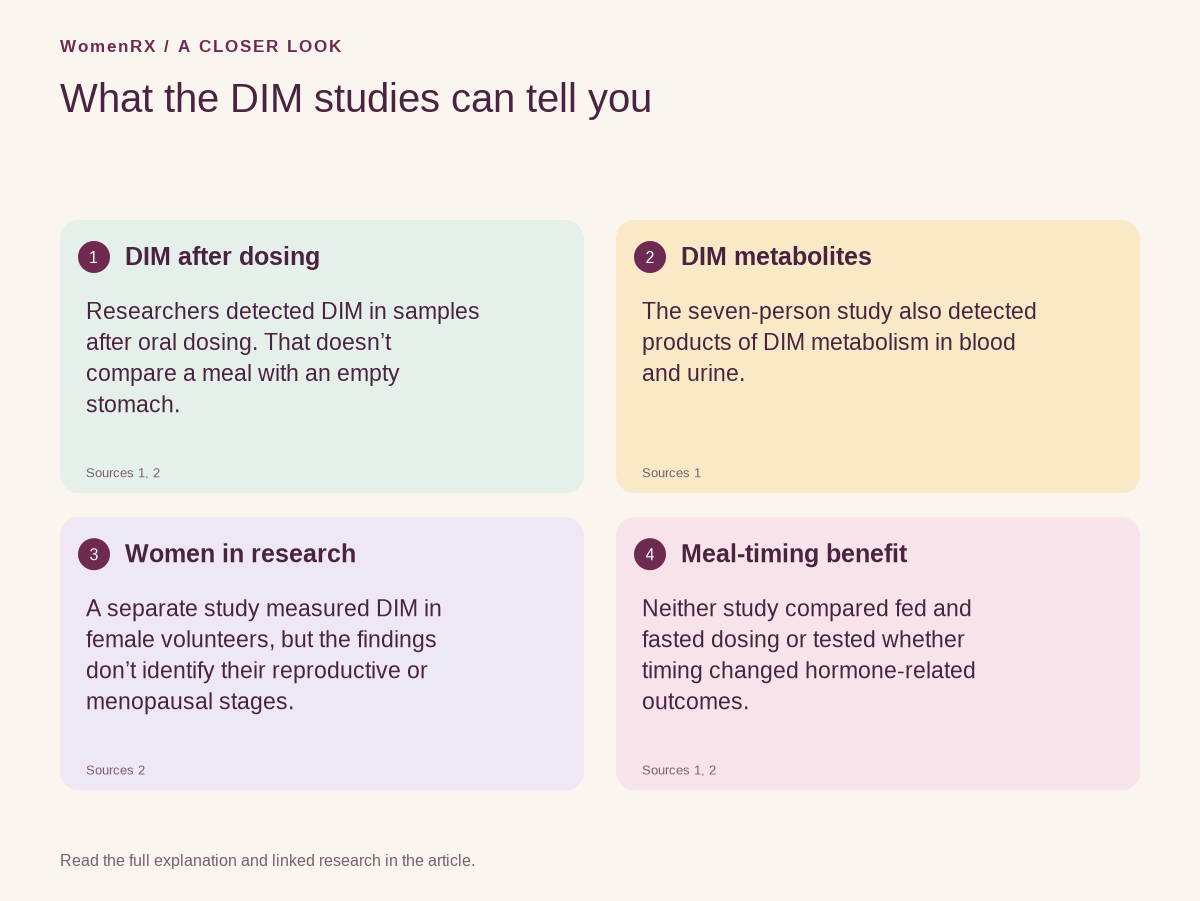
What the DIM studies can tell you
DIM after dosing: Researchers detected DIM in samples after oral dosing. That doesn’t compare a meal with an empty stomach.12
DIM metabolites: The seven-person study also detected products of DIM metabolism in blood and urine.1
Women in research: A separate study measured DIM in female volunteers, but the findings don’t identify their reproductive or menopausal stages.2
Meal-timing benefit: Neither study compared fed and fasted dosing or tested whether timing changed hormone-related outcomes.12
Read the figure as text
These are different research questions, and only some were addressed in the human studies.- DIM after dosing: Researchers detected DIM in samples after oral dosing. That doesn’t compare a meal with an empty stomach.12
- DIM metabolites: The seven-person study also detected products of DIM metabolism in blood and urine.1
- Women in research: A separate study measured DIM in female volunteers, but the findings don’t identify their reproductive or menopausal stages.2
- Meal-timing benefit: Neither study compared fed and fasted dosing or tested whether timing changed hormone-related outcomes.12
More questions, answered
Does the study’s evening dosing mean evening is best?
No. Participants in the seven-person metabolism study took capsules in the evening during the study week, but the researchers didn’t compare evening with other times of day. 1
Sources you can check
- 3,3'-Diindolylmethane Exhibits Significant Metabolism after Oral Dosing in Humans.Vermillion Maier ML, Siddens LK, Uesugi SL, Choi J, Leonard SW, Pennington JM, Tilton SC, Smith JN, Ho E, Chow HHS, Nguyen BD, Kolluri SK, Williams DE. · Drug metabolism and disposition: the biological fate of chemicals · 2021Return to first citation
- A facile and sensitive HPLC-MS/MS method for quantification of 3,3'-diindolylmethane in plasma samples.Lakeev AP, Yanovskaya EA, Tsuran DV, Bryushinina OS, Abdrashitova NY, Zyuz'kova YG, Udut VV, Kiselev VI, Kuznetsov IN. · Biomedical chromatography : BMC · 2022Return to first citation