Taking DIM Long Term: What Do We Know?
Human DIM studies offer limited reassurance about short-term tolerability, but they don’t establish safety over years or compatibility with your medicines.
The human studies covered here tested an absorption-enhanced DIM product after one dose in healthy adults and a different formulation for three months in men with a prostate condition. Neither establishes long-term safety for women or benefit for menstrual or menopause-related symptoms. Lab findings raise medication questions, but don’t prove a clinical interaction with a specific drug. 124
If DIM is already part of your routine, the useful question isn’t just “Is it safe?” It’s whether the research speaks to your product, your length of use, your reason for taking it, and your medicines. A short study can report what happened during that study without settling what happens after months or years.
How long has DIM been tested in people?
In one small study, healthy, drug-free men and women took a single dose of absorption-enhanced DIM or placebo. No DIM-related adverse effects were reported at doses up to 200 mg. Among six people who received 300 mg, one reported mild nausea and headache; vomiting was also reported and judged probably related to the study product. Those findings describe tolerability after one dose, not daily use. 1
Another trial enrolled 14 men with prostatic intraepithelial neoplasia, a prostate condition. It tested a different DIM-based formulation or placebo for three months. The researchers reported no serious adverse events and noted nausea and diarrhea among two participants. Its size, duration, and all-male population limit what it can tell a woman considering continued use. 2
A rat feeding study ran for up to 12 months and reported no observable toxicity from DIM. That’s a longer exposure, but a year in rats cannot establish the safety of years of supplement use in people. 3
What about estrogen and “hormone balance” claims?
DIM is often discussed in terms of estrogen metabolism. That’s a biological claim, not an answer to whether you’ll feel better. A change in a hormone-related marker would not, by itself, show that DIM relieves menstrual symptoms, helps during perimenopause, or benefits someone after menopause. The human studies above tested short-term tolerability in healthy adults and in men with a prostate condition; they did not test those symptom outcomes or report results by women’s life stage. 12
That distinction matters when a label promises “hormone balance.” If you’re taking DIM for a particular symptom, ask what outcome the claim is based on. Research into a pathway isn’t the same as a study showing that people with your symptom improved.
Could DIM affect medicines?
There’s a reason to ask, but not a proven interaction to announce. In cultured human liver cells, DIM changed the expression of some drug-metabolizing enzyme genes and inhibited the activity of certain enzymes in laboratory tests. A rat study also found changes in some CYP enzymes at its higher DIM exposure. Neither experiment measured what happens to a medicine’s levels or effects when a person takes DIM alongside it. 43
That leaves a practical distinction: an interaction hasn’t been established here, but compatibility hasn’t been established either. If you take tamoxifen, hormonal contraception, hormone therapy, or another ongoing medicine, don’t assume DIM is compatible because it’s sold as a supplement. Ask a pharmacist or prescriber to review the exact product and your medication together. The same studies do not answer safety questions for pregnancy or breastfeeding. 124
Four details to check before continuing
Look at your bottle and your routine together:
- DIM amount: Record the amount listed per serving and how much you actually take. The human studies used different amounts; neither establishes a long-term dose for women. 12
- Formulation and other ingredients: Note whether the label describes an absorption-enhanced form and whether it contains other active ingredients. The two human trials used different DIM-based formulations, so their results can’t automatically be applied to every bottle. 12
- Duration and purpose: Write down how long you’ve taken it and what change you hoped to see. If the goal is relief from a menstrual or menopause-related symptom, these tolerability studies don’t show that DIM treats it. 12
- Medicines and life stage: Bring the label and your medicine list to a medication review, especially if a hormonal treatment or tamoxifen is involved. If you’re pregnant or breastfeeding, the human findings above do not resolve safety in those circumstances. 124
The decision point is specific: does the hoped-for benefit have evidence that applies to you, and has someone checked the product you’re actually taking against your medicines? Short-term tolerability alone can’t answer either question.
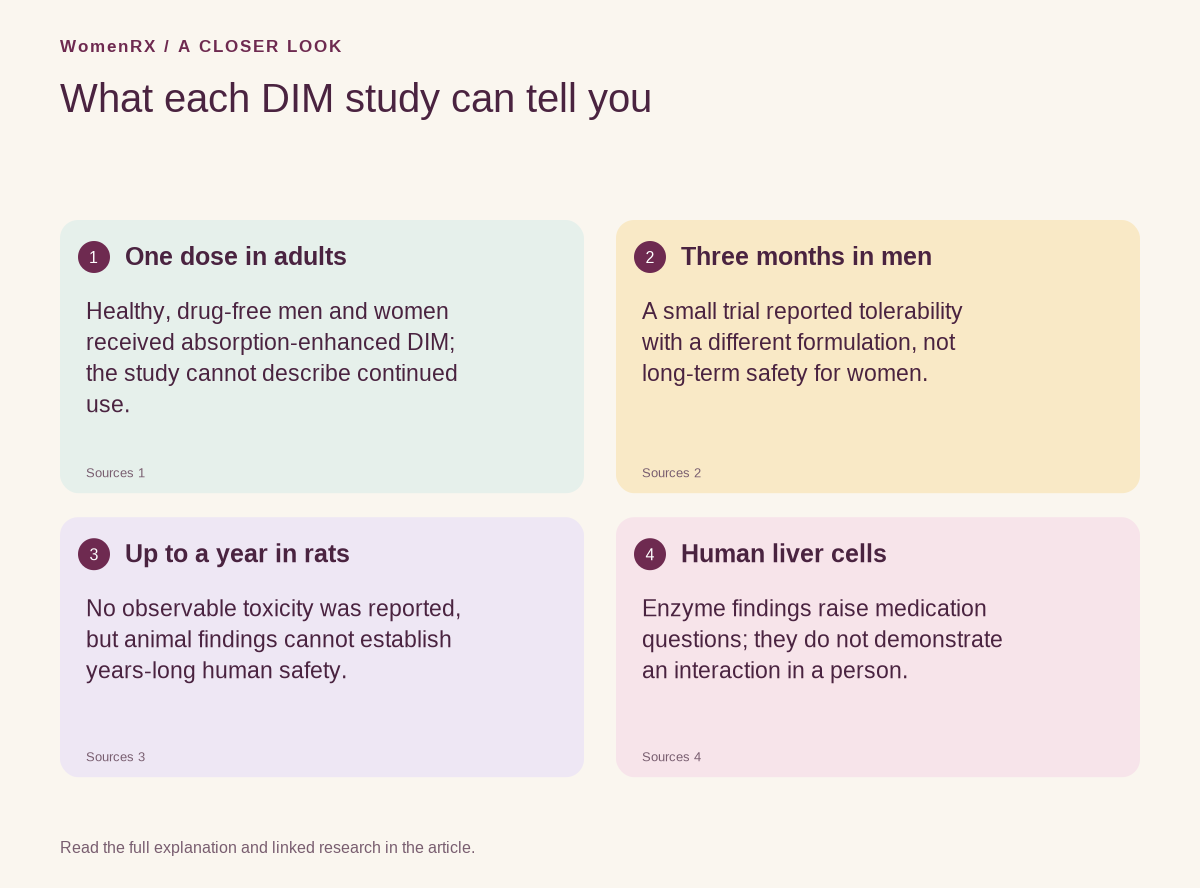
What each DIM study can tell you
One dose in adults: Healthy, drug-free men and women received absorption-enhanced DIM; the study cannot describe continued use.1
Three months in men: A small trial reported tolerability with a different formulation, not long-term safety for women.2
Up to a year in rats: No observable toxicity was reported, but animal findings cannot establish years-long human safety.3
Human liver cells: Enzyme findings raise medication questions; they do not demonstrate an interaction in a person.4
Read the figure as text
The study setting determines whether a finding speaks to continued use, symptoms, or medication compatibility.- One dose in adults: Healthy, drug-free men and women received absorption-enhanced DIM; the study cannot describe continued use.1
- Three months in men: A small trial reported tolerability with a different formulation, not long-term safety for women.2
- Up to a year in rats: No observable toxicity was reported, but animal findings cannot establish years-long human safety.3
- Human liver cells: Enzyme findings raise medication questions; they do not demonstrate an interaction in a person.4
More questions, answered
Does the three-month trial show DIM is safe to take for years?
No. It reports what happened during a small, three-month trial in men with a prostate condition. It does not establish years-long safety or answer that question for women. 2
Is an interaction between DIM and tamoxifen proven?
The liver-cell experiment did not test tamoxifen use in people, so it cannot establish a clinical interaction or confirm that the combination is safe. If you take tamoxifen, have the exact supplement reviewed before continuing it. 4
Sources you can check
- Single-dose pharmacokinetics and tolerability of absorption-enhanced 3,3'-diindolylmethane in healthy subjects.Reed GA, Sunega JM, Sullivan DK, Gray JC, Mayo MS, Crowell JA, Hurwitz A. · Cancer epidemiology, biomarkers & prevention : a publication of the American Association for Cancer Research, cosponsored by the American Society of Preventive Oncology · 2008Return to first citation
- Safety and tolerability of DIM-based therapy designed as personalized approach to reverse prostatic intraepithelial neoplasia (PIN).Paltsev M, Paltsev M, Kiselev V, Muyzhnek E, Drukh V, Kuznetsov I, Pchelintseva O. · The EPMA journal · 2014Return to first citation
- Evaluation of chronic dietary exposure to indole-3-carbinol and absorption-enhanced 3,3'-diindolylmethane in sprague-dawley rats.Leibelt DA, Hedstrom OR, Fischer KA, Pereira CB, Williams DE. · Toxicological sciences : an official journal of the Society of Toxicology · 2003Return to first citation
- Modulation of aflatoxin B1-mediated genotoxicity in primary cultures of human hepatocytes by diindolylmethane, curcumin, and xanthohumols.Gross-Steinmeyer K, Stapleton PL, Tracy JH, Bammler TK, Strom SC, Buhler DR, Eaton DL. · Toxicological sciences : an official journal of the Society of Toxicology · 2009Return to first citation