DIM Safety: Side Effects, Interactions, and When to Ask
A small study offers a limited snapshot of short-term side effects, while laboratory findings raise a reason to check possible medicine interactions.
In a small study of healthy adults who weren’t taking medicines, no DIM-related effects were reported after single doses up to 200 mg. At 300 mg, vomiting was judged probably related. That doesn’t establish safety with repeated use or medicines: laboratory findings suggest DIM could affect how some drugs are processed. Review the exact product with a pharmacist or prescriber, especially during pregnancy or breastfeeding. 352
What was reported in people
The clearest human side-effect information comes from a small study of healthy, nonsmoking adults who weren’t taking medicines. Participants took a single dose of an absorption-enhanced DIM product. No DIM-related adverse effects were reported at single doses up to 200 mg. At 300 mg, one of six participants reported mild nausea and headache, and vomiting was also reported; only the vomiting was judged probably related to DIM. 3
That’s a narrow snapshot, not a full safety profile. The study tested single doses of one product in healthy adults. It can’t establish what happens with repeated use, whether other DIM products have the same effects, or how DIM affects people with medical conditions or medicines. The reported symptoms shouldn’t be taken as a complete list of possible reactions. 3
The interaction signal comes from lab research
In studies using human liver and intestinal cells, DIM increased activity involving CYP3A4 and MDR1. These systems help process or transport some medicines, so a change could matter for a drug that relies on them. But these cell studies don’t show that DIM changes the level or effect of a particular medicine in people, and they don’t establish a confirmed list of DIM-drug interactions. 5
If you take prescription or over-the-counter medicines, ask a pharmacist or prescriber to check your medication list alongside the exact DIM product before you start. Bring the label, including other ingredients. The practical question is whether the potential interaction matters for your specific medicines, not whether every medicine is incompatible with DIM. The study doesn’t identify particular medicines to avoid. 5
Pregnancy, breastfeeding, and hormone-related care
If you’re pregnant or trying to conceive, check with a provider before taking DIM. General pregnancy guidance includes supplements among products to review because some may harm a developing fetus; DIM-specific pregnancy safety isn’t established by the human study above. Don’t start or stop a medicine you need without discussing that decision with your provider. 23
During breastfeeding, general guidance notes that some medicines and other substances can pass into breast milk. That doesn’t establish whether DIM does, or what its effects might be for a nursing infant. Ask your provider to weigh the uncertainty for your situation before using it. 1
If you use hormonal contraception, the lab findings don’t establish that DIM reduces contraceptive effectiveness, or that there’s no interaction with your specific method. Ask a pharmacist or prescriber to check your method and product rather than assuming either outcome. 5
For a hormone-sensitive condition or hormone-related treatment, the available cell and animal findings aren’t proof that DIM harms women. They also can’t settle safety for an individual condition or treatment. Share the diagnosis and treatment details with your care team before adding DIM; this is a reason for an individualized review, not a blanket rule that every person with a hormone-sensitive condition must avoid it. 46
A useful before-start screen
Before using DIM, check three things: the full product label, your current medicines and supplements, and whether pregnancy, breastfeeding, contraception, or hormone-related care applies to you. A pharmacist can help assess the medicine-interaction question; a provider who knows your reproductive or medical circumstances can address those specific uncertainties. If you’ve already started and notice a new or troubling symptom, ask a pharmacist or provider what to do. 25
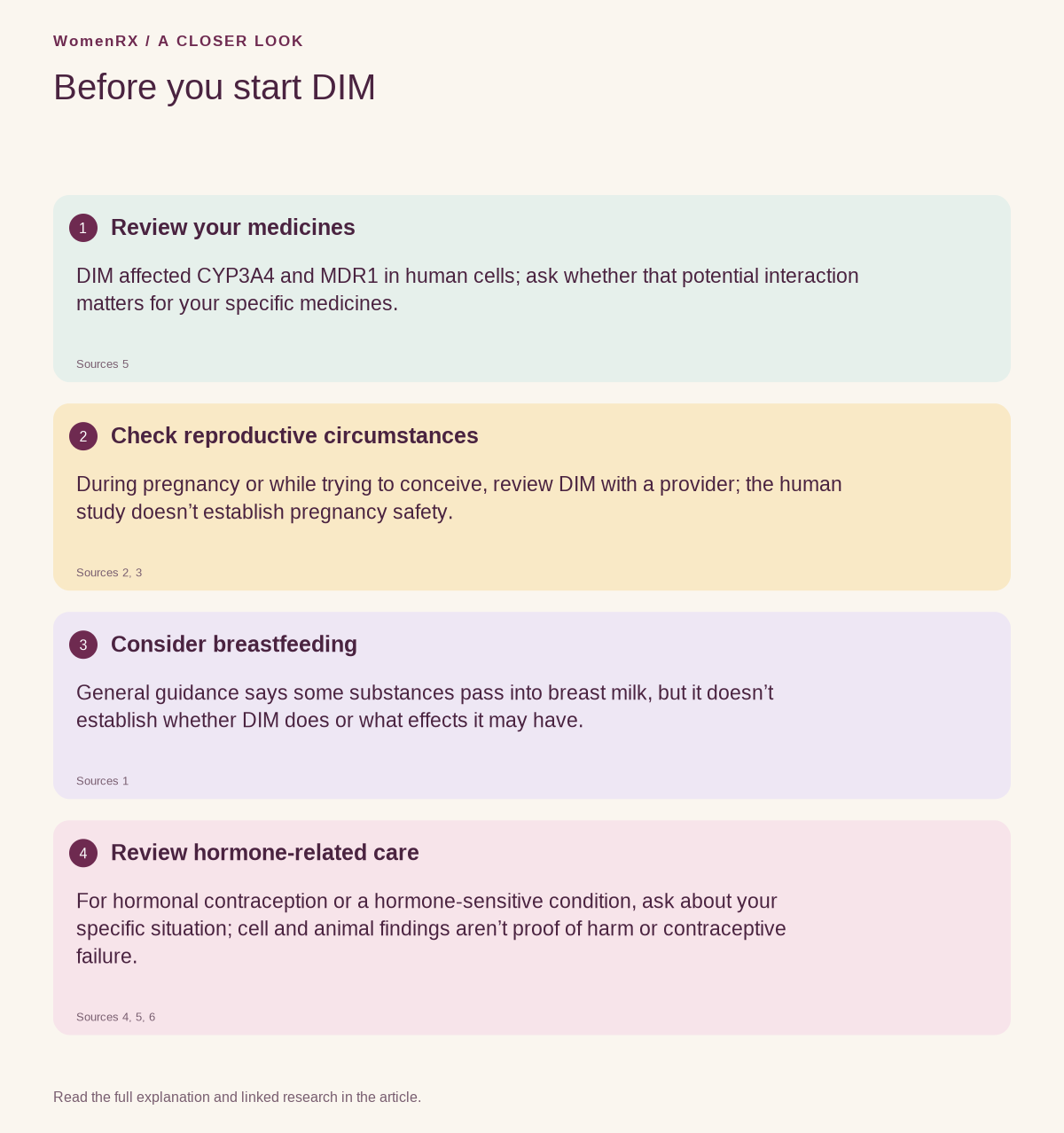
Before you start DIM
Review your medicines: DIM affected CYP3A4 and MDR1 in human cells; ask whether that potential interaction matters for your specific medicines.5
Check reproductive circumstances: During pregnancy or while trying to conceive, review DIM with a provider; the human study doesn’t establish pregnancy safety.23
Consider breastfeeding: General guidance says some substances pass into breast milk, but it doesn’t establish whether DIM does or what effects it may have.1
Review hormone-related care: For hormonal contraception or a hormone-sensitive condition, ask about your specific situation; cell and animal findings aren’t proof of harm or contraceptive failure.456
Read the figure as text
Use these prompts to identify which safety questions apply to you. They’re not a validated safety score.- Review your medicines: DIM affected CYP3A4 and MDR1 in human cells; ask whether that potential interaction matters for your specific medicines.5
- Check reproductive circumstances: During pregnancy or while trying to conceive, review DIM with a provider; the human study doesn’t establish pregnancy safety.23
- Consider breastfeeding: General guidance says some substances pass into breast milk, but it doesn’t establish whether DIM does or what effects it may have.1
- Review hormone-related care: For hormonal contraception or a hormone-sensitive condition, ask about your specific situation; cell and animal findings aren’t proof of harm or contraceptive failure.456
Sources you can check
- Breastfeeding | Benefits of Breastfeeding | MedlinePlusAccessed 2026-09-25Return to first citation
- Pregnancy and Medicines | MedlinePlusAccessed 2026-09-25Return to first citation
- Single-dose pharmacokinetics and tolerability of absorption-enhanced 3,3'-diindolylmethane in healthy subjects.Reed GA, Sunega JM, Sullivan DK, Gray JC, Mayo MS, Crowell JA, Hurwitz A. · Cancer epidemiology, biomarkers & prevention : a publication of the American Association for Cancer Research, cosponsored by the American Society of Preventive Oncology · 2008Return to first citation
- Anti-cancer drug 3,3'-diindolylmethane activates Wnt4 signaling to enhance gastric cancer cell stemness and tumorigenesis.Zhu Y, Zhang B, Gong A, Fu H, Zhang X, Shi H, Sun Y, Wu L, Pan Z, Mao F, Zhu W, Qian H, Xu W. · Oncotarget · 2016Return to first citation
- Diindolylmethane, a naturally occurring compound, induces CYP3A4 and MDR1 gene expression by activating human PXR.Pondugula SR, Flannery PC, Abbott KL, Coleman ES, Mani S, Samuel T, Xie W. · Toxicology letters · 2015Return to first citation
- Linking genomic responses of gonads with reproductive impairment in marine medaka (Oryzias melastigma) exposed chronically to the chemopreventive and antifouling agent, 3,3'-diindolylmethane (DIM).Chen L, Au DWT, Hu C, Zhang W, Zhou B, Cai L, Giesy JP, Qian PY. · Aquatic toxicology (Amsterdam, Netherlands) · 2017Return to first citation