DIM and Estrogen: Where the Evidence Stops
DIM may affect estrogen-related measurements, but a changed marker isn’t the same as feeling better or preventing disease.
DIM is worth studying, but the human findings so far don’t establish it as a treatment for hormone-related symptoms or a way to prevent cancer. A randomized trial in premenopausal women found no significant change in its main estrogen-metabolite measure during treatment. A small study in BRCA carriers found a breast-imaging change but did not establish fewer cancer diagnoses. 1 3
Why the estrogen claim sounds convincing
DIM is a dimer of indole-3-carbinol, a compound found in cruciferous vegetables. Researchers have investigated whether DIM changes how the body processes estrogen. Some estrogen-metabolite patterns have been associated with breast cancer risk, which gives researchers a reason to study DIM, but an association doesn’t tell us that changing the pattern with a supplement will change someone’s risk. 1 3
There are three links to check when you see a DIM claim: Does it affect estrogen-related biology? Does it change a measurable marker in people? Most importantly, does taking it improve the health outcome you care about? A urine test or MRI finding can help answer the second question without answering the third.
A premenopausal trial tested the urine marker
In a randomized, double-blind trial, 60 premenopausal Mexican women with a low baseline ratio of certain urinary estrogen metabolites were assigned to DIM or placebo for 30 days. The DIM group did not have a statistically significant increase in that ratio during treatment. Researchers saw a possible upward trend when they measured it again 30 days after supplementation ended, but that result also was not statistically significant. The trial measured the urine ratio and body composition, not whether periods became easier or disease risk fell. 1
This matters if a product promises to promote a more “favorable” estrogen pathway. Even the proposed marker did not clearly change during treatment in this randomized trial. And a marker change, had there been one, would still need to be linked to an outcome that matters to you. 1
A separate, limited phase I study in patients with thyroid proliferative disease reported an increase in the ratio of two urinary estrogen metabolites after 14 days of DIM. That shows a possible biological effect in a different group and study setting. It does not show that DIM treated thyroid disease or prevented thyroid cancer. 2
What changed in the BRCA-carrier study?
A one-year prospective study followed 23 healthy women with BRCA variants; 78% were postmenopausal. The average MRI score for fibroglandular breast tissue decreased after DIM, while a second MRI measure, background parenchymal enhancement, did not change significantly. Average estradiol and testosterone levels also fell. This was not a randomized trial, although the researchers described a parallel group of untreated women matched by age and menopausal status. 3
The study listed malignancy events during the intervention as a secondary endpoint. That is different from demonstrating that DIM prevents breast cancer: the reported imaging and hormone findings do not establish a reduction in cancer diagnoses, and the researchers called for larger randomized studies. If you have a BRCA variant, a lower imaging score in a small study is not evidence that taking DIM has lowered your personal cancer risk. 3
Decide by the benefit you’re hoping for
If you’re considering DIM for menstrual symptoms or perimenopause-related concerns, look for studies that actually measure those symptoms. The premenopausal trial tested a urine marker, not period relief; the BRCA-carrier study focused on imaging and hormone measures and enrolled mostly postmenopausal women. Neither establishes that DIM will make everyday symptoms better. 1 3
For cancer prevention, the same distinction applies. DIM has a biological rationale and some human marker findings, but these studies don’t demonstrate fewer cases of cancer. For thyroid disease, a short pilot’s urine result is not evidence of treatment benefit. The useful question to bring to any DIM claim is simple: Did the study measure the result I’m being promised, or only something that might be related to it? 1 2 3
Where the DIM Claim Changes
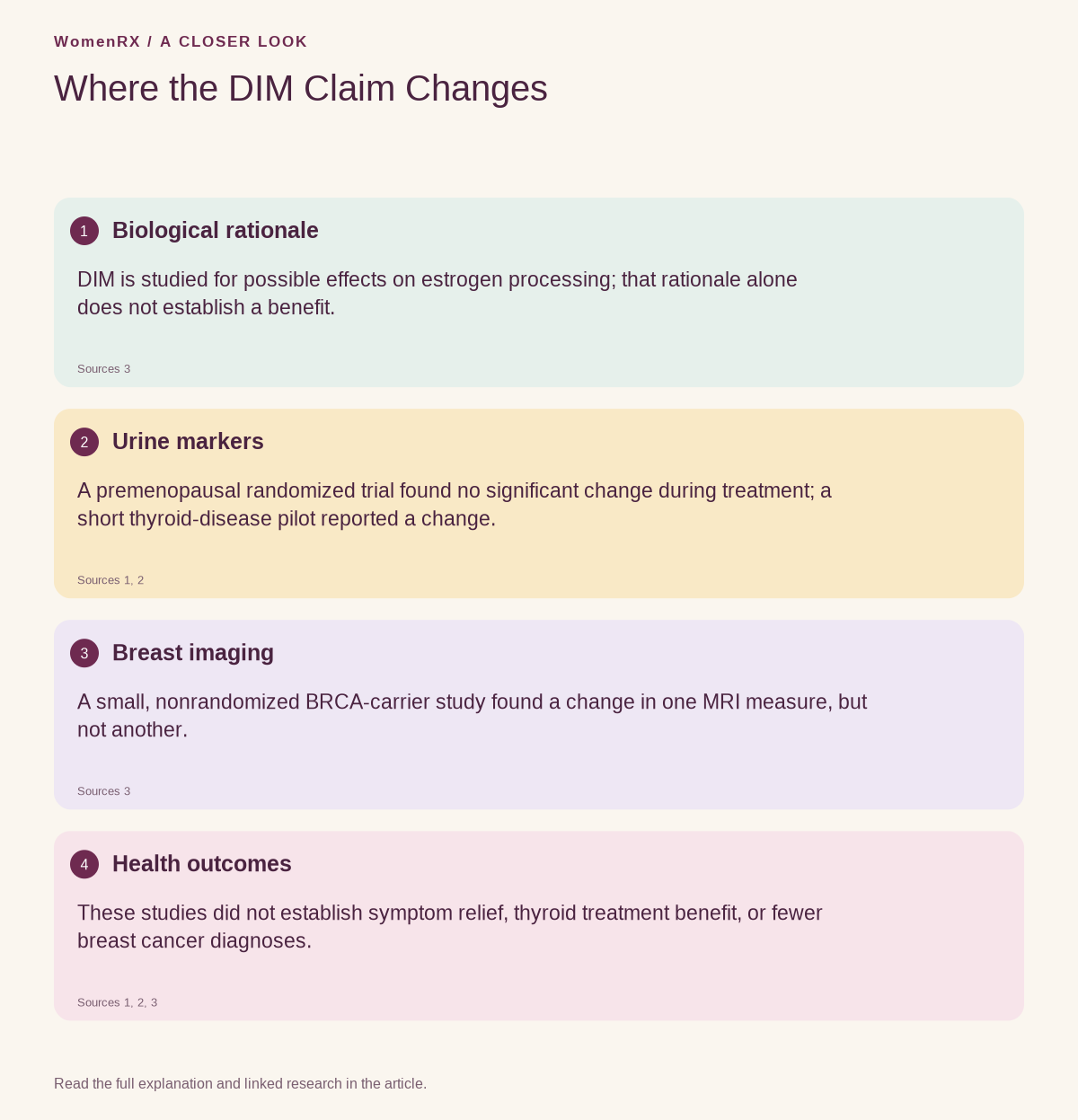
Biological rationale: DIM is studied for possible effects on estrogen processing; that rationale alone does not establish a benefit.3
Urine markers: A premenopausal randomized trial found no significant change during treatment; a short thyroid-disease pilot reported a change.12
Breast imaging: A small, nonrandomized BRCA-carrier study found a change in one MRI measure, but not another.3
Health outcomes: These studies did not establish symptom relief, thyroid treatment benefit, or fewer breast cancer diagnoses.123
Read the figure as text
Follow the proposed estrogen effect from biological rationale to human measurements, then check whether those measurements establish a health benefit.- Biological rationale: DIM is studied for possible effects on estrogen processing; that rationale alone does not establish a benefit.3
- Urine markers: A premenopausal randomized trial found no significant change during treatment; a short thyroid-disease pilot reported a change.12
- Breast imaging: A small, nonrandomized BRCA-carrier study found a change in one MRI measure, but not another.3
- Health outcomes: These studies did not establish symptom relief, thyroid treatment benefit, or fewer breast cancer diagnoses.123
Sources you can check
- Effectiveness of 3,3'-Diindolylmethane Supplements on Favoring the Benign Estrogen Metabolism Pathway and Decreasing Body Fat in Premenopausal Women.Godínez-Martínez E, Santillán R, Sámano R, Chico-Barba G, Tolentino MC, Hernández-Pineda J. · Nutrition and cancer · 2023Return to first citation
- 3,3'-diindolylmethane modulates estrogen metabolism in patients with thyroid proliferative disease: a pilot study.Rajoria S, Suriano R, Parmar PS, Wilson YL, Megwalu U, Moscatello A, Bradlow HL, Sepkovic DW, Geliebter J, Schantz SP, Tiwari RK. · Thyroid : official journal of the American Thyroid Association · 2011Return to first citation
- 3,3-Diindolylmethane (DIM): a nutritional intervention and its impact on breast density in healthy BRCA carriers. A prospective clinical trial.Yerushalmi R, Bargil S, Ber Y, Ozlavo R, Sivan T, Rapson Y, Pomerantz A, Tsoref D, Sharon E, Caspi O, Grubsrein A, Margel D. · Carcinogenesis · 2020Return to first citation