Does DIM Change Hormones or Help Hormone-Related Symptoms?
DIM can change some estrogen measurements, but a changed lab result doesn’t mean you’ll feel better.
DIM may change how estrogen is processed, but studies have not shown that it relieves hormone-related symptoms. Results differ by population: a short trial in premenopausal women found no significant change in its main urine marker during supplementation, while a trial in women taking tamoxifen found marker changes and lower levels of tamoxifen metabolites. DIM use has also been linked to different estrogen profiles in postmenopausal estradiol-patch users.123
DIM, short for diindolylmethane, is a compound derived from cruciferous vegetables and sold as a supplement. The question isn’t simply whether it does something to estrogen. It’s whether that change helps with the concern that brought you to DIM, such as hot flashes or menstrual symptoms. Those are different questions.34
What a changed estrogen ratio actually tells you
Your body processes estrogen into several compounds, called metabolites, that can be measured in urine. DIM appears to affect enzymes involved in this processing. Researchers often look at the ratio of two metabolites, 2-hydroxyestrone and 16α-hydroxyestrone, to see whether the pattern shifts. A higher ratio describes a change in the urine sample; it isn’t a measure of how you feel or proof that your hormones are “balanced.”4
Even the marker result isn’t consistent across studies. In a randomized trial, 60 premenopausal Mexican women who started with a low ratio received DIM or placebo for 30 days. The DIM group did not have a statistically significant increase in the ratio during supplementation. A possible increase measured 30 days after supplementation ended also fell short of statistical significance. The trial did not establish symptom relief.1
A larger retrospective study found differences in urinary estrogen profiles between premenopausal women who reported taking DIM and those who did not. In a smaller group with tests before and after starting DIM, some measurements changed, including the 2-hydroxyestrone-to-16-hydroxyestrone ratio. Because this was an observational analysis of lab results, it cannot establish that DIM caused every difference or that any change improved health.4
The clearest medication concern: tamoxifen
For women taking tamoxifen, the question goes beyond whether an estrogen marker moves. In a 12-month randomized, placebo-controlled trial of women prescribed tamoxifen, DIM increased the urinary 2-to-16 metabolite ratio and sex hormone-binding globulin. It did not change breast density as measured by mammography or MRI. It also reduced measured levels of tamoxifen metabolites, including endoxifen, compared with placebo.2
The trial did not determine whether lower endoxifen levels reduced tamoxifen’s benefit. That distinction matters: the finding is a specific reason to discuss DIM with the team managing your tamoxifen treatment, not proof that DIM makes the treatment fail. Adverse events were reported as minimal and did not differ between groups during the trial, but that result cannot settle long-term safety.2
What if you use an estradiol patch?
A retrospective study examined lab results from postmenopausal women using a transdermal estradiol patch. Women who also reported taking DIM had different urinary estrogen profiles from patch users who did not report DIM use. The study did not test whether DIM changed hot-flash relief, bone health, or the patch’s clinical effectiveness. It raises a possible interaction worth mentioning to the person managing your hormone therapy, rather than establishing that a patch dose needs to change.3
This is different from the tamoxifen finding: the tamoxifen-metabolite change was observed in a randomized trial, while the patch finding came from a comparison of people’s existing lab results. Neither study shows that DIM improves hormone-related symptoms.23
Decide based on the outcome you want
If you’re considering DIM for symptom relief, ask whether the claim you’ve seen is about a urine measurement or about women actually feeling better. The human studies above chiefly examined markers. They do not establish DIM as a treatment for hot flashes, menstrual symptoms, or another hormone-related concern.1234
If you take tamoxifen, mention DIM before adding it because of the measured change in tamoxifen metabolites. If you use a postmenopausal estradiol patch, mention it because concurrent use has been associated with a different estrogen profile. In both cases, what those lab changes mean for treatment outcomes remains uncertain.23
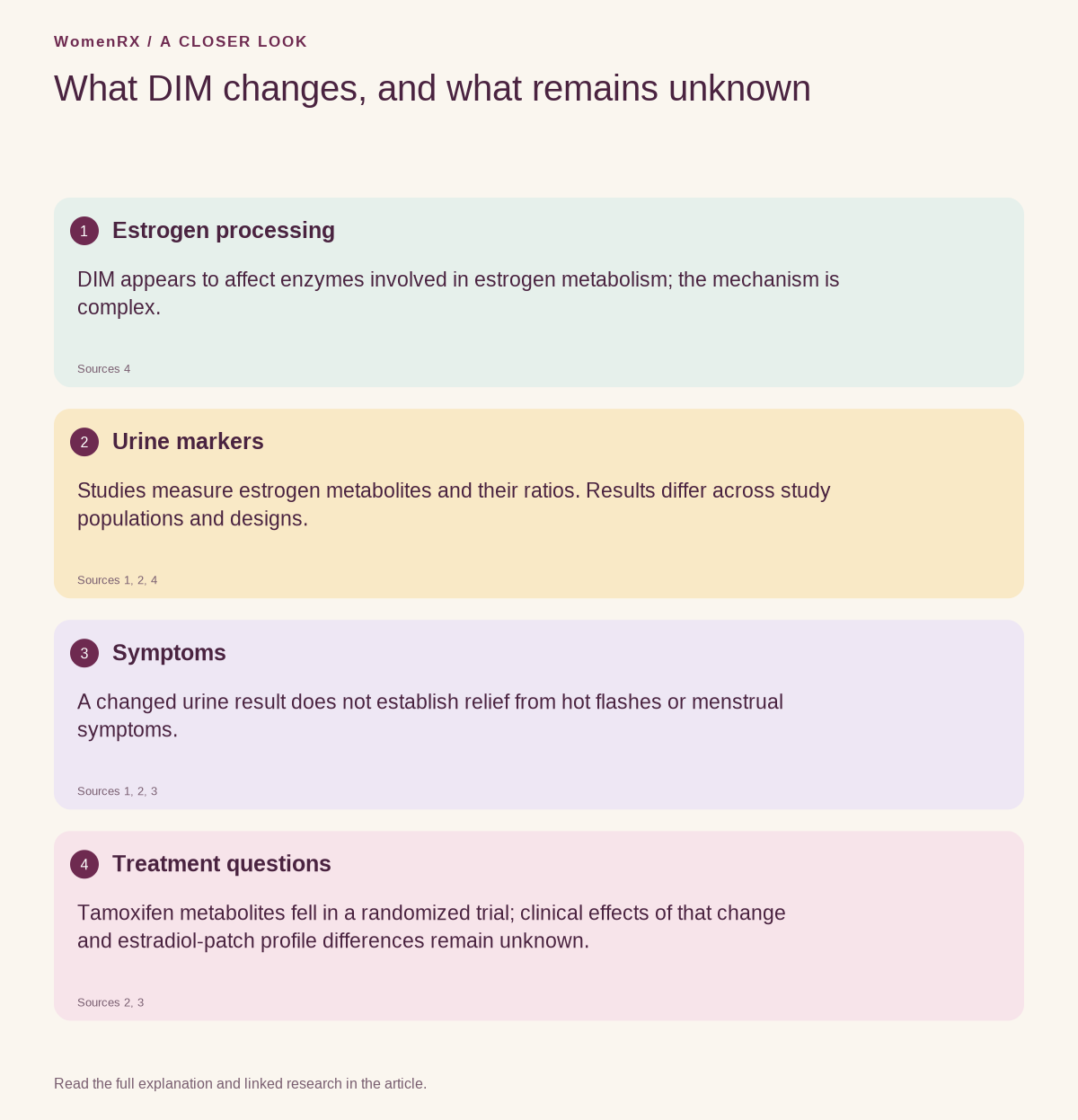
What DIM changes, and what remains unknown
Estrogen processing: DIM appears to affect enzymes involved in estrogen metabolism; the mechanism is complex.4
Urine markers: Studies measure estrogen metabolites and their ratios. Results differ across study populations and designs.124
Symptoms: A changed urine result does not establish relief from hot flashes or menstrual symptoms.123
Treatment questions: Tamoxifen metabolites fell in a randomized trial; clinical effects of that change and estradiol-patch profile differences remain unknown.23
Read the figure as text
Follow the distinction from estrogen processing to a measured urine marker, then to the health outcome a reader may actually care about.- Estrogen processing: DIM appears to affect enzymes involved in estrogen metabolism; the mechanism is complex.4
- Urine markers: Studies measure estrogen metabolites and their ratios. Results differ across study populations and designs.124
- Symptoms: A changed urine result does not establish relief from hot flashes or menstrual symptoms.123
- Treatment questions: Tamoxifen metabolites fell in a randomized trial; clinical effects of that change and estradiol-patch profile differences remain unknown.23
More questions, answered
Does a higher estrogen-metabolite ratio mean DIM prevents breast cancer?
No. A urine ratio is a research marker, not proof of cancer prevention. In the randomized trial of women taking tamoxifen, DIM increased the ratio but did not change breast density, and the trial did not establish an effect on cancer outcomes.2
Does DIM lower estrogen?
DIM can alter urinary estrogen measurements, but that doesn’t mean it predictably lowers estrogen in every woman. Findings differ across the women and measurements studied, and a urine result alone cannot tell you whether symptoms will change.134
Sources you can check
- Effectiveness of 3,3'-Diindolylmethane Supplements on Favoring the Benign Estrogen Metabolism Pathway and Decreasing Body Fat in Premenopausal Women.Godínez-Martínez E, Santillán R, Sámano R, Chico-Barba G, Tolentino MC, Hernández-Pineda J. · Nutrition and cancer · 2023Return to first citation
- A randomized, placebo-controlled trial of diindolylmethane for breast cancer biomarker modulation in patients taking tamoxifen.Thomson CA, Chow HHS, Wertheim BC, Roe DJ, Stopeck A, Maskarinec G, Altbach M, Chalasani P, Huang C, Strom MB, Galons JP, Thompson PA. · Breast cancer research and treatment · 2017Return to first citation
- The impact of 3,3'-diindolylmethane on estradiol and estrogen metabolism in postmenopausal women using a transdermal estradiol patch.Newman MS, Smeaton J. · Menopause (New York, N.Y.) · 2025Return to first citation
- Exploring the impact of 3,3'-diindolylmethane on the urinary estrogen profile of premenopausal women.Newman M, Smeaton J. · BMC complementary medicine and therapies · 2024Return to first citation